このページは、「弧度法の角と三角関数の値」の練習問題アーカイブページとなります。
この問題の解き方の詳細は↓
弧度法の角と三角関数の値 で確認できます。
問題アーカイブ01

また、\(1:2:\sqrt{3}\) の直角三角形より、
動径と半径 \(2\) の円との交点が \((-1~,~\sqrt{3})\) であるので、
\(\sin \displaystyle \frac{\,2\,}{\,3\,}\pi=\displaystyle \frac{\,\sqrt{3}\,}{\,2\,}\)
\(\cos \displaystyle \frac{\,2\,}{\,3\,}\pi=-\displaystyle \frac{\,1\,}{\,2\,}\)
\(\tan \displaystyle \frac{\,2\,}{\,3\,}\pi=-\sqrt{3}\)
\(\theta=\displaystyle \frac{\,5\,}{\,6\,}\pi\) のとき、\(\displaystyle \frac{\,\pi\,}{\,6\,}\) が \(5\) 個分であり、第2象限の位置にある

また、\(1:2:\sqrt{3}\) の直角三角形より、
動径と半径 \(2\) の円との交点が \((-\sqrt{3}~,~1)\) であるので、
\(\sin \displaystyle \frac{\,5\,}{\,6\,}\pi=\displaystyle \frac{\,1\,}{\,2\,}\)
\(\cos \displaystyle \frac{\,5\,}{\,6\,}\pi=-\displaystyle \frac{\,\sqrt{3}\,}{\,2\,}\)
\(\tan \displaystyle \frac{\,5\,}{\,6\,}\pi=-\displaystyle \frac{\,1\,}{\,\sqrt{3}\,}\)
\(\theta=\displaystyle \frac{\,5\,}{\,4\,}\pi\) のとき、\(\displaystyle \frac{\,\pi\,}{\,4\,}\) が \(5\) 個分であり、第3象限の位置にある

また、\(1:1:\sqrt{2}\) の直角三角形より、
動径と半径 \(\sqrt{2}\) の円との交点が \((-1~,~-1)\) であるので、
\(\sin \displaystyle \frac{\,5\,}{\,4\,}\pi=-\displaystyle \frac{\,1\,}{\,\sqrt{2}\,}\)
\(\cos \displaystyle \frac{\,5\,}{\,4\,}\pi=-\displaystyle \frac{\,1\,}{\,\sqrt{2}\,}\)
\(\tan \displaystyle \frac{\,5\,}{\,4\,}\pi=1\)
\(\theta=\displaystyle \frac{\,4\,}{\,3\,}\pi=\displaystyle \frac{\,8\,}{\,6\,}\pi\) のとき、\(\displaystyle \frac{\,\pi\,}{\,6\,}\) が \(8\) 個分であり、第3象限の位置にある

また、\(1:2:\sqrt{3}\) の直角三角形より、
動径と半径 \(2\) の円との交点が \((-1~,~-\sqrt{3})\) であるので、
\(\sin \displaystyle \frac{\,4\,}{\,3\,}\pi=-\displaystyle \frac{\,\sqrt{3}\,}{\,2\,}\)
\(\cos \displaystyle \frac{\,4\,}{\,3\,}\pi=-\displaystyle \frac{\,1\,}{\,2\,}\)
\(\tan \displaystyle \frac{\,4\,}{\,3\,}\pi=\sqrt{3}\)
\(\theta=\displaystyle \frac{\,5\,}{\,3\,}\pi=\displaystyle \frac{\,10\,}{\,6\,}\pi\) のとき、\(\displaystyle \frac{\,\pi\,}{\,6\,}\) が \(10\) 個分であり、第4象限の位置にある

また、\(1:2:\sqrt{3}\) の直角三角形より、
動径と半径 \(2\) の円との交点が \((1~,~-\sqrt{3})\) であるので、
\(\sin \displaystyle \frac{\,5\,}{\,3\,}\pi=-\displaystyle \frac{\,\sqrt{3}\,}{\,2\,}\)
\(\cos \displaystyle \frac{\,5\,}{\,3\,}\pi=\displaystyle \frac{\,1\,}{\,2\,}\)
\(\tan \displaystyle \frac{\,5\,}{\,3\,}\pi=-\sqrt{3}\)
\(\theta=\displaystyle \frac{\,11\,}{\,6\,}\pi\) のとき、\(\displaystyle \frac{\,\pi\,}{\,6\,}\) が \(11\) 個分であり、第4象限の位置にある

また、\(1:2:\sqrt{3}\) の直角三角形より、
動径と半径 \(2\) の円との交点が \((\sqrt{3}~,~-1)\) であるので、
\(\sin \displaystyle \frac{\,11\,}{\,6\,}\pi=-\displaystyle \frac{\,1\,}{\,2\,}\)
\(\cos \displaystyle \frac{\,11\,}{\,6\,}\pi=\displaystyle \frac{\,\sqrt{3}\,}{\,2\,}\)
\(\tan \displaystyle \frac{\,11\,}{\,6\,}\pi=-\displaystyle \frac{\,1\,}{\,\sqrt{3}\,}\)
問題アーカイブ02

\(\sin 0=0\)
\(\cos 0=1\)
\(\tan 0=0\)
\(\theta=\displaystyle \frac{\,\pi\,}{\,2\,}\) のとき、\(\displaystyle \frac{\,\pi\,}{\,2\,}\) が \(1\) 個分であり、半径 \(1\) の円の点 \((0~,~1)\) の位置にある
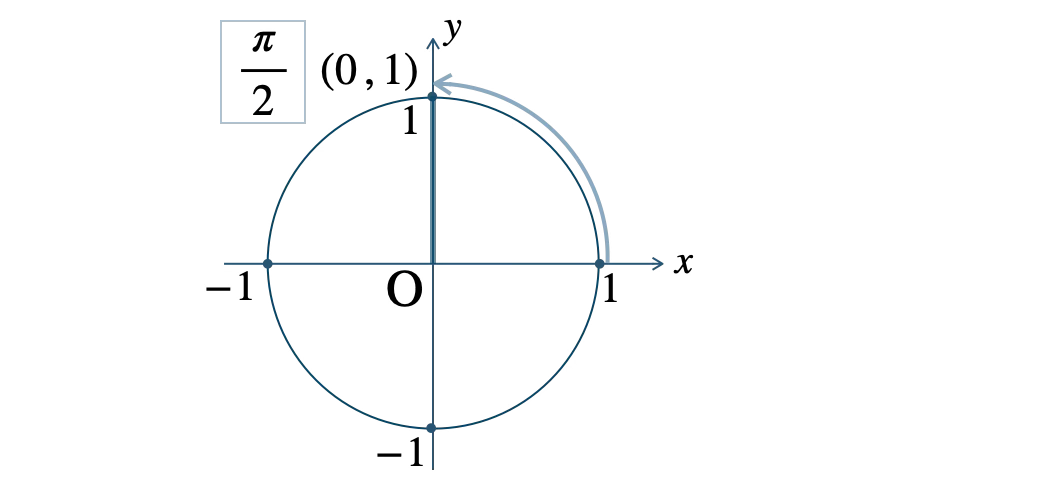
\(x=0\) より、\(\tan \theta\) の値はない
\(\sin \displaystyle \frac{\,\pi\,}{\,2\,}=1\)
\(\cos \displaystyle \frac{\,\pi\,}{\,2\,}=0\)
\(\tan \displaystyle \frac{\,\pi\,}{\,2\,}\) の値はない
\(\theta=\pi=\displaystyle \frac{\,2\,}{\,2\,}\pi\) のとき、\(\displaystyle \frac{\,\pi\,}{\,2\,}\) が \(2\) 個分であり、半径 \(1\) の円の点 \((-1~,~0)\) の位置にある
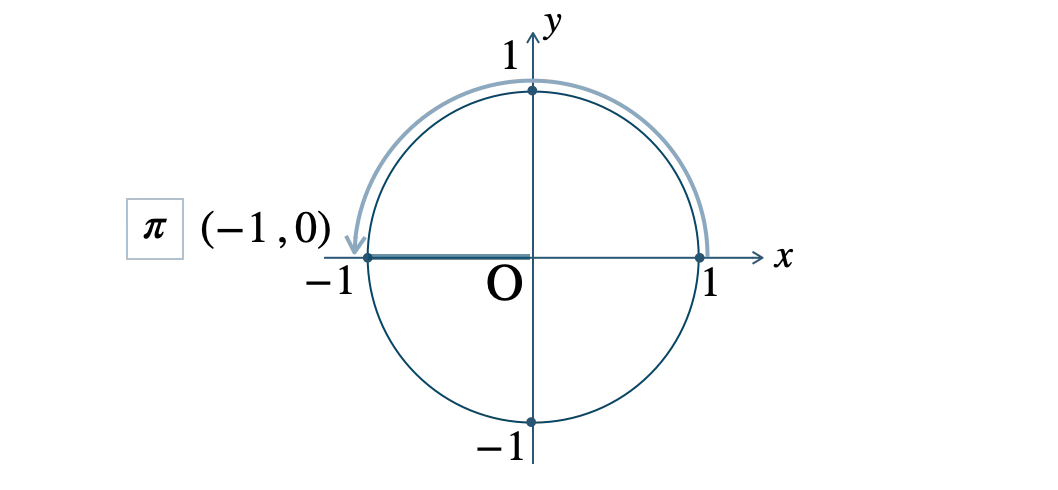
\(\sin \pi=0\)
\(\cos \pi=-1\)
\(\tan \pi=0\)
\(\theta=\displaystyle \frac{\,3\,}{\,2\,}\pi\) のとき、\(\displaystyle \frac{\,\pi\,}{\,2\,}\) が \(3\) 個分であり、半径 \(1\) の円の点 \((0~,~-1)\) の位置にある
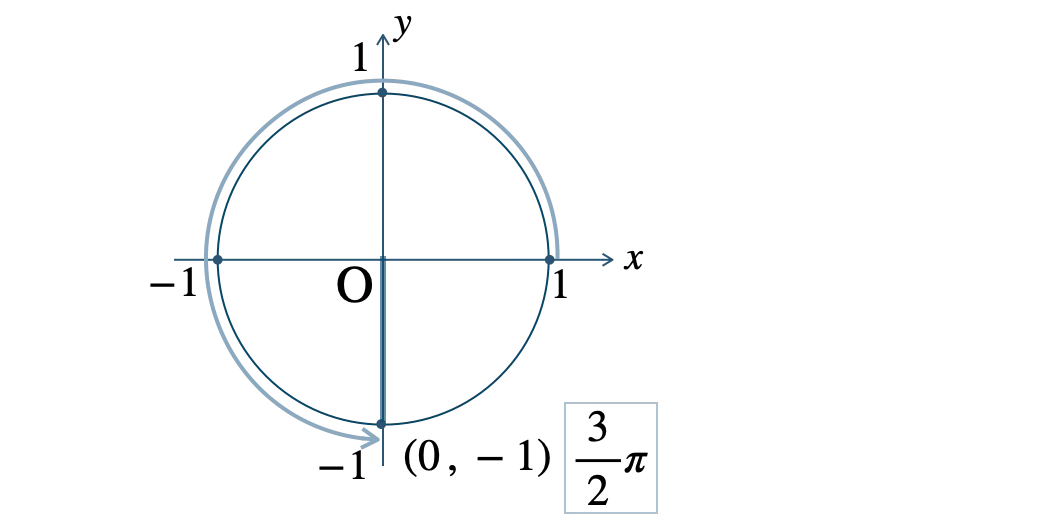
\(x=0\) より、\(\tan \theta\) の値はない
\(\sin \displaystyle \frac{\,3\,}{\,2\,}\pi=-1\)
\(\cos \displaystyle \frac{\,3\,}{\,2\,}\pi=0\)
\(\tan \displaystyle \frac{\,3\,}{\,2\,}\pi\) の値はない
\(\theta=2\pi=\displaystyle \frac{\,4\,}{\,2\,}\pi\) のとき、\(\displaystyle \frac{\,\pi\,}{\,2\,}\) が \(4\) 個分であり、半径 \(1\) の円の点 \((1~,~0)\) の位置にある
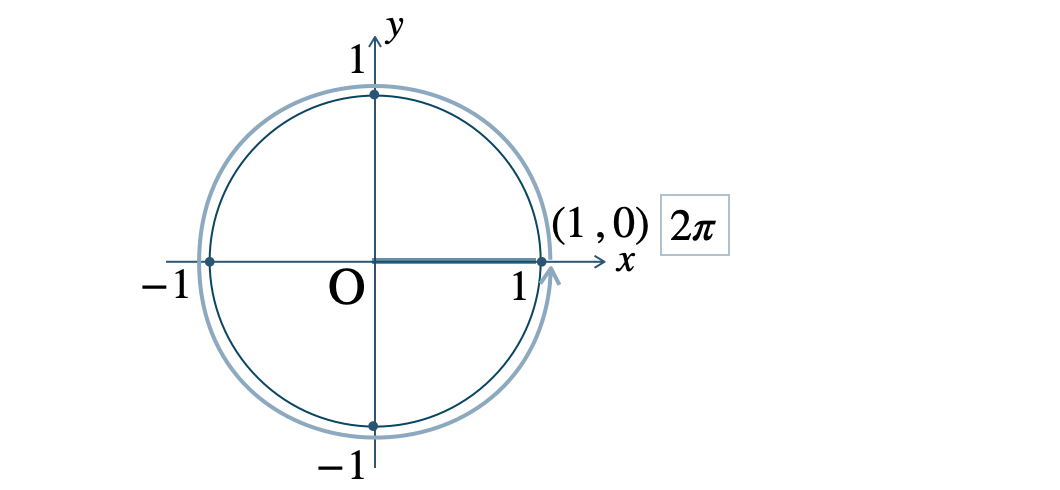
\(\sin 2\pi=0\)
\(\cos 2\pi=1\)
\(\tan 2\pi=0\)