- 数学Ⅱ|三角関数「三角関数を含む方程式」の基本例題解説ページです。
- 目次をクリックすると各セクションへ移動します。

問題|三角関数を含む方程式
三角関数 20方程式 \(\sin\theta=-\displaystyle\frac{\,1\,}{\,2\,}~,~\)\(\cos\theta=\displaystyle\frac{\,1\,}{\,\sqrt{2}\,}~,~\)\(\tan\theta=-\sqrt{3}\) の一般解と \(0{\small ~≦~}\theta\lt 2\pi\) の範囲の \(\theta\) での解の求め方は?また、\(0{\small ~≦~}\theta\lt 2\pi\) の範囲での \(\sin\theta=0~,~\)\(\cos\theta=-1~,~\)\(\tan\theta=0\) の解の求め方は?
高校数学Ⅱ|三角関数
解法のPoint
三角関数を含む方程式
Point:三角関数sinを含む方程式
① 単位円上の直線 \(y=a\) となる点を調べる。

② この点までの動径の表す角 \(\alpha~,~\beta\) が解となる。
\(n\) を整数として、一般角は、
\(\theta=\alpha+2n\pi~,~\beta+2n\pi\)
■ 方程式 \(\sin\theta=a\) の解
① 単位円上の直線 \(y=a\) となる点を調べる。
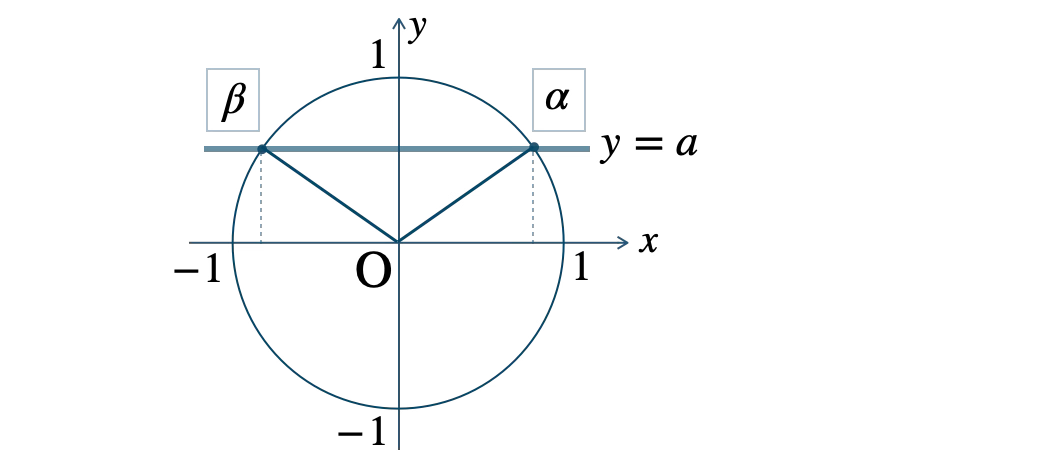
② この点までの動径の表す角 \(\alpha~,~\beta\) が解となる。
\(n\) を整数として、一般角は、
\(\theta=\alpha+2n\pi~,~\beta+2n\pi\)
©︎ 2026 教科書より詳しい高校数学 yorikuwa.com
Point:三角関数cosを含む方程式
① 単位円上の直線 \(x=b\) となる点を調べる。
② この点までの動径の表す角 \(\alpha~,~\beta\) が解となる。
\(n\) を整数として、一般角は、
\(\theta=\alpha+2n\pi~,~\beta+2n\pi\)
■ 方程式 \(\cos\theta=b\) の解
① 単位円上の直線 \(x=b\) となる点を調べる。
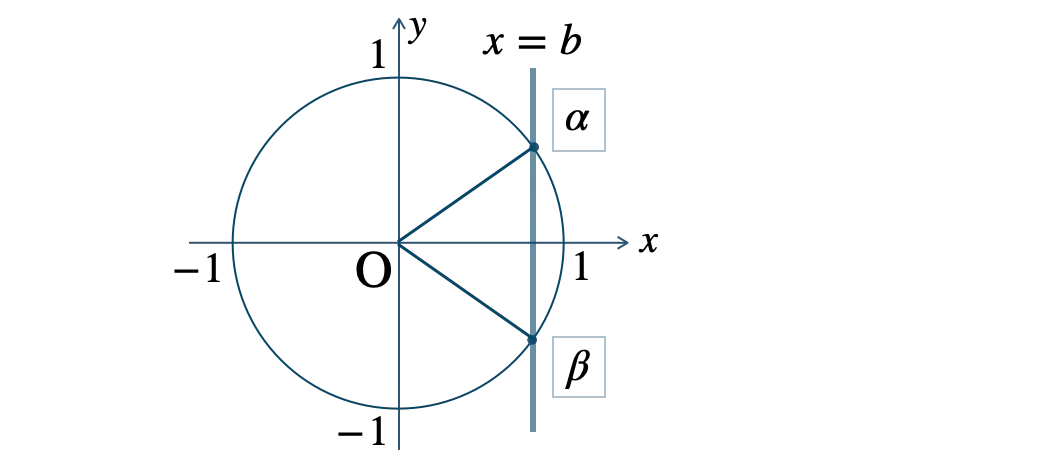
② この点までの動径の表す角 \(\alpha~,~\beta\) が解となる。
\(n\) を整数として、一般角は、
\(\theta=\alpha+2n\pi~,~\beta+2n\pi\)
©︎ 2026 教科書より詳しい高校数学 yorikuwa.com
Point:三角関数tanを含む方程式
① 直線 \(x=1\) 上の点 \((1~,~c)\) と原点を結ぶ直線と単位円との交点を調べる。
② この点までの動径の表す角 \(\alpha~,~\beta\) が解となる。
\(n\) を整数として、周期が \(\pi\) であるので、
一般角は、\(\theta=\alpha+n\pi\)
また、\(0{\small ~≦~}\theta\lt 2\pi\) では、\(\theta=\alpha~,~\beta\)
■ 方程式 \(\tan\theta=c\) の解
① 直線 \(x=1\) 上の点 \((1~,~c)\) と原点を結ぶ直線と単位円との交点を調べる。
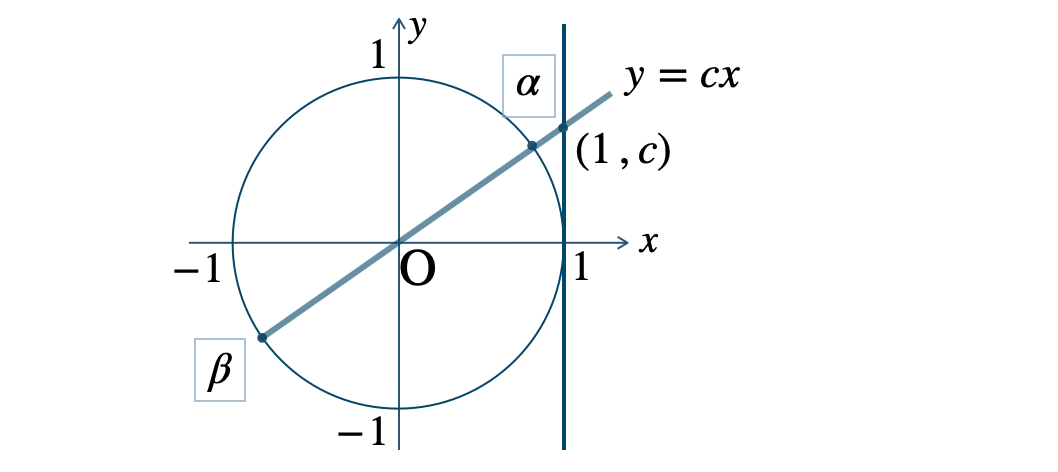
② この点までの動径の表す角 \(\alpha~,~\beta\) が解となる。
\(n\) を整数として、周期が \(\pi\) であるので、
一般角は、\(\theta=\alpha+n\pi\)
また、\(0{\small ~≦~}\theta\lt 2\pi\) では、\(\theta=\alpha~,~\beta\)
©︎ 2026 教科書より詳しい高校数学 yorikuwa.com
詳しい解説|三角関数を含む方程式
三角関数 20
方程式 \(\sin\theta=-\displaystyle\frac{\,1\,}{\,2\,}~,~\)\(\cos\theta=\displaystyle\frac{\,1\,}{\,\sqrt{2}\,}~,~\)\(\tan\theta=-\sqrt{3}\) の一般解と \(0{\small ~≦~}\theta\lt 2\pi\) の範囲の \(\theta\) での解の求め方は?また、\(0{\small ~≦~}\theta\lt 2\pi\) の範囲での \(\sin\theta=0~,~\)\(\cos\theta=-1~,~\)\(\tan\theta=0\) の解の求め方は?
高校数学Ⅱ|三角関数
\(\sin\theta=-\displaystyle\frac{\,1\,}{\,2\,}\) は、
単位円上の \(y=-\displaystyle\frac{\,1\,}{\,2\,}\) となる点は、
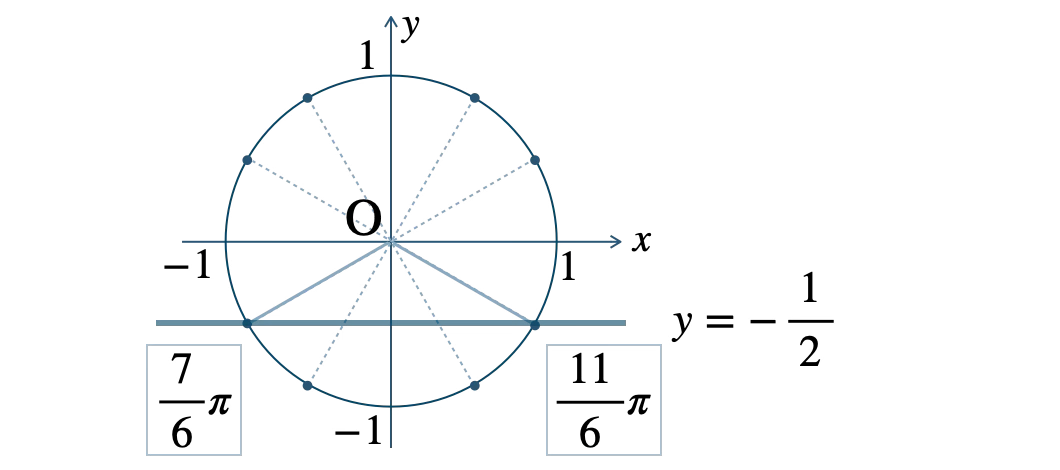
\(1:2:\sqrt{3}\) の直角三角形の基本角 \(\displaystyle\frac{\,\pi\,}{\,6\,}\) より、\(\displaystyle\frac{\,\pi\,}{\,6\,}\) が \(7\) 個分と \(11\) 個分であるので、
\(n\) を整数として、
\(\begin{eqnarray}~~~\theta&=&\displaystyle\frac{\,7\,}{\,6\,}\pi+2n\pi~,~\displaystyle\frac{\,11\,}{\,6\,}\pi+2n\pi\end{eqnarray}\)
また、\(0{\small ~≦~}\theta\lt 2\pi\) の範囲では、
\(\begin{eqnarray}~~~\theta&=&\displaystyle\frac{\,7\,}{\,6\,}\pi~,~\displaystyle\frac{\,11\,}{\,6\,}\pi\end{eqnarray}\)
\(\cos\theta=\displaystyle\frac{\,1\,}{\,\sqrt{2}\,}\) は、
単位円上の \(x=\displaystyle\frac{\,1\,}{\,\sqrt{2}\,}\) となる点は、
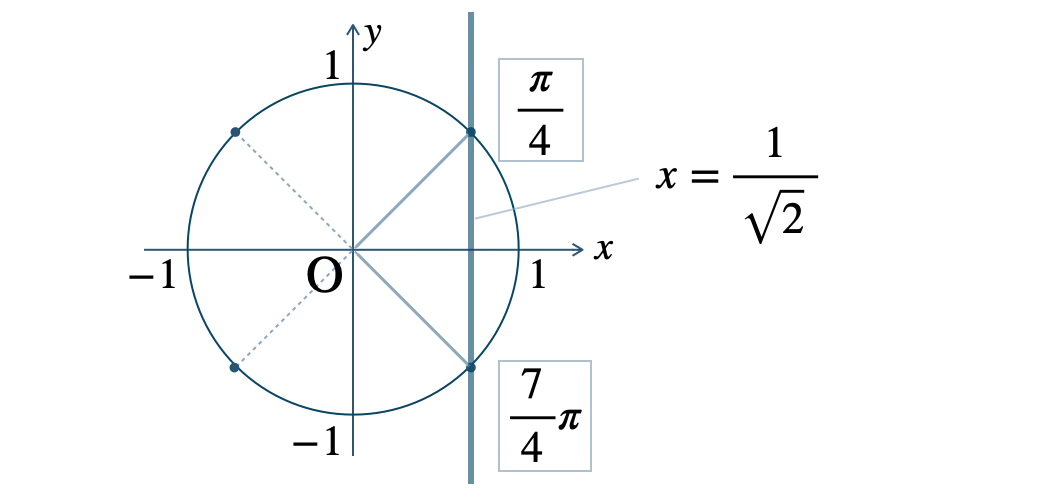
\(1:1:\sqrt{2}\) の直角三角形の基本角 \(\displaystyle\frac{\,\pi\,}{\,4\,}\) より、\(\displaystyle\frac{\,\pi\,}{\,4\,}\) が \(1\) 個分と \(7\) 個分であるので、
\(n\) を整数として、
\(\begin{eqnarray}~~~\theta&=&\displaystyle\frac{\,\pi\,}{\,4\,}+2n\pi~,~\displaystyle\frac{\,7\,}{\,4\,}\pi+2n\pi\end{eqnarray}\)
また、\(0{\small ~≦~}\theta\lt 2\pi\) の範囲では、
\(\begin{eqnarray}~~~\theta&=&\displaystyle\frac{\,\pi\,}{\,4\,}~,~\displaystyle\frac{\,7\,}{\,4\,}\pi\end{eqnarray}\)
\(\tan\theta=-\sqrt{3}\) は、
直線 \(x=1\) 上の点 \((1~,~-\sqrt{3})\) と原点を結ぶ直線と単位円との交点は、
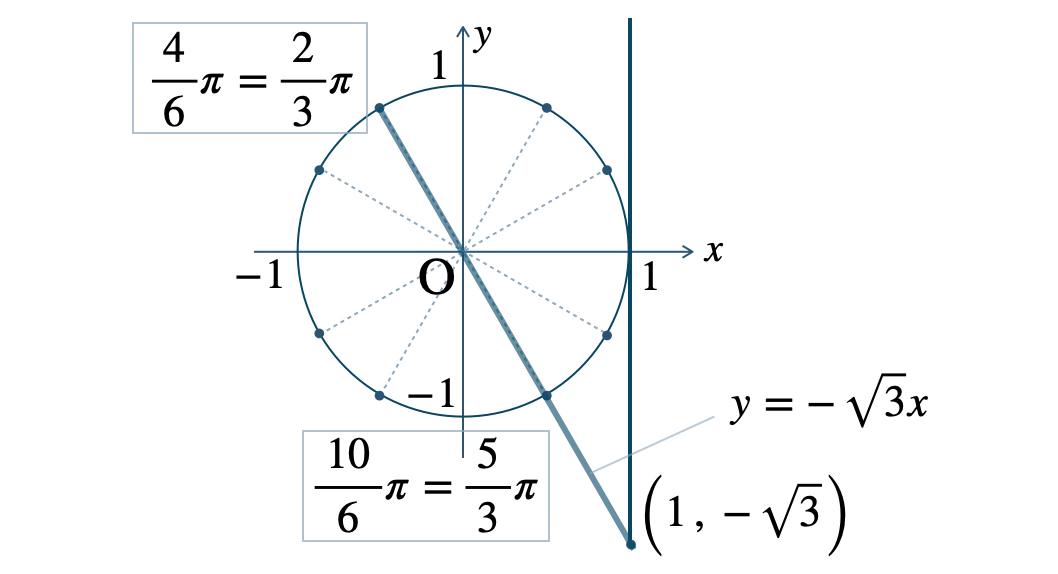
\(1:2:\sqrt{3}\) の直角三角形の基本角 \(\displaystyle\frac{\,\pi\,}{\,6\,}\) より、\(\displaystyle\frac{\,\pi\,}{\,6\,}\) が \(4\) 個分と \(10\) 個分であり、周期が \(\pi\) であるので、
\(n\) を整数として、
\(\begin{eqnarray}~~~\theta&=&\displaystyle\frac{\,2\,}{\,3\,}\pi+n\pi\end{eqnarray}\)
また、\(0{\small ~≦~}\theta\lt 2\pi\) の範囲では、
\(\begin{eqnarray}~~~\theta&=&\displaystyle\frac{\,2\,}{\,3\,}\pi~,~\displaystyle\frac{\,5\,}{\,3\,}\pi\end{eqnarray}\)
\(\sin\theta=0\) は、
単位円上の \(y=0\) となる点より、
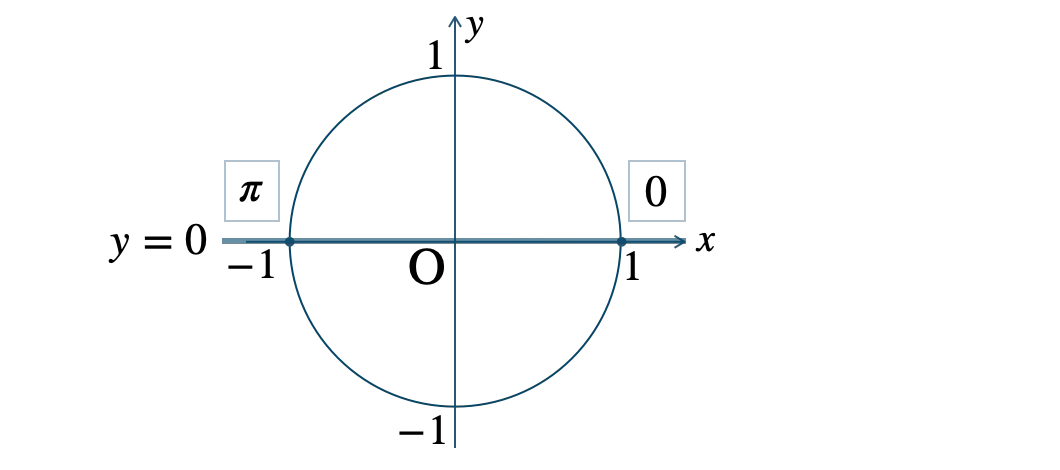
\(0{\small ~≦~}\theta\lt 2\pi\) の範囲で、
\(\begin{eqnarray}~~~\theta&=&0~,~\pi\end{eqnarray}\)
\(\cos\theta=-1\) は、
単位円上の \(x=-1\) となる点より、
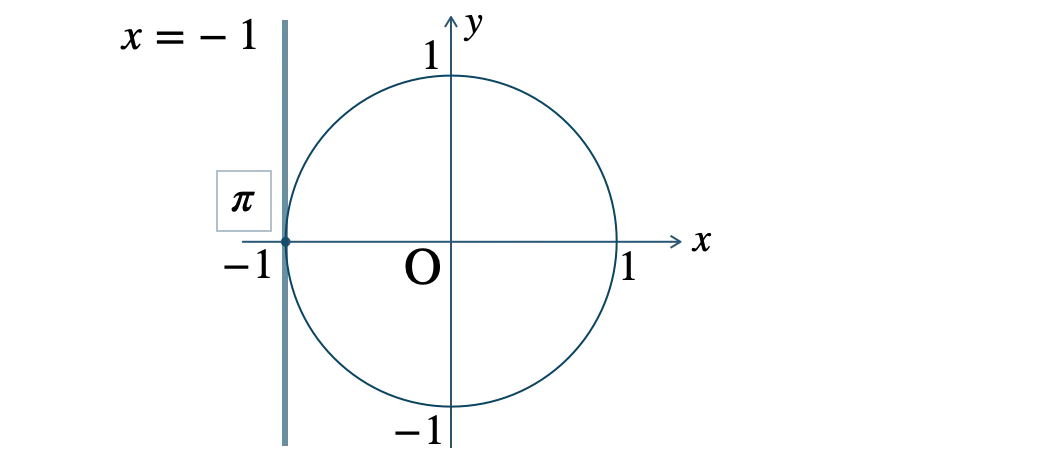
\(0{\small ~≦~}\theta\lt 2\pi\) の範囲で、
\(\begin{eqnarray}~~~\theta&=&\pi\end{eqnarray}\)
\(\tan\theta=0\) は、
直線 \(x=1\) 上の点 \((1~,~0)\) と原点を結ぶ直線と単位円との交点より、
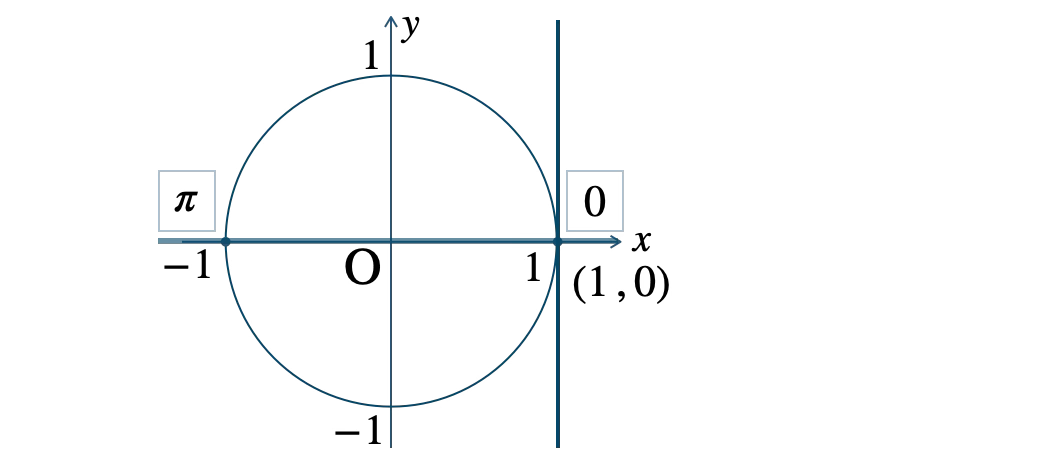
\(0{\small ~≦~}\theta\lt 2\pi\) の範囲で、
\(\begin{eqnarray}~~~\theta&=&0~,~\pi\end{eqnarray}\)