このページは、「t=sinx+cosxと置く関数の最大値・最小値」の練習問題アーカイブページとなります。
この問題の解き方の詳細は↓
t=sinx+cosxと置く関数の最大値・最小値 で確認できます。
問題アーカイブ01
問題アーカイブ01関数 \(y=2\sin x \cos x+\sin x+\cos x\) について、次の問いに答えよ。
\({\small (1)}~\) \(t=\sin x+\cos x\) として、\(y\) を \(t\) の関数で表せ。
\({\small (2)}~\) \(t\) のとりうる値の範囲を求めよ。
\({\small (3)}~\) \(y\) の最大値と最小値を求めよ。
\({\small (1)}~\) \(t=\sin x+\cos x\) として、\(y\) を \(t\) の関数で表せ。
\({\small (2)}~\) \(t\) のとりうる値の範囲を求めよ。
\({\small (3)}~\) \(y\) の最大値と最小値を求めよ。
数研出版|数学Ⅱ[709] p.161 演習問題B 8
数研出版|高等学校数学Ⅱ[710] p.151 章末問題B 13
\(t=\sin x+\cos x\) の両辺を2乗すると、
\(\begin{eqnarray}~~~t^2&=&(\sin x+\cos x)^2
\\[3pt]~~~t^2&=&\sin^2 x+2\sin x \cos x+\cos^2 x\end{eqnarray}\)
\(\sin^2 x+\cos^2 x=1\) より、
\(\begin{eqnarray}~~~t^2&=&1+2\sin x \cos x
\\[3pt]~~~2\sin x \cos x&=&t^2-1
\end{eqnarray}\)
よって、関数 \(y=2\sin x \cos x+\sin x+\cos x\) を \(t\) の関数で表すと、
\(\begin{eqnarray}~~~y&=&2\sin x \cos x+\sin x+\cos x
\\[3pt]~~~&=&2\sin x \cos x+(\sin x+\cos x)
\\[3pt]~~~&=&(t^2-1)+t
\\[3pt]~~~&=&t^2+t-1~~~\hspace{15pt}\cdots {\small [\,1\,]}\end{eqnarray}\)
ここで、\(t=\sin x+\cos x\) を合成すると、
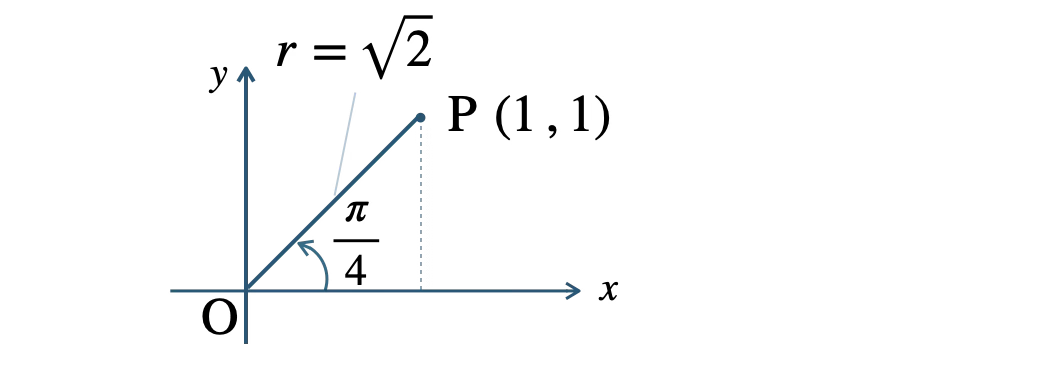
\(r=\sqrt{\,2\,}~,~\alpha=\displaystyle \frac{\,\pi\,}{\,4\,}\)
\(\begin{eqnarray}~~~t&=&\sin x+\cos x
\\[5pt]~~~&=&\sqrt{\,2\,}\sin\left(x+\displaystyle \frac{\,\pi\,}{\,4\,}\right)\end{eqnarray}\)
これより、
\(-1{\small ~≦~}\sin\left(x+\displaystyle \frac{\,\pi\,}{\,4\,}\right){\small ~≦~}1\)
\(\sqrt{\,2\,}\) を掛けると \(t\) の値の範囲は、
\(\begin{eqnarray}~~~-\sqrt{\,2\,}&{\small ~≦~}&\sqrt{\,2\,}\sin\left(x+\displaystyle \frac{\,\pi\,}{\,4\,}\right){\small ~≦~}\sqrt{\,2\,}
\\[5pt]~~~-\sqrt{\,2\,}&{\small ~≦~}&t{\small ~≦~}\sqrt{\,2\,}~~~\hspace{15pt}\cdots {\small [\,2\,]}
\end{eqnarray}\)
\({\small [\,1\,]}\) を平方完成すると、
\(\begin{eqnarray}~~~y&=&t^2+t-1
\\[3pt]~~~&=&\left(t^2+t+\displaystyle \frac{\,1\,}{\,4\,}\right)-\displaystyle \frac{\,1\,}{\,4\,}-1
\\[3pt]~~~&=&\left(t+\displaystyle \frac{\,1\,}{\,2\,}\right)^2-\displaystyle \frac{\,5\,}{\,4\,}\end{eqnarray}\)
\(-\sqrt{\,2\,}{\small ~≦~}t{\small ~≦~}\sqrt{\,2\,}\) の範囲で、
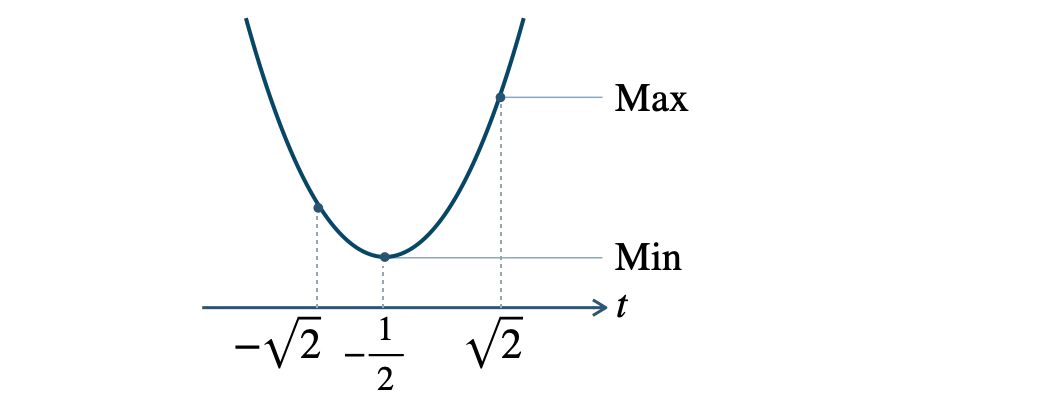
\(t=\sqrt{\,2\,}\) のとき最大となり、
\({\small [\,1\,]}\) に代入して、
\(\begin{eqnarray}~~~y&=&(\sqrt{\,2\,})^2+\sqrt{\,2\,}-1
\\[3pt]~~~&=&2+\sqrt{\,2\,}-1
\\[3pt]~~~&=&1+\sqrt{\,2\,}\end{eqnarray}\)
\(t=-\displaystyle \frac{\,1\,}{\,2\,}\) のとき、
頂点の \(y\) 座標 \(-\displaystyle \frac{\,5\,}{\,4\,}\) が最小値
したがって、
最大値 \(1+\sqrt{\,2\,}\) 、最小値 \(-\displaystyle \frac{\,5\,}{\,4\,}\) となる
問題アーカイブ02
問題アーカイブ02関数 \(y=\sin \theta+\cos \theta+\sin \theta \cos \theta\) について、次の問いに答えよ。
\({\small (1)}~\) \(\sin \theta+\cos \theta=t\) とおいて、\(y\) を \(t\) で表せ。
\({\small (2)}~\) \(0{\small ~≦~}\theta \lt 2\pi\) のとき、この関数のとり得る値の範囲を求めよ。
\({\small (1)}~\) \(\sin \theta+\cos \theta=t\) とおいて、\(y\) を \(t\) で表せ。
\({\small (2)}~\) \(0{\small ~≦~}\theta \lt 2\pi\) のとき、この関数のとり得る値の範囲を求めよ。
東京書籍|Advanced数学Ⅱ[701] p.155 練習問題B 12
東京書籍|Standard数学Ⅱ[702] p.157 Level Up 12
\(t=\sin \theta+\cos \theta\) の両辺を2乗すると、
\(\begin{eqnarray}~~~t^2&=&(\sin \theta+\cos \theta)^2
\\[3pt]~~~t^2&=&\sin^2 \theta+2\sin \theta \cos \theta+\cos^2 \theta\end{eqnarray}\)
\(\sin^2 \theta+\cos^2 \theta=1\) より、
\(\begin{eqnarray}~~~t^2&=&1+2\sin \theta \cos \theta
\\[3pt]~~~\sin \theta \cos \theta&=&\displaystyle \frac{\,t^2-1\,}{\,2\,}
\end{eqnarray}\)
よって、関数 \(y=\sin \theta+\cos \theta+\sin \theta \cos \theta\) を \(t\) の関数で表すと、
\(\begin{eqnarray}~~~y&=&\sin \theta+\cos \theta+\sin \theta \cos \theta
\\[3pt]~~~&=&t+\displaystyle \frac{\,t^2-1\,}{\,2\,}
\\[3pt]~~~&=&\displaystyle \frac{\,t^2+2t-1\,}{\,2\,}~~~\hspace{15pt}\cdots {\small [\,1\,]}\end{eqnarray}\)
ここで、\(t=\sin \theta+\cos \theta\) を合成すると、
\(r=\sqrt{\,2\,}~,~\alpha=\displaystyle \frac{\,\pi\,}{\,4\,}\)
\(\begin{eqnarray}~~~t&=&\sin \theta+\cos \theta
\\[5pt]~~~&=&\sqrt{\,2\,}\sin\left(\theta+\displaystyle \frac{\,\pi\,}{\,4\,}\right)\end{eqnarray}\)
\(0{\small ~≦~}\theta \lt 2\pi\) より \(\displaystyle \frac{\,\pi\,}{\,4\,}{\small ~≦~}\theta+\displaystyle \frac{\,\pi\,}{\,4\,} \lt \displaystyle \frac{\,9\pi\,}{\,4\,}\) なので、
\(-1{\small ~≦~}\sin\left(\theta+\displaystyle \frac{\,\pi\,}{\,4\,}\right){\small ~≦~}1\)
\(\sqrt{\,2\,}\) を掛けると \(t\) の値の範囲は、
\(\begin{eqnarray}~~~-\sqrt{\,2\,}&{\small ~≦~}&\sqrt{\,2\,}\sin\left(\theta+\displaystyle \frac{\,\pi\,}{\,4\,}\right){\small ~≦~}\sqrt{\,2\,}
\\[5pt]~~~-\sqrt{\,2\,}&{\small ~≦~}&t{\small ~≦~}\sqrt{\,2\,}~~~\hspace{15pt}\cdots {\small [\,2\,]}
\end{eqnarray}\)
\({\small [\,1\,]}\) を平方完成すると、
\(\begin{eqnarray}~~~y&=&\displaystyle \frac{\,t^2+2t-1\,}{\,2\,}
\\[3pt]~~~&=&\displaystyle \frac{\,1\,}{\,2\,}(t^2+2t-1)
\\[3pt]~~~&=&\displaystyle \frac{\,1\,}{\,2\,}\{(t^2+2t+1)-1-1\}
\\[3pt]~~~&=&\displaystyle \frac{\,1\,}{\,2\,}(t+1)^2-1\end{eqnarray}\)
\(-\sqrt{\,2\,}{\small ~≦~}t{\small ~≦~}\sqrt{\,2\,}\) の範囲で、
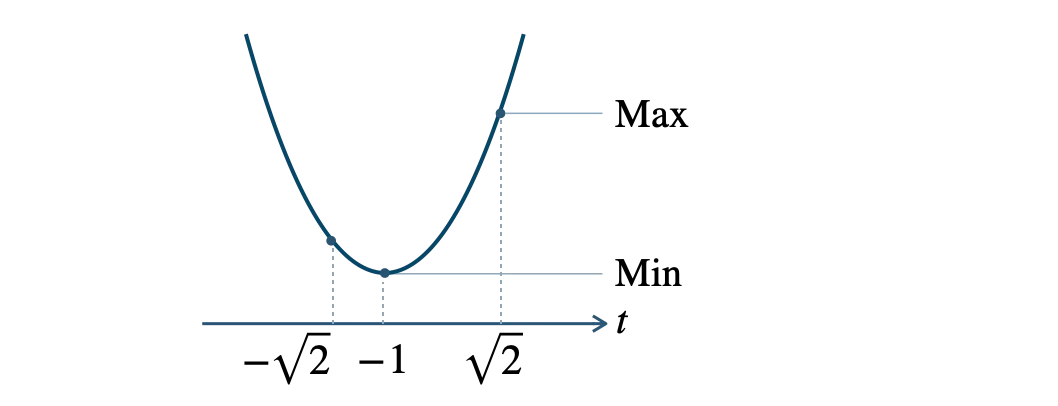
\(t=\sqrt{\,2\,}\) のとき最大となり、
\({\small [\,1\,]}\) に代入して、
\(\begin{eqnarray}~~~y&=&\displaystyle \frac{\,(\sqrt{\,2\,})^2+2\sqrt{\,2\,}-1\,}{\,2\,}
\\[3pt]~~~&=&\displaystyle \frac{\,2+2\sqrt{\,2\,}-1\,}{\,2\,}
\\[3pt]~~~&=&\displaystyle \frac{\,1+2\sqrt{\,2\,}\,}{\,2\,}\end{eqnarray}\)
\(t=-1\) のとき、
頂点の \(y\) 座標 \(-1\) が最小値
したがって、
最大値 \(\displaystyle \frac{\,1+2\sqrt{\,2\,}\,}{\,2\,}\) 、最小値 \(-1\) となる