2章 平面上の曲線

文字数が多く、重くなるのでページを分割しています。
各章は下のリンクまたはページ下の「次へ」をクリックしてください。
Advanced数学C 1章 ベクトル
Advanced数学C 2章 平面上の曲線
Advanced数学C 3章 複素数平面
2章 平面上の曲線
1節 2次曲線
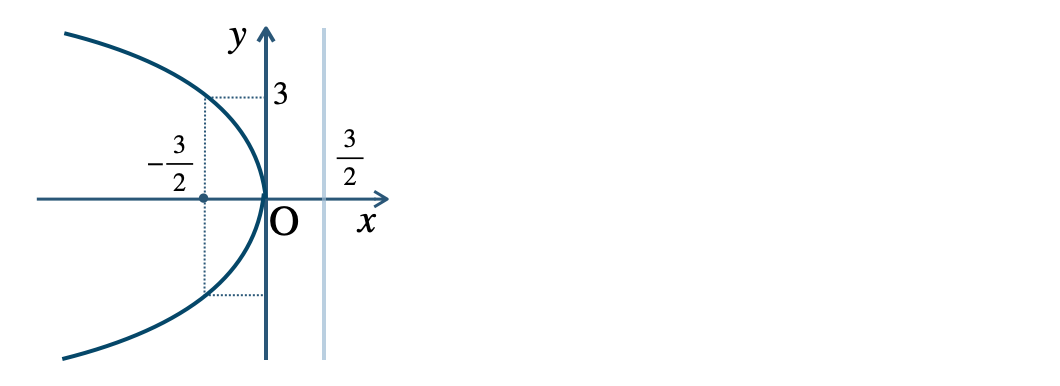
\({\small (2)}~\)焦点 \((-\displaystyle \frac{\,3\,}{\,2\,}~,~0)\)、準線 \(x=\displaystyle \frac{\,3\,}{\,2\,}\)
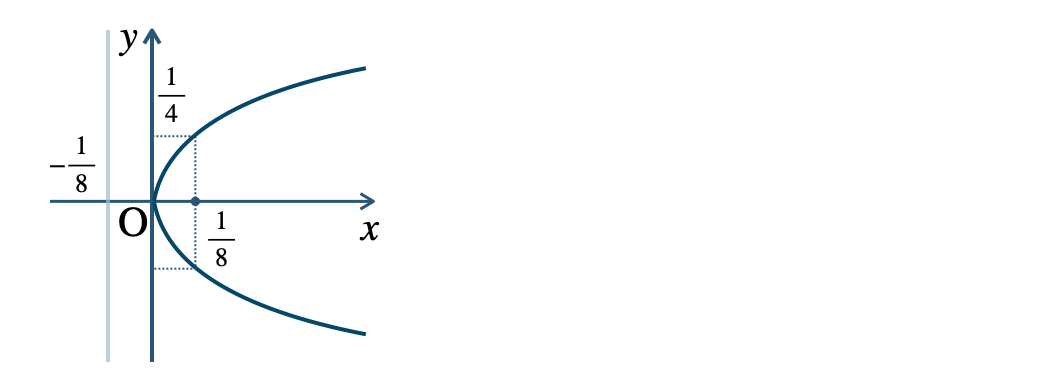
\({\small (3)}~\)焦点 \(\left(\displaystyle \frac{\,1\,}{\,8\,}~,~0\right)\)、準線 \(x=-\displaystyle \frac{\,1\,}{\,8\,}\)
解法のPoint|放物線の方程式と焦点・準線
\({\small (2)}~\)焦点 \((0~,~-3)\)、準線 \(y=3\)
\({\small (3)}~\)焦点 \(\left(0~,~\displaystyle \frac{\,1\,}{\,4\,}\right)\)、準線 \(y=-\displaystyle \frac{\,1\,}{\,4\,}\)
解法のPoint|放物線の方程式と焦点・準線
\({\small (2)}~x^2=-\displaystyle \frac{\,3\,}{\,2\,}y\)
解法のPoint|放物線の方程式の決定
\((0~,~2)~,~(0~,~-2)\)
焦点 \((2~,~0)~,~(-2~,~0)\)
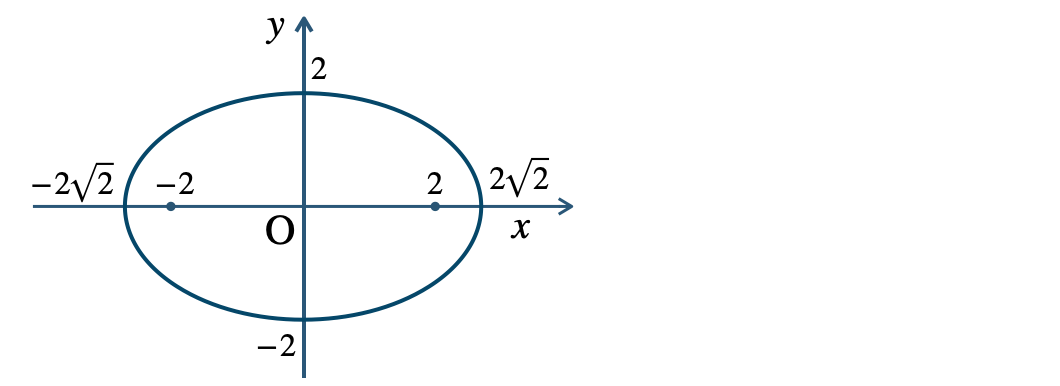
\({\small (2)}~\)頂点 \((2~,~0)~,~(-2~,~0)\)
\((0~,~1)~,~(0~,~-1)\)
焦点 \((\sqrt{3}~,~0)~,~(-\sqrt{3}~,~0)\)
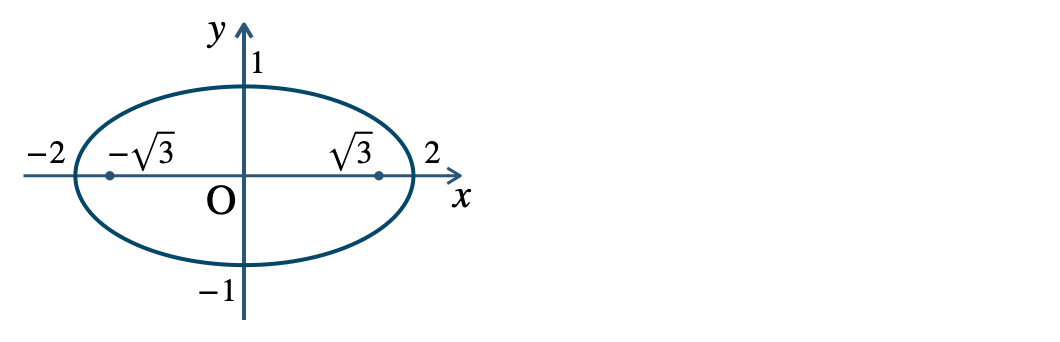
解法のPoint|楕円の方程式と概形
解法のPoint|楕円の方程式の決定
\((0~,~5)~,~(0~,~-5)\)
焦点 \((0~,~3)~,~(0~,~-3)\)
長軸 \(10\)、短軸 \(8\)
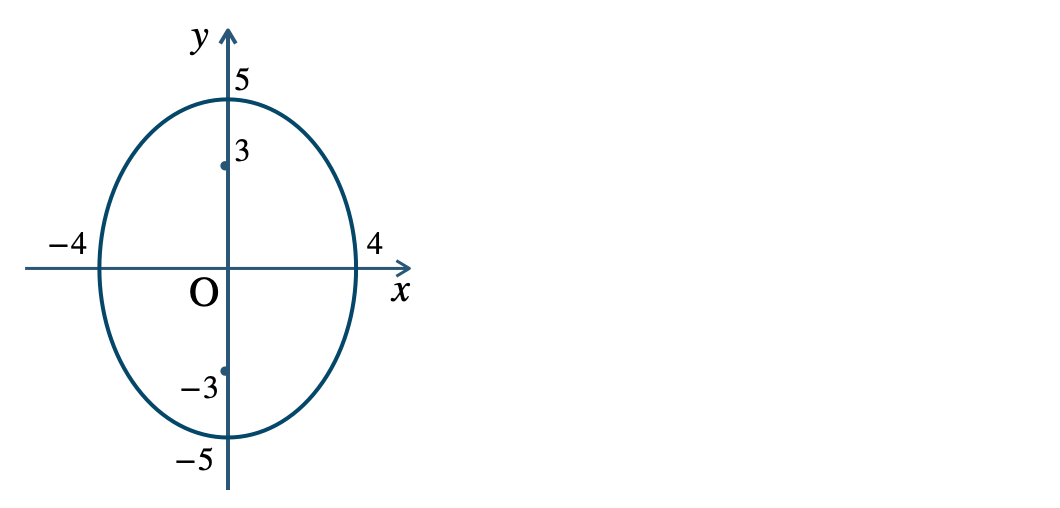
\({\small (2)}~\)頂点 \((1~,~0)~,~(-1~,~0)\)
\((0~,~3)~,~(0~,~-3)\)
焦点 \((0~,~2\sqrt{2})~,~(0~,~-2\sqrt{2})\)
長軸 \(6\)、短軸 \(2\)
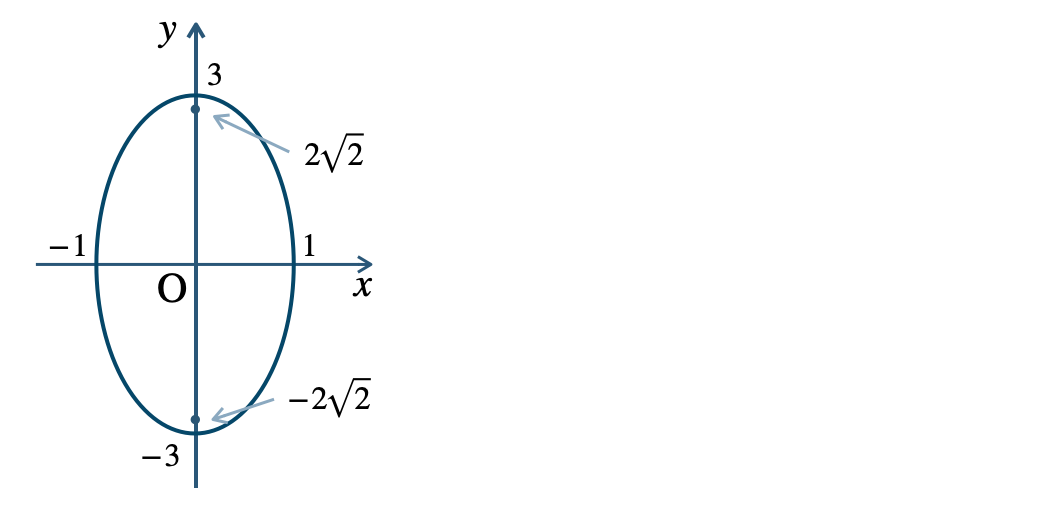
\({\small (3)}~\)頂点 \(\left(\displaystyle \frac{\,1\,}{\,3\,}~,~0\right)~,~\left(-\displaystyle \frac{\,1\,}{\,3\,}~,~0\right)\)
\(\left(0~,~\displaystyle \frac{\,1\,}{\,2\,}\right)~,~\left(0~,~-\displaystyle \frac{\,1\,}{\,2\,}\right)\)
焦点 \(\left(0~,~\displaystyle \frac{\,\sqrt{5}\,}{\,6\,}\right)~,~\left(0~,~-\displaystyle \frac{\,\sqrt{5}\,}{\,6\,}\right)\)
長軸 \(1\)、短軸 \(\displaystyle \frac{\,2\,}{\,3\,}\)
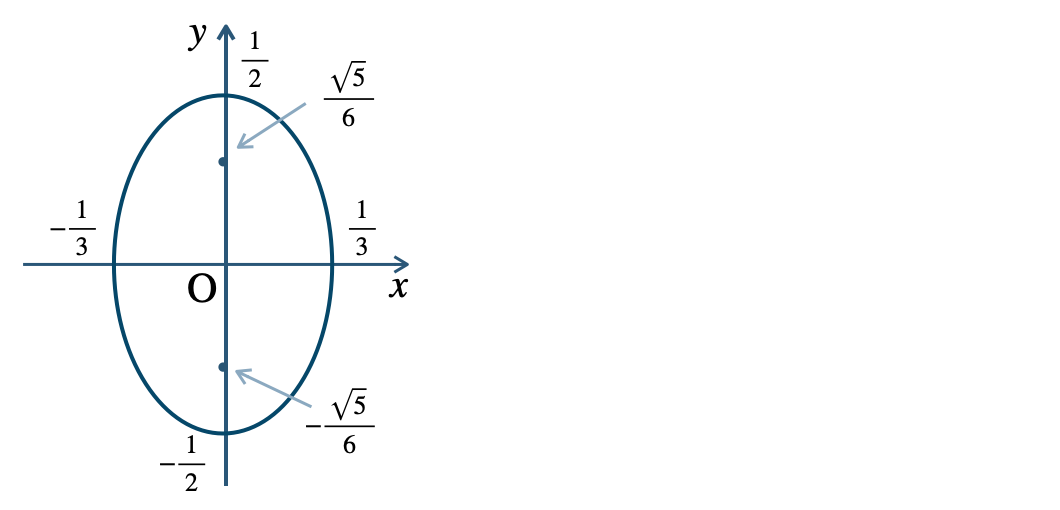
解法のPoint|楕円の方程式と概形
解法のPoint|円と楕円の関係
■ この問題の詳しい解説はこちら!
焦点 \((\sqrt{13}~,~0)~,~(-\sqrt{13}~,~0)\)
\({\small (2)}~\)頂点 \((5~,~0)~,~(-5~,~0)\)
焦点 \((\sqrt{41}~,~0)~,~(-\sqrt{41}~,~0)\)
解法のPoint|双曲線の方程式と概形
\({\small (2)}~\displaystyle \frac{\,x^2\,}{\,16\,}-\displaystyle \frac{\,y^2\,}{\,9\,}=1\)
解法のPoint|双曲線の方程式の決定
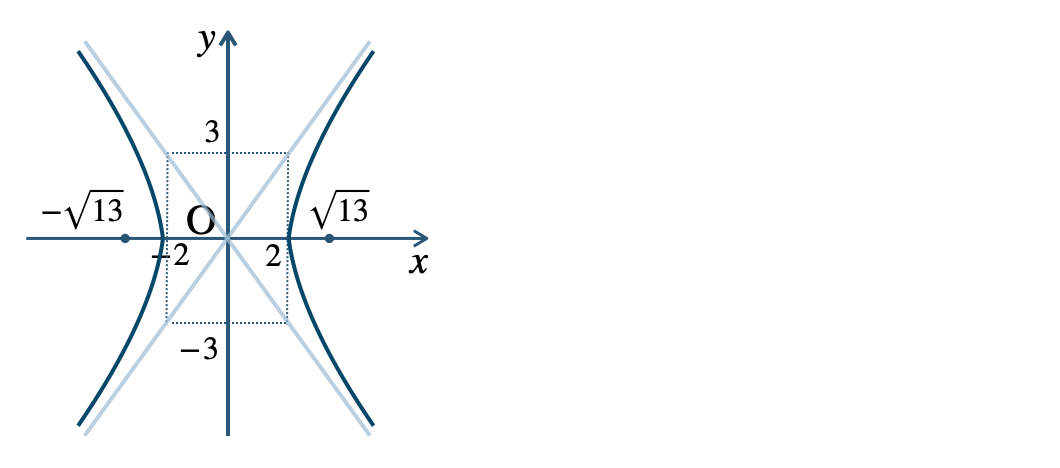
\({\small (2)}~y=\displaystyle \frac{\,4\,}{\,5\,}x~,~y=-\displaystyle \frac{\,4\,}{\,5\,}x\)
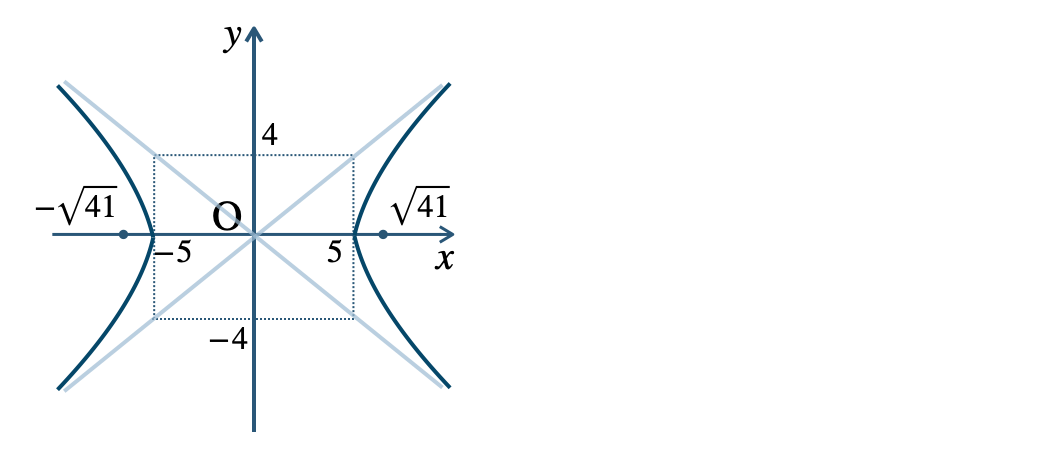
解法のPoint|双曲線の方程式と概形
解法のPoint|直角双曲線の方程式
焦点 \((0~,~5)~,~(0~,~-5)\)
漸近線 \(y=\displaystyle \frac{\,3\,}{\,4\,}x~,~y=-\displaystyle \frac{\,3\,}{\,4\,}x\)
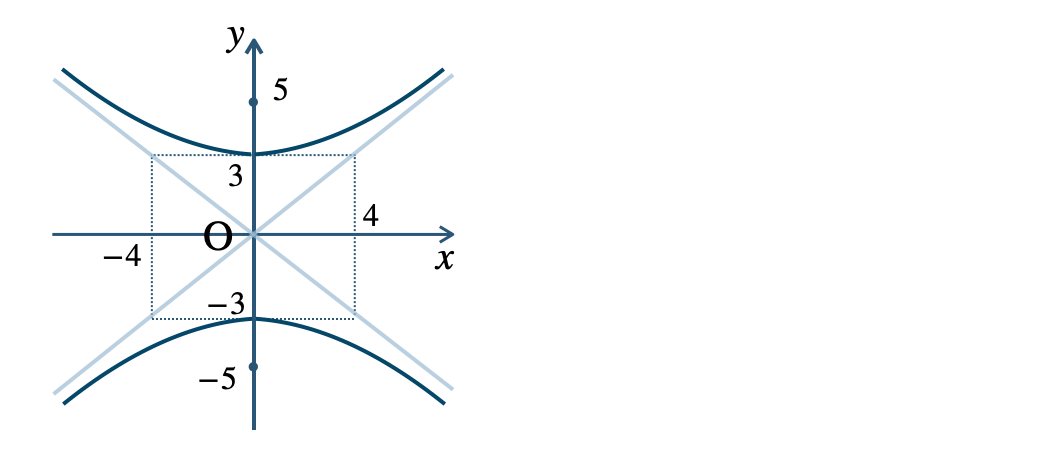
\({\small (2)}~\)頂点 \((0~,~\sqrt{5})~,~(0~,~-\sqrt{5})\)
焦点 \((0~,~\sqrt{6})~,~(0~,~-\sqrt{6})\)
漸近線 \(y=\sqrt{5}x~y=-\sqrt{5}x\)
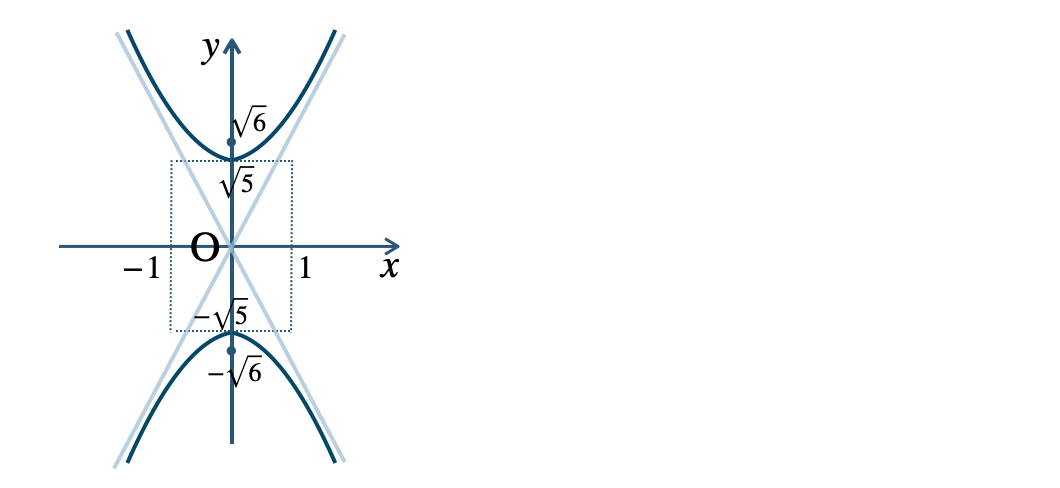
\({\small (3)}~\)頂点 \(\left(0~,~\displaystyle \frac{\,1\,}{\,3\,}\right)~,~\left(0~,~-\displaystyle \frac{\,1\,}{\,3\,}\right)\)
焦点 \(\left(0~,~\displaystyle \frac{\,2\,}{\,3\,}\right)~,~\left(0~,~-\displaystyle \frac{\,2\,}{\,3\,}\right)\)
漸近線 \(y=\displaystyle \frac{\,\sqrt{3}\,}{\,3\,}x~,~y=-\displaystyle \frac{\,\sqrt{3}\,}{\,3\,}x\)
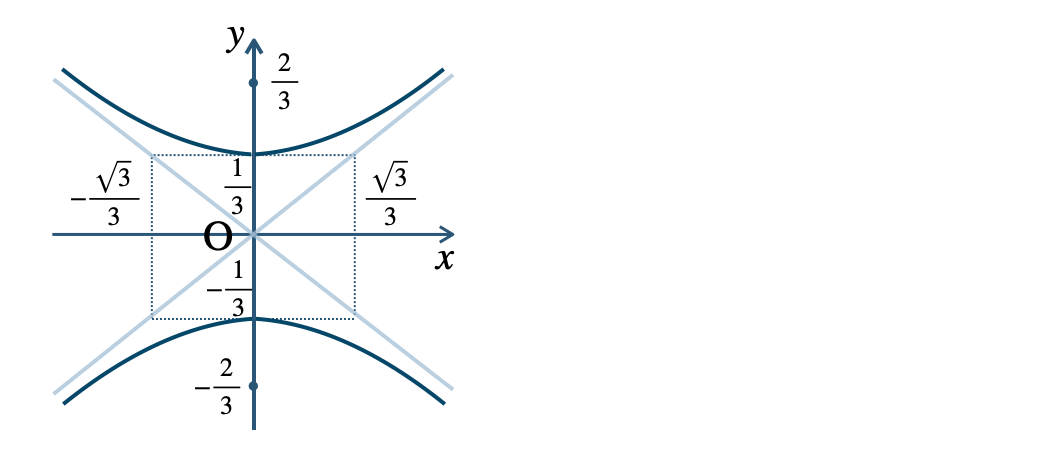
\({\small (4)}~\)頂点 \((0~,~2)~,~(0~,~-2)\)
焦点 \((0~,~\sqrt{10})~,~(0~,~-\sqrt{10})\)
漸近線 \(y=\displaystyle \frac{\,\sqrt{6}\,}{\,3\,}x~,~y=-\displaystyle \frac{\,\sqrt{6}\,}{\,3\,}x\)
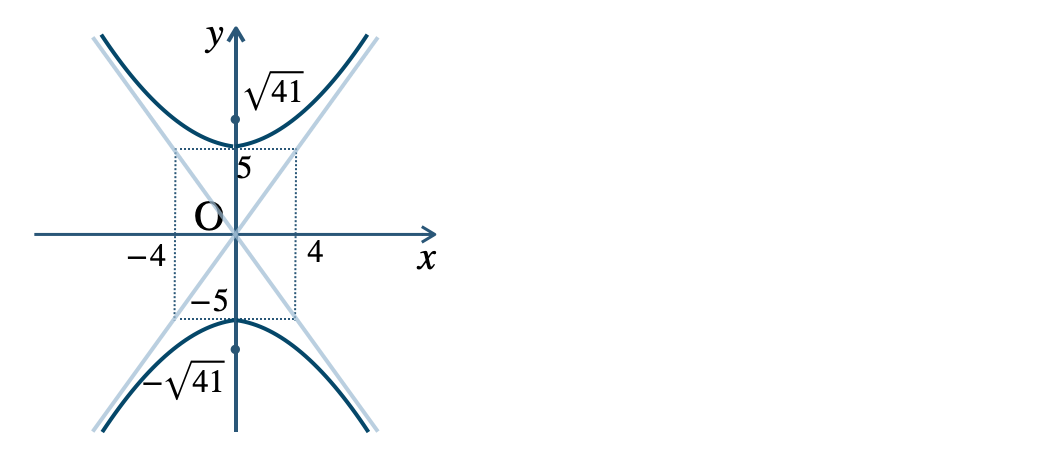
解法のPoint|双曲線の方程式と概形
焦点 \((3~,~-2)~,~(-1~,~-2)\)
\({\small (2)}~\displaystyle \frac{\,(x-1)^2\,}{\,4\,}-\displaystyle \frac{\,(y+2)^2\,}{\,9\,}=1\)
焦点 \((1+\sqrt{13}~,~-2)~,~(1-\sqrt{13}~,~-2)\)
解法のPoint|平行移動した2次曲線の方程式
\({\small (2)}~\)焦点 \(\left( 0~,~-\displaystyle \frac{\,1\,}{\,2\,} \right)\)、準線 \(x=-\displaystyle \frac{\,1\,}{\,2\,}\)
解法のPoint|x,yの2次方程式と2次曲線
\(x\) 軸方向に \(3\) だけ平行移動した楕円
\({\small (2)}~\)双曲線 \(\displaystyle \frac{\,x^2\,}{\,4\,}-\displaystyle \frac{\,y^2\,}{\,5\,}=-1\) を、
\(x\) 軸方向に \(-1\) 、\(y\) 軸方向に \(2\) だけ平行移動した双曲線
解法のPoint|x,yの2次方程式と2次曲線
\(x\) 軸方向に \(8\) だけ平行移動した楕円
\({\small (2)}~\)放物線 \(y^2=12x\) を、
\(x\) 軸方向に \(3\) だけ平行移動した放物線
■ この問題の詳しい解説はこちら!
\(y\) 軸方向に \(5\) だけ平行移動した双曲線
■ この問題の詳しい解説はこちら!
問題
円 \({\rm O}\) の半径を \(r\) 、円 \({\rm P}\) の半径を \(R\) とすると、
円 \({\rm P}\) は円 \({\rm O}\) に外接するので、
\({\rm OP}=r+R~~~\cdots {\small [\,1\,]}\)
また、円 \({\rm P}\) は直線 \(m\) に接するので、点 \({\rm P}\) と直線 \(m\) との距離は \(R\) となる
ここで、\(m\) に関して円 \({\rm O}\) と反対側に、\(m\) との距離が \(r\) となる直線 \(\ell\) をとると、
点 \({\rm P}\) は \(m\) に関して円 \({\rm O}\) と同じ側にあるので、
点 \({\rm P}\) から直線 \(\ell\) に下ろした垂線の足を \({\rm H}\) とすると、点 \({\rm P}\) と直線 \(\ell\) との距離 \({\rm PH}\) は、
\({\rm PH}=R+r~~~\cdots {\small [\,2\,]}\)
\({\small [\,1\,]}\) 、\({\small [\,2\,]}\) より、
\({\rm OP}={\rm PH}\)
これより、点 \({\rm P}\) は定点 \({\rm O}\) からの距離と定直線 \(\ell\) からの距離が常に等しい点となる
したがって、点 \({\rm P}\) の軌跡は、点 \({\rm O}\) を焦点、直線 \(\ell\) を準線とする放物線となる
[終]
■ この問題の詳しい解説はこちら!
\({\small (2)}~\displaystyle \frac{\,x^2\,}{\,9\,}+\displaystyle \frac{\,y^2\,}{\,13\,}=1\)
\({\small (3)}~\displaystyle \frac{\,x^2\,}{\,6\,}+\displaystyle \frac{\,y^2\,}{\,4\,}=1\)
解法のPoint|楕円の方程式の決定
■ この問題の詳しい解説はこちら!
\({\small (2)}~\displaystyle \frac{\,x^2\,}{\,4\,}-\displaystyle \frac{\,y^2\,}{\,4\,}=-1\)
解法のPoint|双曲線の方程式の決定
焦点 \((-1~,~2+\sqrt{\,7\,})~,~(-1~,~2-\sqrt{\,7\,})\)
\({\small (2)}~(y-2)^2=6(x+1)\)
焦点 \(\left(\displaystyle \frac{\,1\,}{\,2\,}~,~2\right)\)
\({\small (3)}~\displaystyle \frac{\,(x+1)^2\,}{\,3\,}-\displaystyle \frac{\,(y-2)^2\,}{\,5\,}=-1\)
焦点 \((-1~,~2+2\sqrt{\,2\,})~,~(-1~,~2-2\sqrt{\,2\,})\)
解法のPoint|平行移動した2次曲線の方程式
\({\small (2)}~\)焦点 \((0~,~2+3\sqrt{\,2\,})~,~(0~,~2-3\sqrt{\,2\,})\)
\({\small (3)}~\)焦点 \(\left(-\displaystyle \frac{\,3\,}{\,2\,}~,~1\right)\)
解法のPoint|x,yの2次方程式と2次曲線
\(k=\pm\sqrt{\,2\,}\) のとき、\(1\) 個
\(-\sqrt{\,2\,}\lt k\lt\sqrt{\,2\,}\) のとき、なし
解法のPoint|2次曲線と直線の共有点の個数
2節 媒介変数表示と極座標
\({\small (2)}~x=\displaystyle \frac{\,1\,}{\,4\,}y^2-1\)
解法のPoint|媒介変数表示の曲線の概形
x=5\cos{\theta} \\ y=5\sin{\theta}
\end{array}\right.\end{eqnarray}\)
解法のPoint|円・楕円・双曲線の媒介変数表示
x=2\cos{\theta} \\ y=3\sin{\theta}
\end{array}\right.\end{eqnarray}\)
解法のPoint|円・楕円・双曲線の媒介変数表示
\(1+\tan^2{\theta}=\displaystyle \frac{\,1\,}{\,\cos^2{\theta}\,}\) に代入すると、
\(\begin{eqnarray}~~~1+\left( \displaystyle \frac{\,y\,}{\,b\,} \right)^2&=&\left( \displaystyle \frac{\,x\,}{\,a\,} \right)^2
\\[5pt]~~~\displaystyle \frac{\,x^2\,}{\,a^2\,}-\displaystyle \frac{\,y^2\,}{\,b^2\,}&=&1
\end{eqnarray}\)[終]
解法のPoint|円・楕円・双曲線の媒介変数表示
\({\small (2)}~\)楕円 \(\displaystyle \frac{\,x^2\,}{\,9\,}+\displaystyle \frac{\,y^2\,}{\,25\,}=1\) を、
\(x\) 軸方向に \(-2\)、\(y\) 軸方向に \(2\) だけ平行移動した楕円
解法のPoint|媒介変数表示の曲線の平行移動
x=2\cos{\theta}+4 \\ y=2\sin{\theta}+3
\end{array}\right.\end{eqnarray}\)
解法のPoint|媒介変数表示の曲線の平行移動
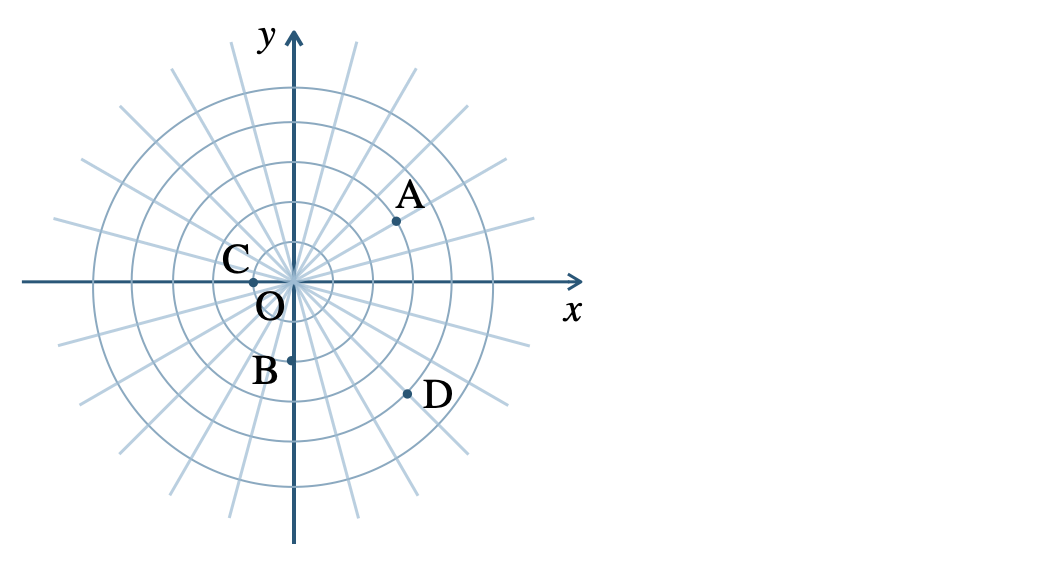
\(~~~{\rm C}(-1~,~0)~,~{\rm D}(2\sqrt{2}~,~-2\sqrt{2})\)
解法のPoint|極座標の表し方と直交座標に変換
\({\small (2)}~\left(2~,~\displaystyle \frac{\,3\,}{\,2\,}\pi \right)\)
\({\small (3)}~\left(2~,~\displaystyle \frac{\,11\,}{\,6\,}\pi \right)\)
解法のPoint|直交座標の点を極座標に変換
\({\small (2)}~\)極 \({\rm O}\) を通り、始線とのなす角が \(\displaystyle \frac{\,\pi\,}{\,3\,}\) の直線
解法のPoint|極方程式の表す図形
\(~~~r^2=6r\cos{\theta}\)
ここで、\(r^2=x^2+y^2~,~r\cos{\theta}=y\) より、
\(\begin{eqnarray}~~~x^2+y^2&=&6y\\[2pt]~~~x^2+(y-3)^2&=&3^2\end{eqnarray}\)
したがって、この極方程式は、
中心 \((0~,~3)\)、半径 \(3\) の円を表す [終]
解法のPoint|極方程式の表す図形
解法のPoint|点を通る垂直な直線の極方程式
\({\small (2)}~r=\displaystyle \frac{\,3\cos{\theta}\,}{\,\sin^2{\theta}\,}\)
解法のPoint|直交座標の方程式を極方程式に変換
\({\small (2)}~\)放物線 \(y^2=8(x+2)\)
解法のPoint|離心率と極方程式
問題
\(\begin{eqnarray}~~~x&=&p\left(\displaystyle \frac{\,y\,}{\,2p\,} \right)^2\\[5pt]~~~y^2&=&4px\end{eqnarray}\)
これより、\(t\) が実数全体を動くとき、放物線 \(y^2=4px\) を表す [終]
解法のPoint|放物線の媒介変数表示
\({\small (2)}~\)双曲線 \((x-1)^2-(y+3)^2=1\)
解法のPoint|媒介変数表示の曲線の平行移動
\({\small (2)}~\)放物線 \(y=-x^2+1\) の \(-1{\small ~≦~}x{\small ~≦~}1\) の部分
解法のPoint|媒介変数表示の曲線の概形
\({\small (2)}~\)放物線 \(y=x^2\)
\({\small (3)}~\)円 \((x+1)^2+(y-1)^2=2\)
解法のPoint|極方程式を直交座標の方程式に変換
\({\small (4)}~\)双曲線 \((x+2\sqrt{\,2\,})^2-y^2=4\)
解法のPoint|離心率と極方程式
\({\small (2)}~r=6\sin \theta\)
\({\small (3)}~r=\displaystyle \frac{\,2\sin \theta\,}{\,\cos^2\theta\,}\)
解法のPoint|直交座標の方程式を極方程式に変換
練習問題 平面上の曲線
\({\small (2)}~\displaystyle \frac{\,(x-2)^2\,}{\,16\,}+\displaystyle \frac{\,(y-1)^2\,}{\,25\,}=1\)
\({\small (3)}~\displaystyle \frac{\,(x+2)^2\,}{\,5\,}-\displaystyle \frac{\,y^2\,}{\,4\,}=1\)
解法のPoint|平行移動した2次曲線の方程式
\({\small (2)}~(-3~,~1)\)
解法のPoint|x,yの2次方程式と2次曲線
\(\begin{eqnarray}~~~ \left\{~\begin{array}{l}
\displaystyle \frac{\,x^2\,}{\,4\,}+y^2=1~~~\cdots {\small [\,1\,]}\\ y=\displaystyle \frac{\,1\,}{\,2\,}x+k~~~\cdots {\small [\,2\,]}
\end{array}\right.\end{eqnarray}\)
\({\small [\,1\,]}\) に \({\small [\,2\,]}\) を代入すると、
\(\begin{eqnarray}~~~\displaystyle \frac{\,x^2\,}{\,4\,}+\left(\displaystyle \frac{\,1\,}{\,2\,}x+k\right)^2&=&1
\\[5pt]~~~\displaystyle \frac{\,x^2\,}{\,4\,}+\displaystyle \frac{\,1\,}{\,4\,}x^2+kx+k^2&=&1\end{eqnarray}\)
両辺に \(4\) をかけると、
\(\begin{eqnarray}~~~x^2+x^2+4kx+4k^2&=&4
\\[3pt]~~~2x^2+4kx+4k^2-4&=&0
\\[3pt]~~~x^2+2kx+2k^2-2&=&0~~~\cdots {\small [\,3\,]}\end{eqnarray}\)
\(2\) つの共有点をもつのは、\({\small [\,3\,]}\) が異なる \(2\) つの実数解をもつときなので、
\({\small [\,3\,]}\) の判別式 \(D\) について \(D \gt 0\) となる
ここで、
\(\begin{eqnarray}~~~D&=&(2k)^2-4 \cdot 1 \cdot (2k^2-2)
\\[3pt]~~~&=&4k^2-8k^2+8
\\[3pt]~~~&=&-4k^2+8\end{eqnarray}\)
よって、
\(\begin{eqnarray}~~~-4k^2+8&\gt&0
\\[3pt]~~~-4k^2&\gt&-8
\\[3pt]~~~k^2&\lt&2\end{eqnarray}\)
\(-\sqrt{\,2\,} \lt k \lt \sqrt{\,2\,}~~~\cdots {\small [\,4\,]}\)
また、\({\small [\,3\,]}\) の異なる \(2\) つの解が \(\alpha~,~\beta\) となるので、
解と係数の関係より、
\(\alpha+\beta=-\displaystyle \frac{\,2k\,}{\,1\,}=-2k~~~\cdots {\small [\,5\,]}\)
ここで、中点 \({\rm R}\) の座標を \((X~,~Y)\) とおくと、
中点の \(x\) 座標は \(\displaystyle \frac{\,\alpha+\beta\,}{\,2\,}\) より、
\(\begin{eqnarray}~~~X&=&\displaystyle \frac{\,\alpha+\beta\,}{\,2\,}
\\[5pt]~~~&=&\displaystyle \frac{\,-2k\,}{\,2\,}
\\[5pt]~~~&=&-k~~~\cdots {\small [\,6\,]}\end{eqnarray}\)
また、この中点は直線 \({\small [\,2\,]}\) 上にあるので、
\(\begin{eqnarray}~~~Y&=&\displaystyle \frac{\,1\,}{\,2\,} \cdot (-k)+k
\\[5pt]~~~&=&-\displaystyle \frac{\,1\,}{\,2\,}k+k
\\[5pt]~~~&=&\displaystyle \frac{\,1\,}{\,2\,}k~~~\cdots {\small [\,7\,]}\end{eqnarray}\)
次に、\({\small [\,6\,]}\) より \(k=-X\) となるので、
これを \({\small [\,7\,]}\) に代入すると、
\(\begin{eqnarray}~~~Y&=&\displaystyle \frac{\,1\,}{\,2\,} \cdot (-X)
\\[5pt]~~~&=&-\displaystyle \frac{\,1\,}{\,2\,}X\end{eqnarray}\)
よって、中点 \({\rm R}\) は直線 \(y=-\displaystyle \frac{\,1\,}{\,2\,}x\) 上にある
また、\({\small [\,4\,]}\) に \(k=-X\) を代入すると、
\(\begin{eqnarray}~~~-\sqrt{\,2\,} &\lt& -X \lt \sqrt{\,2\,}
\\[3pt]~~~-\sqrt{\,2\,} &\lt& X \lt \sqrt{\,2\,}\end{eqnarray}\)
したがって、線分 \({\rm PQ}\) の中点 \({\rm R}\) は、直線 \(y=-\displaystyle \frac{\,1\,}{\,2\,}x\) 上の \(-\sqrt{\,2\,} \lt x \lt \sqrt{\,2\,}\) の部分にある [終]
■ この問題の詳しい解説はこちら!
\({\small (2)}~\)円 \(\left(x-\displaystyle \frac{\,1\,}{\,2\,}\right)^2+y^2=\displaystyle \frac{\,1\,}{\,4\,}\)
原点を除く
解法のPoint|媒介変数表示の曲線の概形
\({\rm OP}_1=r_1~,~{\rm OP}_2=r_2\) 、\(\angle {\rm P}_1{\rm OP}_2=|\, \theta_2-\theta_1 \,|\) となるので、
三角形の面積の公式を用いると、
\(\begin{eqnarray}~~~\triangle {\rm OP}_1{\rm P}_2&=&\displaystyle \frac{\,1\,}{\,2\,} \cdot r_1 \cdot r_2 \cdot \sin |\, \theta_2-\theta_1 \,|\end{eqnarray}\)
ここで、\(0 \lt |\, \theta_2-\theta_1 \,| \lt \pi\) より、
\(\sin |\, \theta_2-\theta_1 \,|=|\, \sin (\theta_2-\theta_1) \,|\)
となるので、
\(\begin{eqnarray}~~~\phantom{\triangle {\rm OP}_1{\rm P}_2}&=&\displaystyle \frac{\,1\,}{\,2\,}r_1r_2|\, \sin (\theta_2-\theta_1) \,|\end{eqnarray}\)
また、\(r_1 \gt 0~,~r_2 \gt 0\) より、
\(\begin{eqnarray}~~~\phantom{\triangle {\rm OP}_1{\rm P}_2}&=&\displaystyle \frac{\,1\,}{\,2\,}|\, r_1r_2\sin (\theta_2-\theta_1) \,|\end{eqnarray}\)
したがって、\(\triangle {\rm OP}_1{\rm P}_2=\displaystyle \frac{\,1\,}{\,2\,}|\, r_1r_2\sin (\theta_2-\theta_1) \,|\) が成り立つ [終]
\({\small (2)}~\)[証明] 極座標 \((r~,~\theta)\) と直交座標 \((x~,~y)\) の関係より、
\(x_1=r_1\cos \theta_1~,~y_1=r_1\sin \theta_1\)
\(x_2=r_2\cos \theta_2~,~y_2=r_2\sin \theta_2\)
これより、
\\[3pt]~~~&=&r_1r_2(\sin \theta_2\cos \theta_1-\cos \theta_2\sin \theta_1)
\\[3pt]~~~&=&r_1r_2\sin (\theta_2-\theta_1)\end{eqnarray}\)
※ 数式は横にスクロールできます。
よって、\({\small (1)}\) の結果を用いると、
\(\begin{eqnarray}~~~\triangle {\rm OP}_1{\rm P}_2&=&\displaystyle \frac{\,1\,}{\,2\,}|\, r_1r_2\sin (\theta_2-\theta_1) \,|
\\[5pt]~~~&=&\displaystyle \frac{\,1\,}{\,2\,}|\, x_1y_2-x_2y_1 \,|\end{eqnarray}\)
したがって、\(\triangle {\rm OP}_1{\rm P}_2=\displaystyle \frac{\,1\,}{\,2\,}|\, x_1y_2-x_2y_1 \,|\) が成り立つ [終]
■ この問題の詳しい解説はこちら!
\({\small (2)}~\)放物線 \(y^2=12(x+3)\)
\({\small (3)}~\)双曲線 \(\displaystyle \frac{\,(x+8)^2\,}{\,16\,}-\displaystyle \frac{\,y^2\,}{\,48\,}=1\)
■ この問題の詳しい解説はこちら!
\(\displaystyle \frac{\,{x_1}^2\,}{\,a^2\,}+\displaystyle \frac{\,{y_1}^2\,}{\,b^2\,}=1~~~\cdots {\small [\,1\,]}\)
また、点 \({\rm P}\) は \({\rm A}~,~{\rm B}\) と異なる楕円上の点なので、\(x_1\) は \(0\) ではなく、\(-b \lt y_1 \lt b\) となる
直線 \({\rm AP}\) は \(2\) 点 \({\rm A}(0~,~b)~,~{\rm P}(x_1~,~y_1)\) を通るので、
\(y=\displaystyle \frac{\,y_1-b\,}{\,x_1\,}x+b\)
点 \({\rm Q}\) は直線 \({\rm AP}\) と \(x\) 軸との交点なので、\(y=0\) を代入すると、
\(\begin{eqnarray}~~~\displaystyle \frac{\,y_1-b\,}{\,x_1\,}x+b&=&0
\\[5pt]~~~\displaystyle \frac{\,y_1-b\,}{\,x_1\,}x&=&-b
\\[5pt]~~~x&=&-b \cdot \displaystyle \frac{\,x_1\,}{\,y_1-b\,}
\\[5pt]~~~x&=&-\displaystyle \frac{\,bx_1\,}{\,y_1-b\,}\end{eqnarray}\)
よって、\({\rm Q}\left(-\displaystyle \frac{\,bx_1\,}{\,y_1-b\,}~,~0\right)\)
直線 \({\rm BP}\) は \(2\) 点 \({\rm B}(0~,~-b)~,~{\rm P}(x_1~,~y_1)\) を通るので、
\(y=\displaystyle \frac{\,y_1+b\,}{\,x_1\,}x-b\)
点 \({\rm R}\) は直線 \({\rm BP}\) と \(x\) 軸との交点なので、\(y=0\) を代入すると、
\(\begin{eqnarray}~~~\displaystyle \frac{\,y_1+b\,}{\,x_1\,}x-b&=&0
\\[5pt]~~~\displaystyle \frac{\,y_1+b\,}{\,x_1\,}x&=&b
\\[5pt]~~~x&=&b \cdot \displaystyle \frac{\,x_1\,}{\,y_1+b\,}
\\[5pt]~~~x&=&\displaystyle \frac{\,bx_1\,}{\,y_1+b\,}\end{eqnarray}\)
よって、\({\rm R}\left(\displaystyle \frac{\,bx_1\,}{\,y_1+b\,}~,~0\right)\)
\(-b \lt y_1 \lt b\) より、\(b-y_1\gt0~,~y_1+b\gt0\) となるので、
\(\begin{eqnarray}~~~{\rm OQ}&=&\left|\,-\displaystyle \frac{\,bx_1\,}{\,y_1-b\,}\,\right|
\\[5pt]~~~&=&\displaystyle \frac{\,b|\, x_1 \,|\,}{\,b-y_1\,}\end{eqnarray}\)
また、
\(\begin{eqnarray}~~~{\rm OR}&=&\left|\,\displaystyle \frac{\,bx_1\,}{\,y_1+b\,}\,\right|
\\[5pt]~~~&=&\displaystyle \frac{\,b|\, x_1 \,|\,}{\,y_1+b\,}\end{eqnarray}\)
この \(2\) つの積を求めると、
\(\begin{eqnarray}~~~{\rm OQ} \cdot {\rm OR}&=&\displaystyle \frac{\,b|\, x_1 \,|\,}{\,b-y_1\,} \cdot \displaystyle \frac{\,b|\, x_1 \,|\,}{\,y_1+b\,}
\\[5pt]~~~&=&\displaystyle \frac{\,b^2{x_1}^2\,}{\,(b-y_1)(b+y_1)\,}
\\[5pt]~~~&=&\displaystyle \frac{\,b^2{x_1}^2\,}{\,b^2-{y_1}^2\,}~~~\cdots {\small [\,2\,]}\end{eqnarray}\)
ここで、\({\small [\,1\,]}\) より、
\(\begin{eqnarray}~~~\displaystyle \frac{\,{x_1}^2\,}{\,a^2\,}+\displaystyle \frac{\,{y_1}^2\,}{\,b^2\,}&=&1
\\[5pt]~~~\displaystyle \frac{\,{y_1}^2\,}{\,b^2\,}&=&1-\displaystyle \frac{\,{x_1}^2\,}{\,a^2\,}
\\[5pt]~~~{y_1}^2&=&b^2-\displaystyle \frac{\,b^2{x_1}^2\,}{\,a^2\,}
\\[5pt]~~~b^2-{y_1}^2&=&\displaystyle \frac{\,b^2{x_1}^2\,}{\,a^2\,}\end{eqnarray}\)
\({\small [\,2\,]}\) に代入すると、
\(\begin{eqnarray}~~~{\rm OQ} \cdot {\rm OR}&=&\displaystyle \frac{\,b^2{x_1}^2\,}{\,\displaystyle \frac{\,b^2{x_1}^2\,}{\,a^2\,}\,}
\\[5pt]~~~&=&b^2{x_1}^2 \cdot \displaystyle \frac{\,a^2\,}{\,b^2{x_1}^2\,}
\\[5pt]~~~&=&a^2\end{eqnarray}\)
したがって、
\({\rm OQ} \cdot {\rm OR}=a^2\) となり、一定である [終]
■ この問題の詳しい解説はこちら!
極 \({\rm O}\) と中心との距離が半径と等しくなることより、
円 \(S\) は極 \({\rm O}\) を通る
中心の極座標が \((a~,~\alpha)\) で極 \({\rm O}\) を通る円の極方程式が \(r=2a\cos (\theta-\alpha)\) となるので、
円 \(S\) の極方程式は、
\(\begin{eqnarray}~~~r&=&2 \cdot \displaystyle \frac{\,a\,}{\,2\,}\cos (\theta-0)
\\[5pt]~~~&=&a\cos \theta\end{eqnarray}\)
点 \({\rm P}\) の極座標を \((r~,~\theta)\) とすると、点 \({\rm P}\) は \(C\) 上の点なので、
\({\rm OP}=r=a(1+\cos \theta)\)
直線 \({\rm OP}\) が極 \({\rm O}\) 以外の点で円 \(S\) と交わるとき、点 \({\rm Q}\) は次の \(2\) つの場合がある
※ \(\cos \theta=0\) のとき、直線 \({\rm OP}\) は極 \({\rm O}\) で円 \(S\) に接するので、条件を満たさない。
\({\small [\,1\,]}~\)点 \({\rm Q}\) が線分 \({\rm OP}\) を内分するとき、
点 \({\rm Q}\) は極 \({\rm O}\) から見て点 \({\rm P}\) と同じ側にあるので、
点 \({\rm Q}\) の偏角は \(\theta\) となるので、
\({\rm OQ}=a\cos \theta\)
また、\({\rm OQ} \gt 0\) より、\(\cos \theta \gt 0\) となる
これより、
\(\begin{eqnarray}~~~{\rm PQ}&=&{\rm OP}-{\rm OQ}
\\[3pt]~~~&=&a(1+\cos \theta)-a\cos \theta
\\[3pt]~~~&=&a+a\cos \theta-a\cos \theta
\\[3pt]~~~&=&a\end{eqnarray}\)
\({\small [\,2\,]}~\)点 \({\rm Q}\) が線分 \({\rm OP}\) を外分するとき、
点 \({\rm Q}\) は極 \({\rm O}\) から見て点 \({\rm P}\) と反対側にあるので、
点 \({\rm Q}\) の偏角を \(\theta^{\prime}\) とすると、\(\theta^{\prime}=\theta-\pi\) または \(\theta^{\prime}=\theta+\pi\) となるので、
\(\begin{eqnarray}~~~{\rm OQ}&=&a\cos \theta^{\prime}
\\[3pt]~~~&=&-a\cos \theta\end{eqnarray}\)
また、\({\rm OQ} \gt 0\) より、\(\cos \theta \lt 0\) となる
このとき、極 \({\rm O}\) は線分 \({\rm PQ}\) 上にあるので、
\(\begin{eqnarray}~~~{\rm PQ}&=&{\rm OP}+{\rm OQ}
\\[3pt]~~~&=&a(1+\cos \theta)+(-a\cos \theta)
\\[3pt]~~~&=&a+a\cos \theta-a\cos \theta
\\[3pt]~~~&=&a\end{eqnarray}\)
\({\small [\,1\,]}~,~{\small [\,2\,]}\) より、
\({\rm PQ}=a\)
したがって、\({\rm PQ}\) は一定である [終]
\({\small (2)}~\)点 \({\rm P}\) の極座標は \(\left(\displaystyle \frac{\,3\,}{\,2\,}a~,~\displaystyle \frac{\,\pi\,}{\,3\,}\right)~,~\)\(\left(\displaystyle \frac{\,3\,}{\,2\,}a~,~\displaystyle \frac{\,5\,}{\,3\,}\pi\right)\) 、距離は \({\rm AP}=\displaystyle \frac{\,3\sqrt{\,3\,}\,}{\,4\,}a\)
■ この問題の詳しい解説はこちら!
次のページ「3章 複素数平面」