- 数学Ⅰ|図形と計量(三角比)「三角比のとりうる値の範囲」の基本例題解説ページです。
- 目次をクリックすると各セクションへ移動します。
問題|三角比のとりうる値の範囲
図形と計量(三角比) 11\(0^\circ \lt \theta \lt 90^\circ\) や \(90^\circ \lt \theta{\small ~≦~}180^\circ\) での \(\sin \theta~,~\)\(\cos \theta~,~\)\(\tan \theta\) の正負の調べ方は?また、\(0^\circ{\small ~≦~}\theta{\small ~≦~}180^\circ\) での \(\sin \theta~,~\)\(\cos \theta~,~\)\(\tan \theta\) のとりうる値の範囲の求め方は?
高校数学Ⅰ|図形と計量(三角比)
解法のPoint
三角比のとりうる値の範囲
Point:三角比のとりうる値の範囲

\(0^\circ \lt \theta \lt 90^\circ\) のとき、
\(\sin \theta \gt 0~,~\cos \theta \gt 0~,~\tan \theta \gt 0\)
\(90^\circ \lt \theta \lt 180^\circ\) のとき、
\(\sin \theta \gt 0~,~\cos \theta \lt 0~,~\tan \theta \lt 0\)
\(0^\circ{\small ~≦~}\theta{\small ~≦~}180^\circ\) のとき、
\(0{\small ~≦~}\sin \theta{\small ~≦~}1~,~-1{\small ~≦~}\cos \theta{\small ~≦~}1\)
また、\(\theta \neq 90^\circ\) で、\(\tan \theta\) はすべての実数値をとる。
■ \(\theta\) の値と三角比の正負の関係

\(0^\circ \lt \theta \lt 90^\circ\) のとき、
\(\sin \theta \gt 0~,~\cos \theta \gt 0~,~\tan \theta \gt 0\)
\(90^\circ \lt \theta \lt 180^\circ\) のとき、
\(\sin \theta \gt 0~,~\cos \theta \lt 0~,~\tan \theta \lt 0\)
■ \(\theta\) の値と三角比のとりうる値の範囲
\(0^\circ{\small ~≦~}\theta{\small ~≦~}180^\circ\) のとき、
\(0{\small ~≦~}\sin \theta{\small ~≦~}1~,~-1{\small ~≦~}\cos \theta{\small ~≦~}1\)
また、\(\theta \neq 90^\circ\) で、\(\tan \theta\) はすべての実数値をとる。
©︎ 2026 教科書より詳しい高校数学 yorikuwa.com
詳しい解説|三角比のとりうる値の範囲
図形と計量(三角比) 11\(0^\circ \lt \theta \lt 90^\circ\) や \(90^\circ \lt \theta{\small ~≦~}180^\circ\) での \(\sin \theta~,~\)\(\cos \theta~,~\)\(\tan \theta\) の正負の調べ方は?また、\(0^\circ{\small ~≦~}\theta{\small ~≦~}180^\circ\) での \(\sin \theta~,~\)\(\cos \theta~,~\)\(\tan \theta\) のとりうる値の範囲の求め方は?
高校数学Ⅰ|図形と計量(三角比)
\(0^\circ \lt \theta \lt 90^\circ\) のとき、
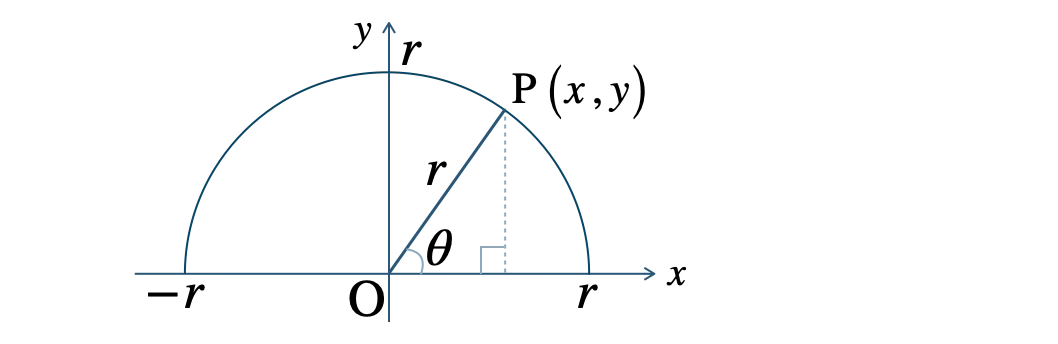
点 \({\rm P}\) が第 \(1\) 象限にあり、\(x \gt 0~,~y \gt 0~,~r \gt 0\)
これより、
\(\sin \theta=\displaystyle \frac{\,y\,}{\,r\,} \gt 0\)
\(\cos \theta=\displaystyle \frac{\,x\,}{\,r\,} \gt 0\)
\(\tan \theta=\displaystyle \frac{\,y\,}{\,x\,} \gt 0\)
したがって、\(\sin \theta \gt 0~,~\cos \theta \gt 0~,~\tan \theta \gt 0\) となる
\(90^\circ \lt \theta{\small ~≦~}180^\circ\) のとき、
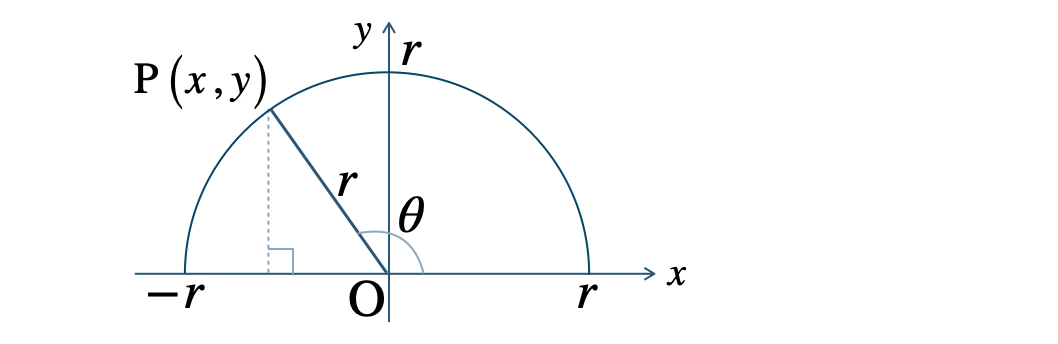
点 \({\rm P}\) が第 \(2\) 象限または \(x\) 軸上にあり、\(x \lt 0~,~y{\small ~≧~}0~,~r \gt 0\)
※ \(\theta=180^\circ\) のとき \(y=0\) となるので \(y{\small ~≧~}0\) とイコールを付ける。
これより、
\(\sin \theta=\displaystyle \frac{\,y\,}{\,r\,}{\small ~≧~}0\)
\(\cos \theta=\displaystyle \frac{\,x\,}{\,r\,} \lt 0\)
\(\tan \theta=\displaystyle \frac{\,y\,}{\,x\,}{\small ~≦~}0\)
したがって、\(\sin \theta{\small ~≧~}0~,~\cos \theta \lt 0~,~\tan \theta{\small ~≦~}0\) となる
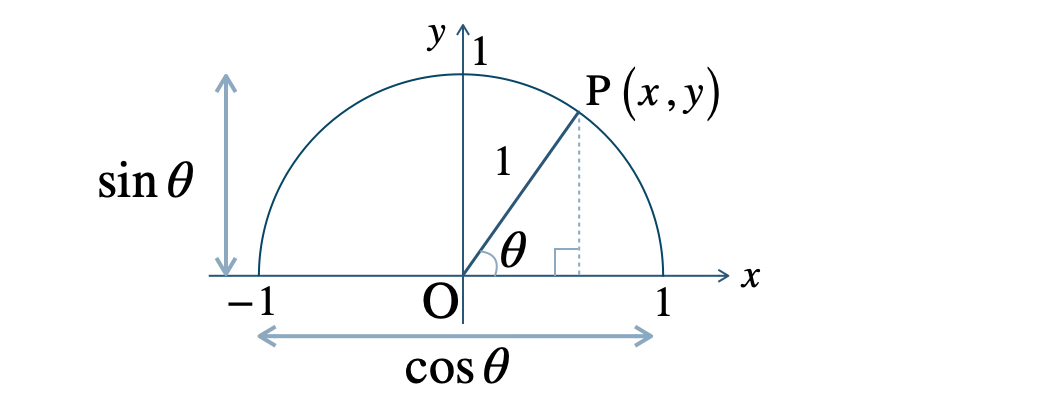
半径 \(1\) の半円について、
線分 \({\rm OP}\) と \(x\) 軸の正の部分とのなす角 \(\theta\) と点 \({\rm P}(x~,~y)\) の座標の範囲について、
\(-1{\small ~≦~}x{\small ~≦~}1~,~0{\small ~≦~}y{\small ~≦~}1\)
これより、半径 \(1\) であるので \(\sin \theta=y~,~\cos \theta=x\) とすると、
\(0{\small ~≦~}\sin \theta{\small ~≦~}1~,~-1{\small ~≦~}\cos \theta{\small ~≦~}1\)
また、\(\tan \theta=\displaystyle \frac{\,y\,}{\,x\,}\) より、
\(\tan\) の値は直線 \({\rm OP}\) の傾きと等しくなるので、
\(\theta \neq 90^\circ\) で \(\tan \theta\) はすべての実数値をとる