
第4章 式と曲線

文字数が多く、重くなるのでページを分割しています。
各章は下のリンクまたはページ下の「次へ」をクリックしてください。
数研出版数学C 第1章 平面のベクトル
数研出版数学C 第2章 空間のベクトル
数研出版数学C 第3章 複素数平面
数研出版数学C 第4章 式と曲線
第4章 式と曲線
第1節 2次曲線
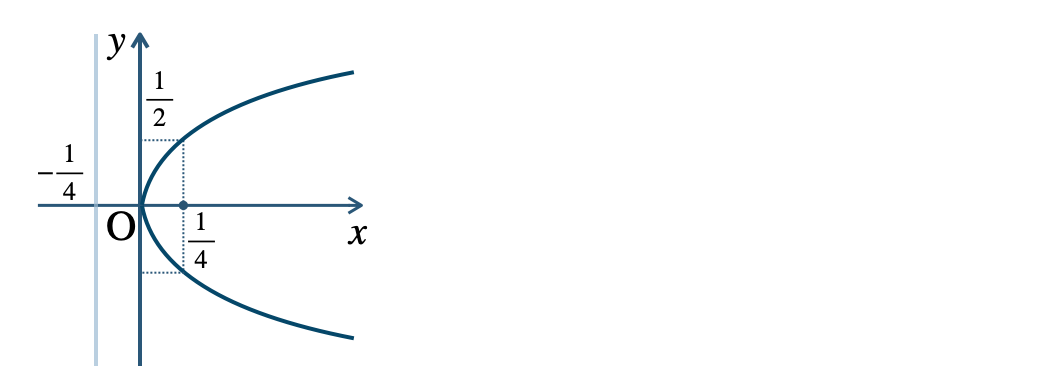
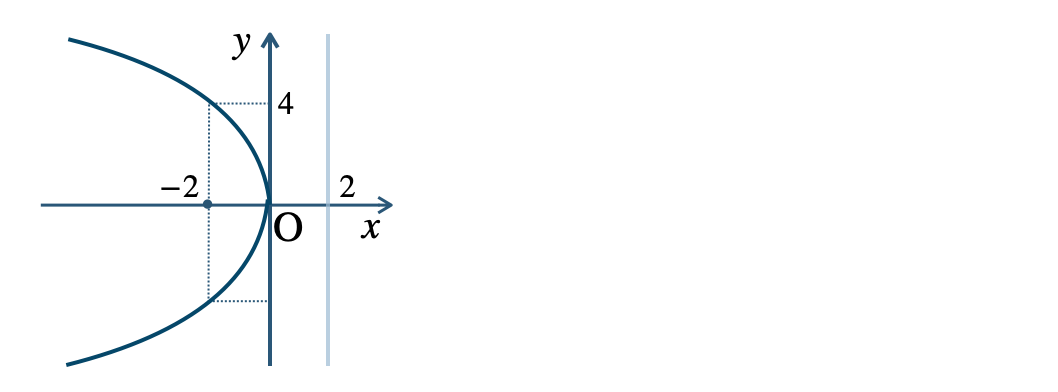
\({\small (2)}~\)焦点 \(\left(-\displaystyle \frac{\,1\,}{\,2\,}~,~0 \right)\)、準線 \(x=\displaystyle \frac{\,1\,}{\,2\,}\)
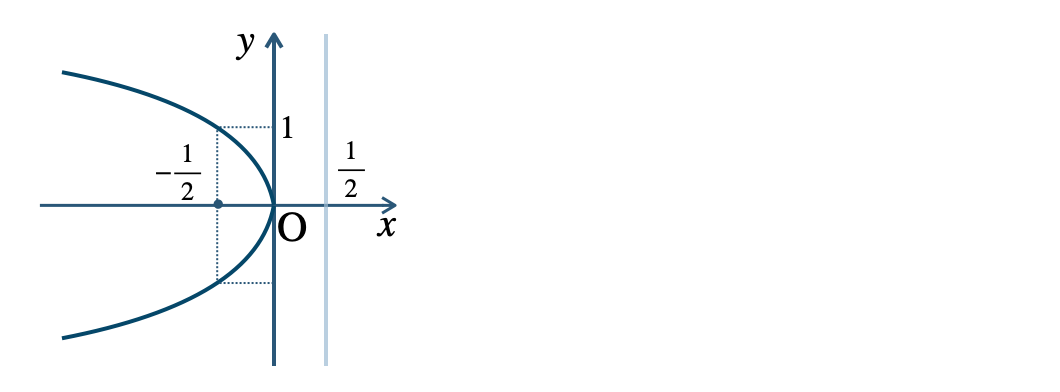
解法のPoint|放物線の方程式と焦点・準線
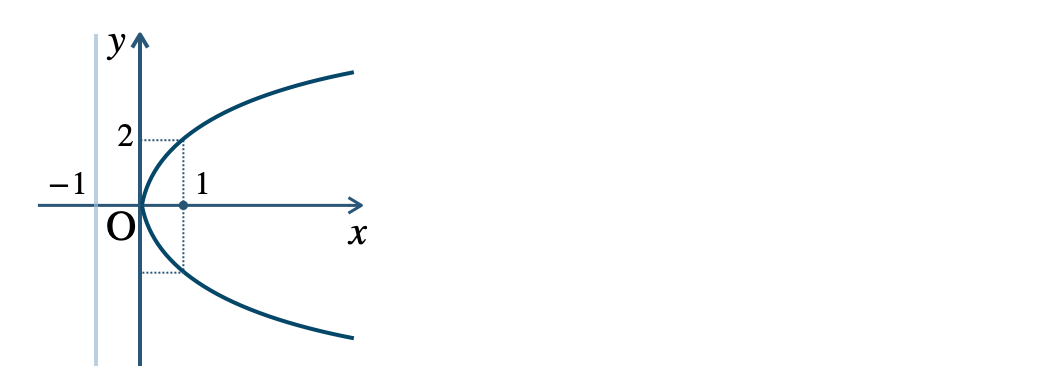
解法のPoint|放物線の方程式と焦点・準線
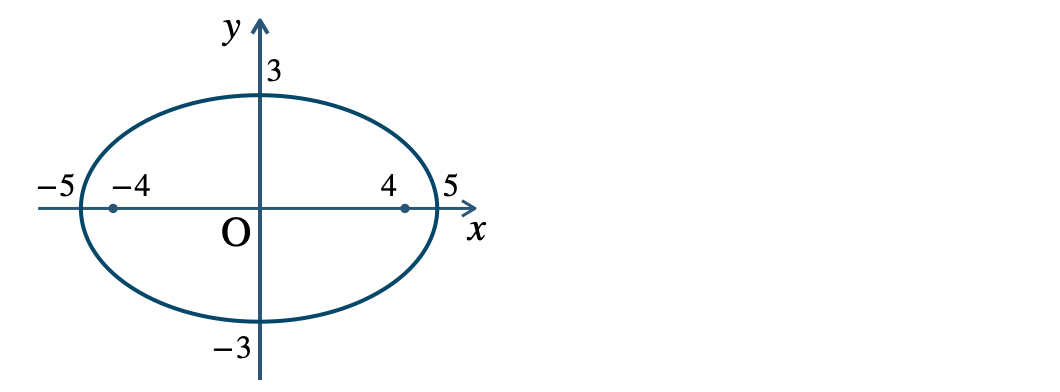
焦点 \((4~,~0)~,~(-4~,~0)\)
頂点 \((5~,~0)~,~(-5~,~0)~,~(0~,~3)~,~(0~,~-3)\)
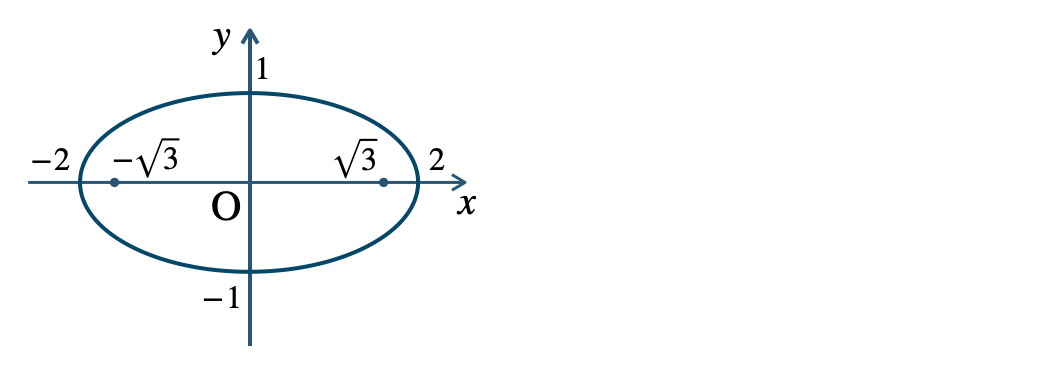
\({\small (2)}~\)長軸 \(4\)、短軸 \(2\)
焦点 \((\sqrt{3}~,~0)~,~(-\sqrt{3}~,~0)\)
頂点 \((2~,~0)~,~(-2~,~0)~,~(0~,~1)~,~(0~,~-1)\)
解法のPoint|楕円の方程式と概形
解法のPoint|楕円の方程式の決定
解法のPoint|楕円の方程式の決定
焦点 \((0~,~1)~,~(0~,~-1)\)
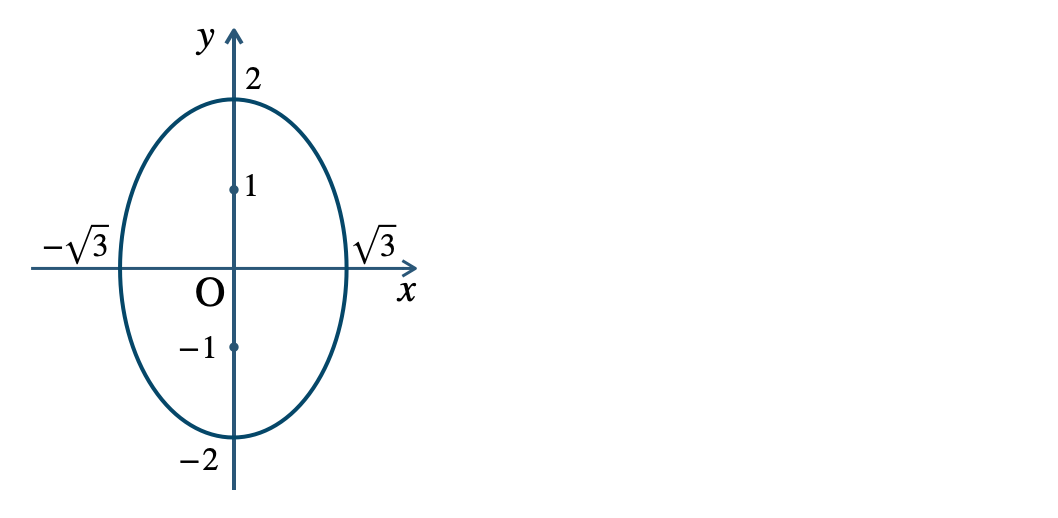
\({\small (2)}~\)長軸 \(3\)、短軸 \(2\)
焦点 \(\left(0~,~\displaystyle \frac{\,\sqrt{5}\,}{\,2\,}\right)~,~\left(0~,~-\displaystyle \frac{\,\sqrt{5}\,}{\,2\,}\right)\)
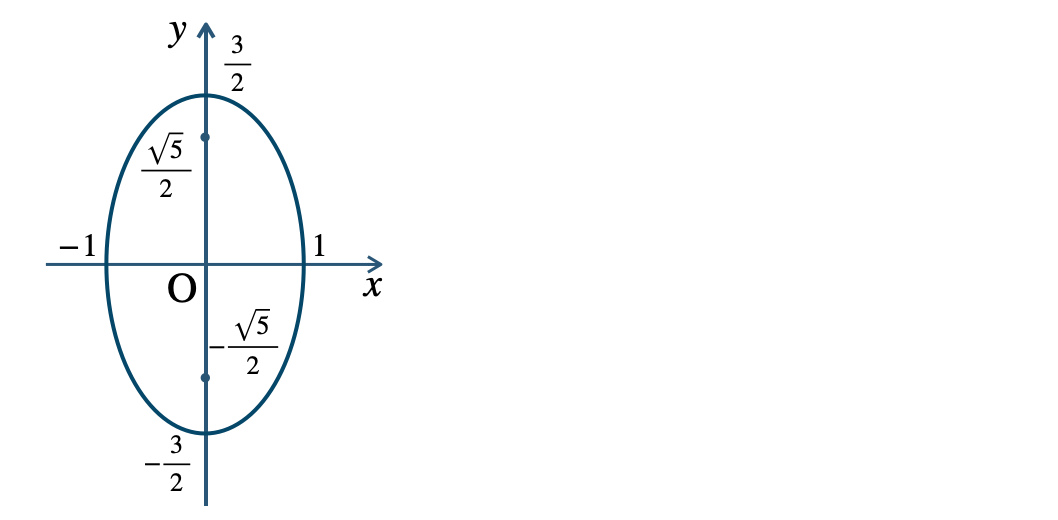
解法のPoint|楕円の方程式と概形
解法のPoint|円と楕円の関係
\({\small (2)}~\displaystyle \frac{\,x^2\,}{\,36\,}+\displaystyle \frac{\,y^2\,}{\,16\,}=1\)
解法のPoint|円と楕円の関係
■ この問題の詳しい解説はこちら!
■ この問題の詳しい解説はこちら!
焦点 \((5~,~0)~,~(-5~,~0)\)
漸近線\(~~~\displaystyle \frac{\,x\,}{\,3\,}-\displaystyle \frac{\,y\,}{\,4\,}=0~,~\displaystyle \frac{\,x\,}{\,3\,}+\displaystyle \frac{\,y\,}{\,4\,}=0\)
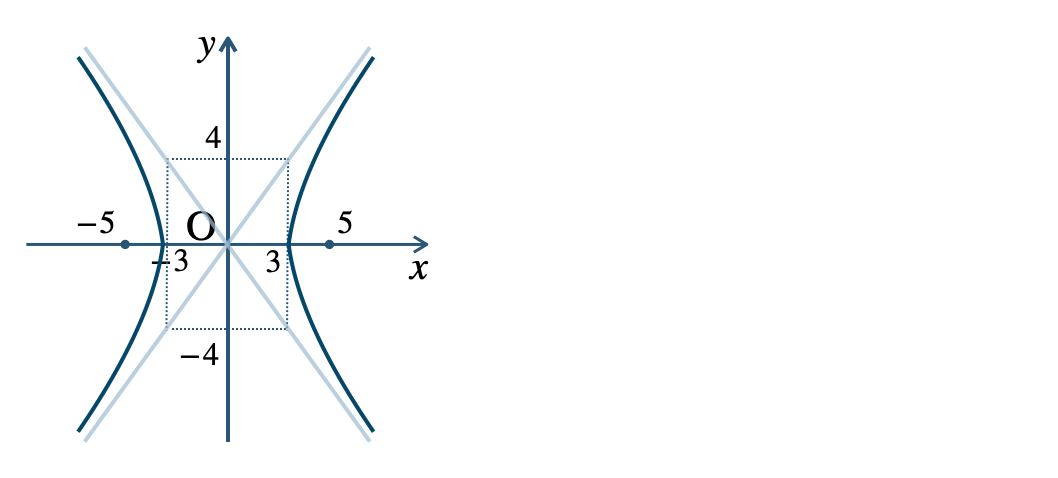
\({\small (2)}~\)頂点 \((1~,~0)~,~(-1~,~0)\)
焦点 \((\sqrt{2}~,~0)~,~(-\sqrt{2}~,~0)\)
漸近線\(~~~x-y=0~,~x+y=0\)
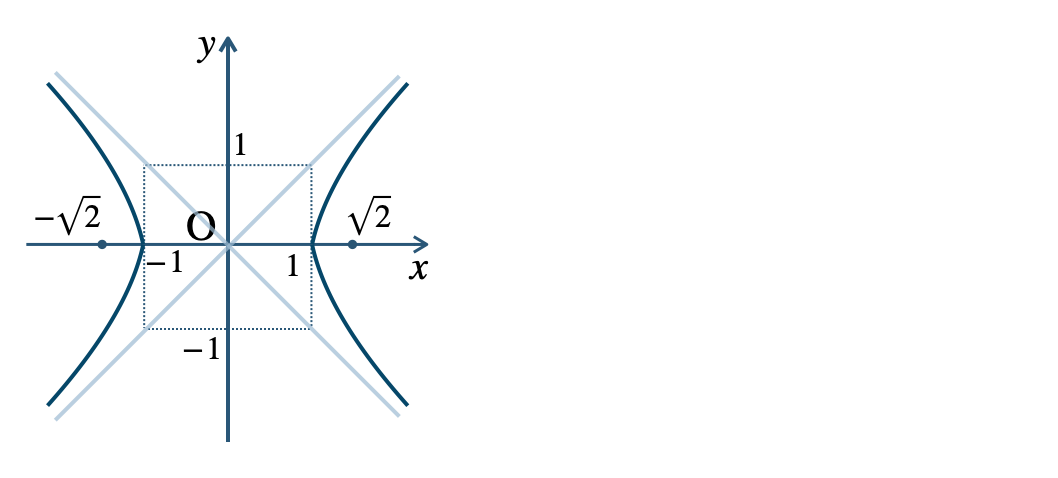
解法のPoint|双曲線の方程式と概形
解法のPoint|双曲線の方程式の決定
解法のPoint|双曲線の方程式の決定
焦点 \((0~,~\sqrt{41})~,~(0~,~-\sqrt{41})\)
漸近線\(~~~\displaystyle \frac{\,x\,}{\,5\,}-\displaystyle \frac{\,y\,}{\,4\,}=0~,~\displaystyle \frac{\,x\,}{\,5\,}+\displaystyle \frac{\,y\,}{\,4\,}=0\)
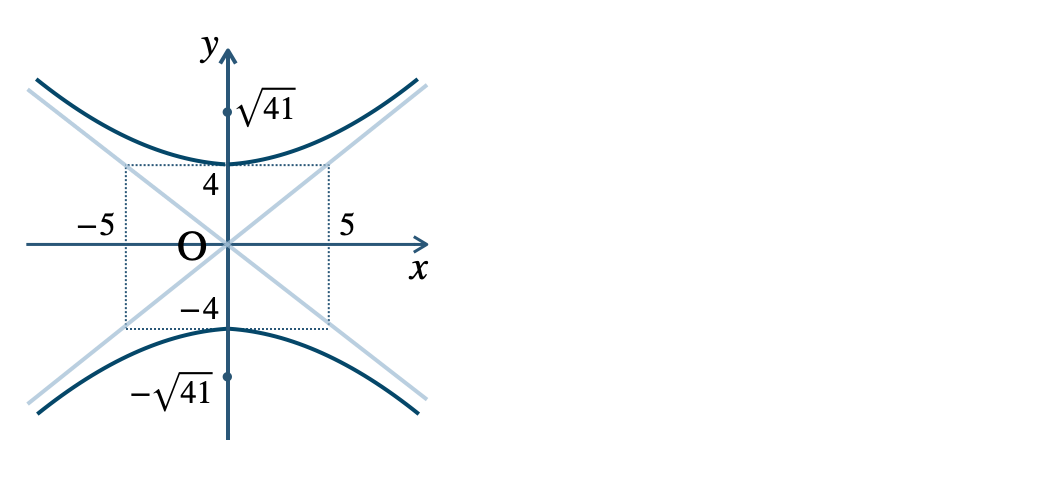
\({\small (2)}~\)頂点 \((0~,~\sqrt{6})~,~(0~,~-\sqrt{6})\)
焦点 \((0~,~\sqrt{10})~,~(0~,~-\sqrt{10})\)
漸近線\(~~~\displaystyle \frac{\,x\,}{\,2\,}-\displaystyle \frac{\,y\,}{\,\sqrt{6}\,}=0~,~\displaystyle \frac{\,x\,}{\,2\,}+\displaystyle \frac{\,y\,}{\,\sqrt{6}\,}=0\)
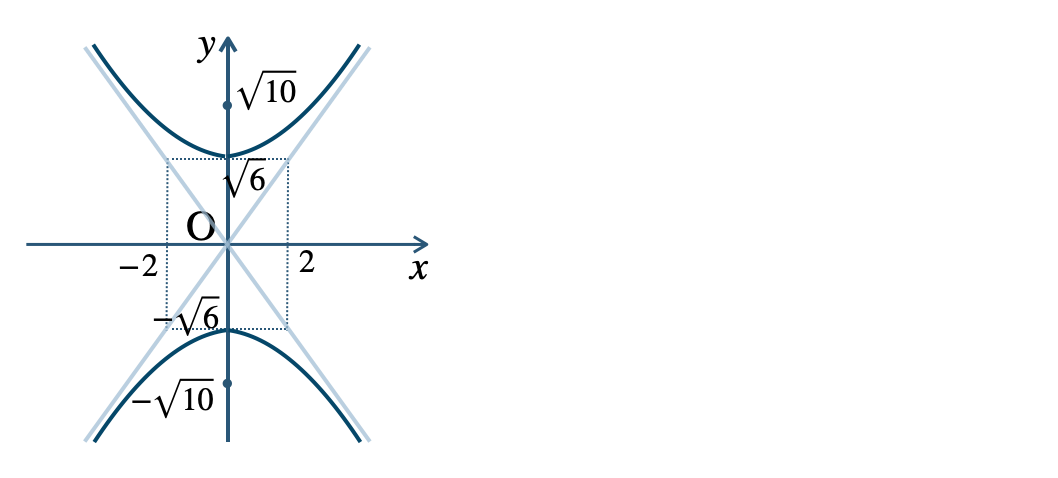
解法のPoint|双曲線の方程式と概形
\({\small (2)}~\displaystyle \frac{\,x^2\,}{\,4\,}-\displaystyle \frac{\,y^2\,}{\,4\,}=-1\)
解法のPoint|直角双曲線の方程式
焦点 \((\sqrt{3}-2~,~3)~,~(-\sqrt{3}-2~,~3)\)
\({\small (2)}~\displaystyle \frac{\,(x+2)^2\,}{\,4\,}-\displaystyle \frac{\,(y-3)^2\,}{\,9\,}=1\)
焦点 \((\sqrt{13}-2~,~3)~,~(-\sqrt{13}-2~,~3)\)
\({\small (3)}~(y-3)^2=4(x+2)\) 焦点 \((-1~,~3)\)
解法のPoint|平行移動した2次曲線の方程式
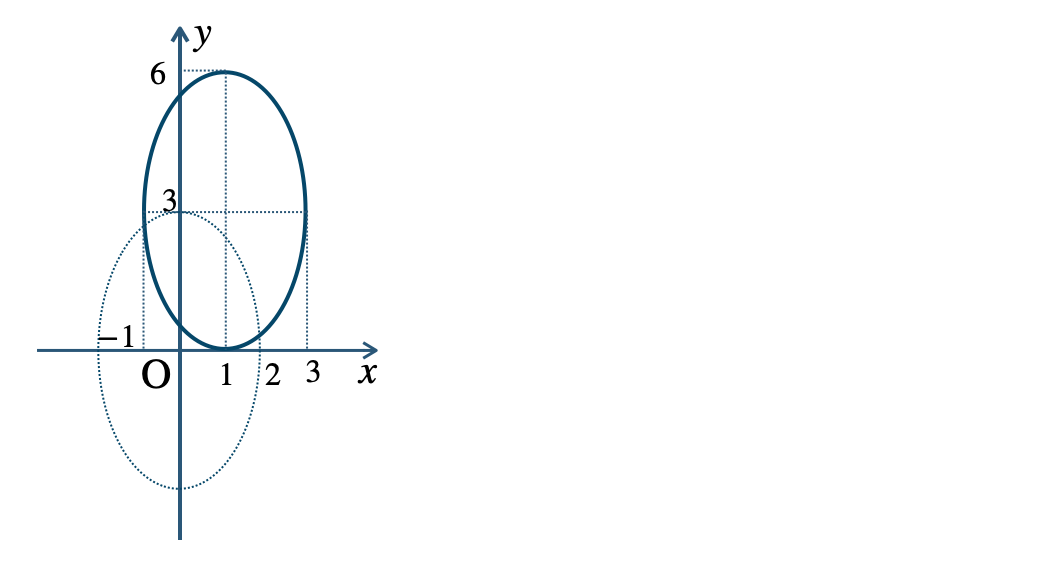
\({\small (2)}~\)双曲線 \(\displaystyle \frac{\,x^2\,}{\,4\,}-y^2=1\) を \(x\) 軸方向に \(-1\)、\(y\) 軸方向に \(-2\) だけ平行移動させた双曲線
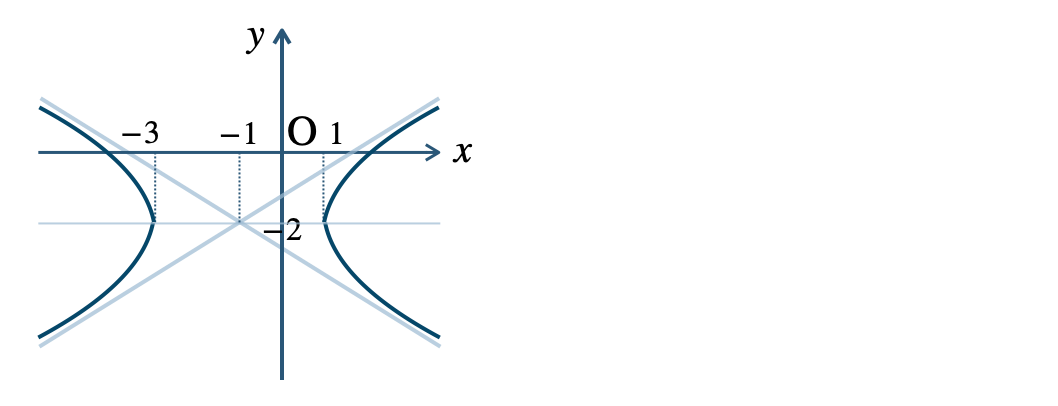
解法のPoint|x,yの2次方程式と2次曲線
\(\begin{eqnarray}~~~y^2-6y-4x-7&=&0\\[2pt]~~~y^2-6y+9&=&4x+16\\[2pt]~~~(y-3)^2&=&4(x+4)\end{eqnarray}\)
これより、放物線 \(y^2=4x\) を \(x\) 軸方向に \(-4\)、\(y\) 軸方向に \(3\) だけ平行移動させた放物線 [終]
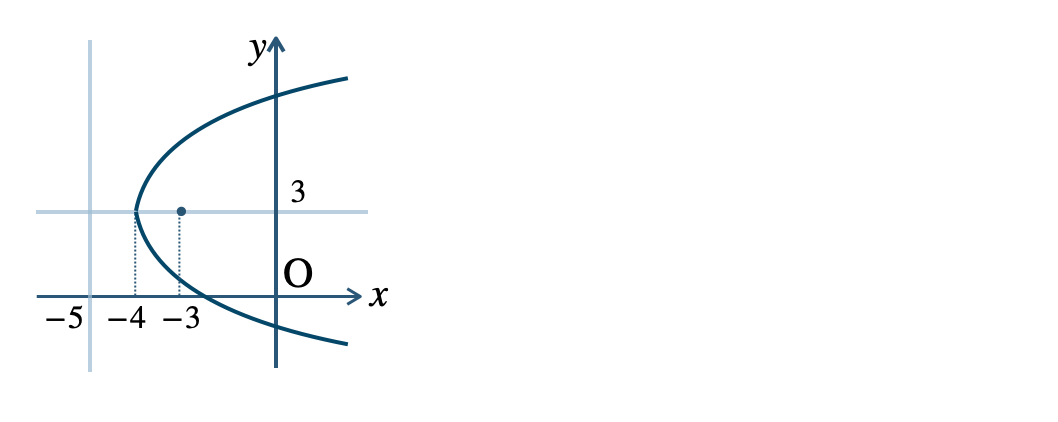
頂点 \((-4~,~3)\)、焦点 \((-3~,~3)\)、準線\(x=-5\)
解法のPoint|x,yの2次方程式と2次曲線
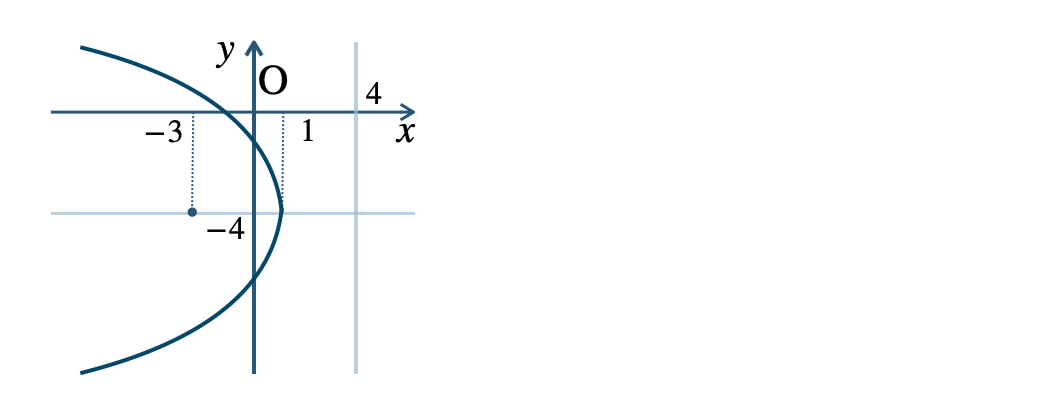
解法のPoint|x,yの2次方程式と2次曲線
\({\small (2)}~\left(\displaystyle \frac{\,2\,}{\,\sqrt{3}\,}~,~\displaystyle \frac{\,1\,}{\,\sqrt{3}\,} \right)~,~\left(-\displaystyle \frac{\,2\,}{\,\sqrt{3}\,}~,~-\displaystyle \frac{\,1\,}{\,\sqrt{3}\,} \right)\)
\({\small (3)}~(2~,~4)\)
解法のPoint|2次曲線と直線の共有点の座標
\(k\lt -2~,~2\lt k\) のとき、2個
\(k=\pm 2\) のとき、1個
\(-2\lt k\lt 2\) のとき、0個
\({\small (2)}~\)
\(-1 \lt k \lt 1\) のとき、2個
\(k{\small ~≦~}-1~,~1{\small ~≦~}k\) のとき、0個
解法のPoint|2次曲線と直線の共有点の個数
解法のPoint|曲線と直線との交点の中点の座標
解法のPoint|曲線外の点から引いた接線の方程式
\(\begin{eqnarray}~~~{y_1}^2&=&4x_1~~~\cdots {\small [\,1\,]}
\\[3pt]~~~{y_2}^2&=&4x_2~~~\cdots {\small [\,2\,]}\end{eqnarray}\)
ここで、\(y_1=y_2\) だとすると、\(2\) 点 \({\rm P}\) 、\({\rm Q}\) が一致してしまうので、\(y_1 \neq y_2\) となる
また、\(y^2=4x=4 \cdot 1 \cdot x\) 上の点 \({\rm P}(x_1~,~y_1)\) 、\({\rm Q}(x_2~,~y_2)\) における接線の方程式は、それぞれ
\(\begin{eqnarray}~~~y_1y&=&2(x+x_1)~~~\cdots {\small [\,3\,]}
\\[3pt]~~~y_2y&=&2(x+x_2)~~~\cdots {\small [\,4\,]}\end{eqnarray}\)
接線の交点 \({\rm R}\) の座標は、\({\small [\,3\,]}\) と \({\small [\,4\,]}\) を連立させると、
\({\small [\,3\,]}-{\small [\,4\,]}\) より、
\(\begin{eqnarray}~~~y_1y-y_2y&=&2(x+x_1)-2(x+x_2)
\\[3pt]~~~(y_1-y_2)y&=&2x+2x_1-2x-2x_2
\\[3pt]~~~(y_1-y_2)y&=&2(x_1-x_2)\end{eqnarray}\)
\(y_1 \neq y_2\) より両辺を \(y_1-y_2\) で割ると、
\(\begin{eqnarray}~~~y&=&\displaystyle \frac{\,2(x_1-x_2)\,}{\,y_1-y_2\,}
\\[5pt]~~~&=&2 \cdot \displaystyle \frac{\,x_1-x_2\,}{\,y_1-y_2\,}\end{eqnarray}\)
また、\({\small [\,1\,]}\) 、\({\small [\,2\,]}\) より、\(x_1=\displaystyle \frac{\,{y_1}^2\,}{\,4\,}~,~x_2=\displaystyle \frac{\,{y_2}^2\,}{\,4\,}\) を代入すると、
\(\begin{eqnarray}~~~y&=&2 \cdot \displaystyle \frac{\,\displaystyle \frac{\,{y_1}^2\,}{\,4\,}-\displaystyle \frac{\,{y_2}^2\,}{\,4\,}\,}{\,y_1-y_2\,}
\\[5pt]~~~&=&2 \cdot \displaystyle \frac{\,1\,}{\,4\,} \cdot \displaystyle \frac{\,{y_1}^2-{y_2}^2\,}{\,y_1-y_2\,}
\\[5pt]~~~&=&\displaystyle \frac{\,1\,}{\,2\,} \cdot \displaystyle \frac{\,(y_1+y_2)(y_1-y_2)\,}{\,y_1-y_2\,}
\\[5pt]~~~&=&\displaystyle \frac{\,y_1+y_2\,}{\,2\,}\end{eqnarray}\)
よって、点 \({\rm R}\) の \(y\) 座標は \(\displaystyle \frac{\,y_1+y_2\,}{\,2\,}\) となる
ここで、中点の公式より、線分 \({\rm PQ}\) の中点 \({\rm M}\) の \(y\) 座標は、
\(\displaystyle \frac{\,y_1+y_2\,}{\,2\,}\)
したがって、点 \({\rm R}\) と点 \({\rm M}\) の \(y\) 座標が等しいので、直線 \({\rm RM}\) は \(x\) 軸に平行である [終]
■ この問題の詳しい解説はこちら!
\({\small (2)}~3x+2y=5\)
解法のPoint|楕円・双曲線の接線の方程式
点 \({\rm P}\) と点 \({\rm F}(4~,~0)\) からの距離 \({\rm PF}\) は、
\({\rm PF}=\sqrt{\,(x-4)^2+y^2\,}~~~\cdots {\small [\,1\,]}\)
点 \({\rm P}\) から直線 \(x=1\) に下ろした垂線の足を \({\rm H}\) とすると、
直線 \(x=1\) 上の点 \({\rm H}\) からの距離 \({\rm PH}\) は、
\({\rm PH}=|\, x-1 \,|~~~\cdots {\small [\,2\,]}\)
距離の比が \(2:1\) のとき、\({\rm PF}:{\rm PH}=2:1\) より、
\(\begin{eqnarray}~~~{\rm PF}&=&2{\rm PH}
\\[3pt]~~~{\rm PF}^2&=&4{\rm PH}^2\end{eqnarray}\)
\({\small [\,1\,]}\) 、\({\small [\,2\,]}\) より、
\\[3pt]~~~x^2-8x+16+y^2&=&4(x^2-2x+1)
\\[3pt]~~~x^2-8x+16+y^2&=&4x^2-8x+4
\\[3pt]~~~x^2-8x+16+y^2-4x^2+8x-4&=&0
\\[3pt]~~~-3x^2+12+y^2&=&0
\\[3pt]~~~3x^2-y^2&=&12\end{eqnarray}\)
※ 数式は横にスクロールできます。
両辺を \(12\) で割ると、
\(\begin{eqnarray}~~~\displaystyle \frac{\,3x^2\,}{\,12\,}-\displaystyle \frac{\,y^2\,}{\,12\,}&=&\displaystyle \frac{\,12\,}{\,12\,}
\\[5pt]~~~\displaystyle \frac{\,x^2\,}{\,4\,}-\displaystyle \frac{\,y^2\,}{\,12\,}&=&1~~~\cdots {\small [\,3\,]}\end{eqnarray}\)
これより、条件を満たす点 \({\rm P}\) はこの双曲線 \({\small [\,3\,]}\) 上にあり、逆にこの双曲線上の点はすべて条件を満たす
したがって、点 \({\rm P}\) の軌跡は、双曲線 \(\displaystyle \frac{\,x^2\,}{\,4\,}-\displaystyle \frac{\,y^2\,}{\,12\,}=1\) となる [終]
[証明] 双曲線 \(\displaystyle \frac{\,x^2\,}{\,4\,}-\displaystyle \frac{\,y^2\,}{\,12\,}=1\) の焦点の \(x\) 座標を \(c~(c\gt 0)\) とすると、
\(\begin{eqnarray}~~~c&=&\sqrt{\,4+12\,}
\\[3pt]~~~&=&\sqrt{\,16\,}
\\[3pt]~~~&=&4\end{eqnarray}\)
よって、焦点の座標は \((4~,~0)\) 、\((-4~,~0)\) となるので、
したがって、点 \({\rm F}(4~,~0)\) は、双曲線 \(\displaystyle \frac{\,x^2\,}{\,4\,}-\displaystyle \frac{\,y^2\,}{\,12\,}=1\) の焦点の \(1\) つである [終]
■ この問題の詳しい解説はこちら!
問題
解法のPoint|放物線の方程式の決定
\({\small (2)}~\displaystyle \frac{\,x^2\,}{\,36\,}+\displaystyle \frac{\,y^2\,}{\,24\,}=1\)
解法のPoint|楕円の方程式の決定
\({\small (3)}~\displaystyle \frac{\,x^2\,}{\,5\,}-\displaystyle \frac{\,y^2\,}{\,4\,}=1\)
\({\small (4)}~\displaystyle \frac{\,5\,}{\,4\,}x^2-5y^2=-1\)
解法のPoint|双曲線の方程式の決定
\({\small (2)}~2\) 点 \((4~,~2)~,~(2~,~2)\)
\({\small (3)}~2\) 点 \((-1~,~0)~,~(-1~,~-4)\)
解法のPoint|x,yの2次方程式と2次曲線
\({\small (2)}~\)双曲線 \(\displaystyle \frac{\,(x-5)^2\,}{\,16\,}-\displaystyle \frac{\,(y+1)^2\,}{\,9\,}=1\)
\({\small (3)}~\)放物線 \((y-1)^2=-4(x-2)\)
■ この問題の詳しい解説はこちら!
\({\small (4)}~\)双曲線 \(\displaystyle \frac{\,(x-4)^2\,}{\,8\,}-\displaystyle \frac{\,y^2\,}{\,8\,}=1\)
■ この問題の詳しい解説はこちら!
解法のPoint|曲線と直線との交点の中点の座標

第2節 媒介変数表示と極座標
\({\small (2)}~\)放物線 \(y=x^2+1\) の \(x{\small ~≧~}0\)
解法のPoint|媒介変数表示の曲線の概形
解法のPoint|放物線の媒介変数表示
\({\small (2)}~x=\sqrt{3}\cos{\theta}~,~y=\sqrt{3}\sin{\theta}\)
解法のPoint|円・楕円・双曲線の媒介変数表示
\({\small (2)}~x=2\cos{\theta}~,~y=5\sin{\theta}\)
解法のPoint|円・楕円・双曲線の媒介変数表示
\({\small (2)}~x=\displaystyle \frac{\,2\,}{\,\cos{\theta}\,}~,~y=\sqrt{3}\tan{\theta}\)
解法のPoint|円・楕円・双曲線の媒介変数表示
\({\small (2)}~\)双曲線\(~~~\displaystyle \frac{\,(x-3)^2\,}{\,9\,}-\displaystyle \frac{\,(y-1)^2\,}{\,4\,}=1\)
解法のPoint|媒介変数表示の曲線の平行移動
\({\small (3)}~(3\pi+2~,~2)\) \({\small (4)}~(4\pi~,~0)\)
■ この問題の詳しい解説はこちら!

\({\small (3)}~\left( \displaystyle \frac{\,3\,}{\,\sqrt{2}\,}~,~-\displaystyle \frac{\,3\,}{\,\sqrt{2}\,} \right)\)
解法のPoint|極座標の表し方と直交座標に変換
\({\small (3)}~\left(2~,~\displaystyle \frac{\,7\,}{\,6\,}\pi \right)\)
解法のPoint|直交座標の点を極座標に変換
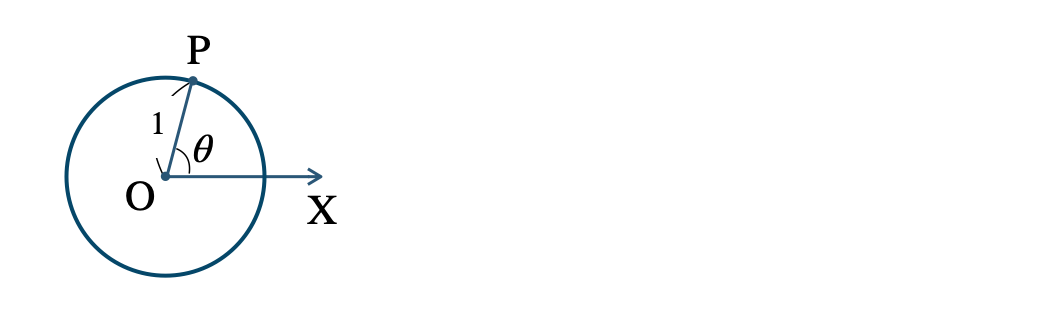
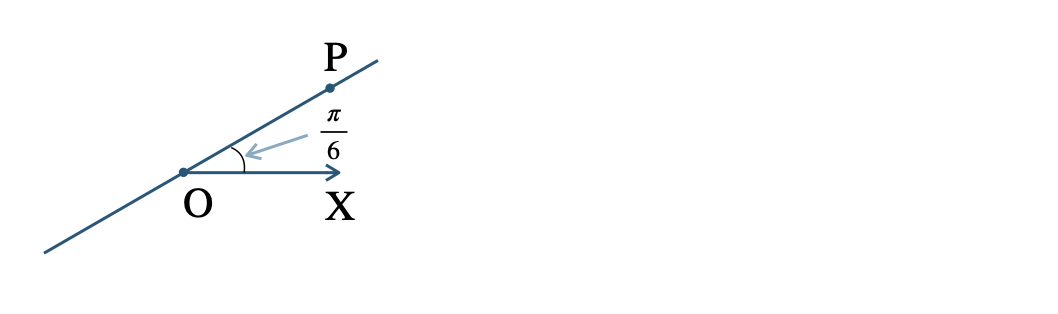
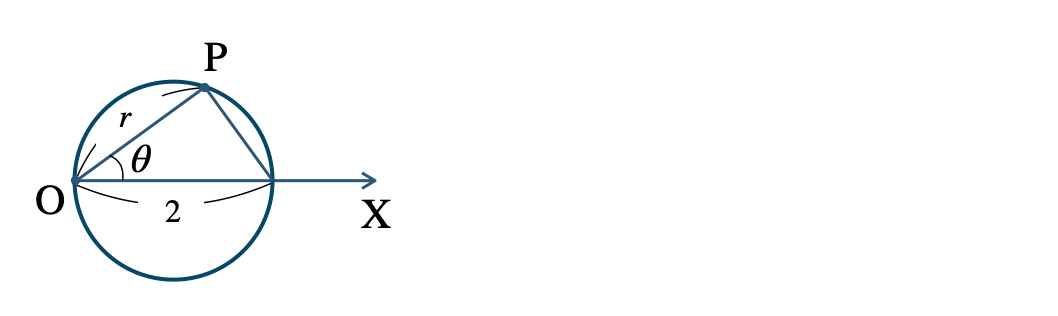
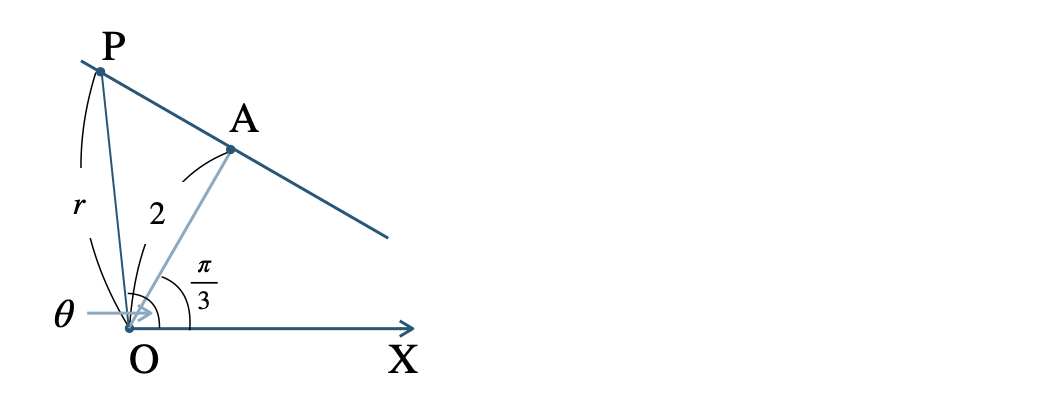
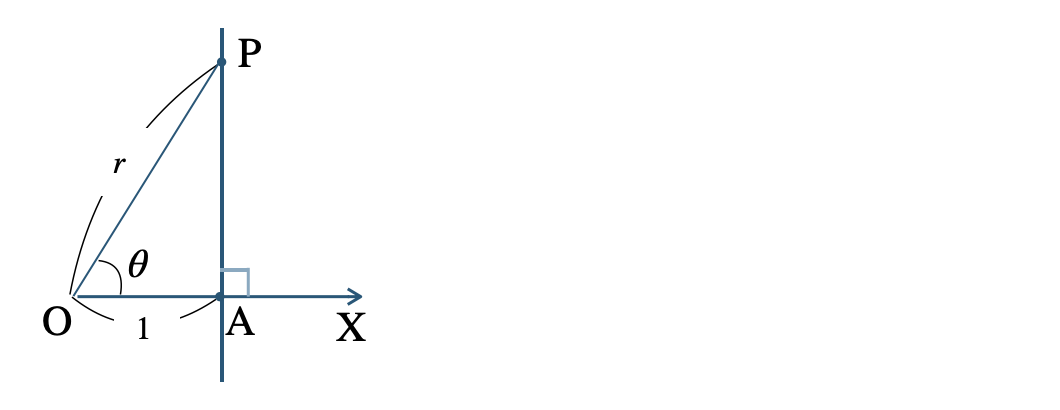
\({\small (3)}~y=x+1\)
解法のPoint|極方程式を直交座標の方程式に変換
\({\small (2)}~r=2\cos{\theta}\)
解法のPoint|直交座標の方程式を極方程式に変換
問題
\({\small (2)}~\)放物線 \(y=-\displaystyle \frac{\,x^2\,}{\,2\,}+\displaystyle \frac{\,x\,}{\,2\,}\) の \(x{\small ~≧~}0\) の部分
\({\small (3)}~\)放物線 \(y=x^2-2\) の \(x{\small ~≧~}2\) の部分
解法のPoint|媒介変数表示の曲線の概形
\({\small (4)}~\)双曲線 \(x^2-y^2=-1\)
\({\small (5)}~\)放物線 \(y=2x^2-1\) の \(-1{\small ~≦~}x{\small ~≦~}1\) の部分
解法のPoint|媒介変数表示の曲線の平行移動
\({\small [\,1\,]}~\theta \gt \theta_1\) のとき、
\(\angle {\rm POC}=\theta-\theta_1\) となるので、
\(\triangle {\rm POC}\) の余弦定理より、
\\[3pt]~~~a^2&=&r^2+r_1^2-2rr_1\cos (\theta-\theta_1)
\\[3pt]~~~r^2+r_1^2-2rr_1\cos (\theta-\theta_1)&=&a^2\end{eqnarray}\)
※ 数式は横にスクロールできます。
\({\small [\,2\,]}~\theta \lt \theta_1\) のとき、
\(\angle {\rm COP}=\theta_1-\theta\) となるので、
\(\triangle {\rm COP}\) の余弦定理より、
\\[3pt]~~~a^2&=&r^2+r_1^2-2rr_1\cos (\theta_1-\theta)
\\[3pt]~~~r^2+r_1^2-2rr_1\cos (\theta_1-\theta)&=&a^2\end{eqnarray}\)
※ 数式は横にスクロールできます。
ここで、
\(\begin{eqnarray}~~~\cos (\theta_1-\theta)&=&\cos \left\{\,-(\theta-\theta_1)\,\right\}
\\[3pt]~~~&=&\cos (\theta-\theta_1)\end{eqnarray}\)
これより、
\(r^2+r_1^2-2rr_1\cos (\theta-\theta_1)=a^2\)
\({\small [\,3\,]}~\theta=\theta_1\) のとき、
点 \({\rm P}\) は半直線 \({\rm OC}\) 上にあるので、
\({\rm OP}=r_1-a\) または \({\rm OP}=r_1+a\)
これより、\(r=r_1-a~,~r_1+a\) となる
ここで、\(r^2+r_1^2-2rr_1\cos (\theta-\theta_1)=a^2\) に \(\theta=\theta_1\) を代入すると、
\(\begin{eqnarray}~~~r^2+r_1^2-2rr_1\cos 0&=&a^2
\\[3pt]~~~r^2-2r_1r+r_1^2&=&a^2
\\[3pt]~~~(r-r_1)^2&=&a^2
\\[3pt]~~~r-r_1&=&\pm a
\\[3pt]~~~r&=&r_1-a~,~r_1+a\end{eqnarray}\)
よって、\({\small [\,3\,]}\) のときも極方程式は成り立つ
\({\small [\,1\,]}~,~{\small [\,2\,]}~,~{\small [\,3\,]}\) より、
\(r^2+r_1^2-2rr_1\cos (\theta-\theta_1)=a^2\)
逆に、この極方程式を満たす点は条件を満たす
したがって、極方程式は \(r^2+r_1^2-2rr_1\cos (\theta-\theta_1)=a^2\) となる [終]
■ この問題の詳しい解説はこちら!
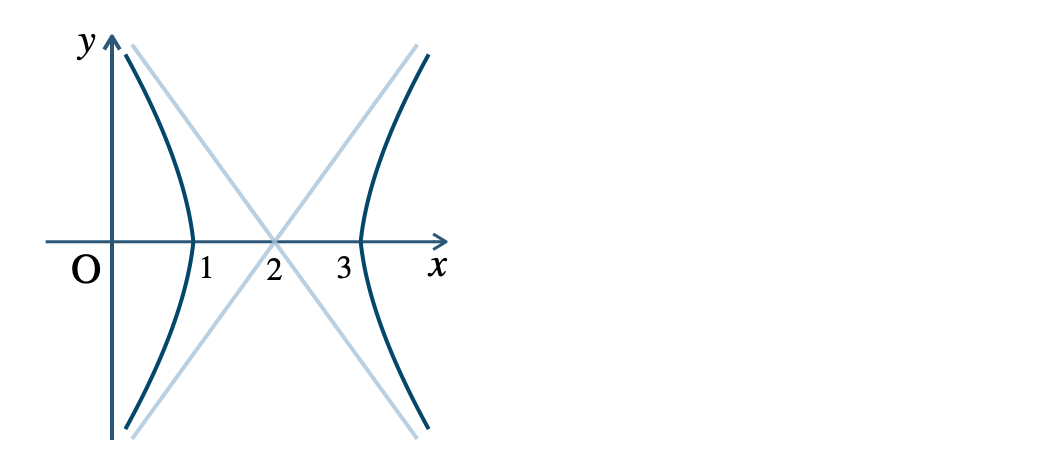
ここで、棒の長さが \(5\) 、壁と棒のなす角が \(\theta\) なので、下端 \({\rm B}\) の \(x\) 座標は
\(5\sin \theta\)
また、点 \({\rm P}\) は下端 \({\rm B}\) から棒に沿って \(2\) だけ上にあるので、点 \({\rm B}\) から見た点 \({\rm P}\) の \(x\) 軸方向、\(y\) 軸方向の移動量は
\(-2\sin \theta~,~2\cos \theta\)
これより、点 \({\rm P}\) の \(x\) 座標は、
\(\begin{eqnarray}~~~x&=&5\sin \theta-2\sin \theta
\\[3pt]~~~&=&3\sin \theta\end{eqnarray}\)
点 \({\rm P}\) の \(y\) 座標は、
\(y=2\cos \theta\)
よって、\(\sin \theta=\displaystyle \frac{\,x\,}{\,3\,}~,~\cos \theta=\displaystyle \frac{\,y\,}{\,2\,}\) となり、\(\sin^2 \theta+\cos^2 \theta=1\) に代入すると、
\(\begin{eqnarray}~~~\left(\displaystyle \frac{\,x\,}{\,3\,}\right)^2+\left(\displaystyle \frac{\,y\,}{\,2\,}\right)^2&=&1
\\[5pt]~~~\displaystyle \frac{\,x^2\,}{\,9\,}+\displaystyle \frac{\,y^2\,}{\,4\,}&=&1\end{eqnarray}\)
また、棒が壁に立てかけられた状態から床に倒れるまで動くので、
\(0{\small ~≦~}\theta{\small ~≦~}\displaystyle \frac{\,\pi\,}{\,2\,}\)
となり、
\(x{\small ~≧~}0~,~y{\small ~≧~}0\)
したがって、点 \({\rm P}\) は楕円 \(\displaystyle \frac{\,x^2\,}{\,9\,}+\displaystyle \frac{\,y^2\,}{\,4\,}=1\) の \(x{\small ~≧~}0~,~y{\small ~≧~}0\) の部分にあるので、楕円の一部を描く [終]
■ この問題の詳しい解説はこちら!
演習問題 式と曲線
\(\left(0~,~\displaystyle \frac{\,\sqrt{\,70\,}\,}{\,3\,}\right)~,~\left(0~,~-\displaystyle \frac{\,\sqrt{\,70\,}\,}{\,3\,}\right)\)
解法のPoint|双曲線の方程式の決定
直線 \(y=4x\) の \(-\displaystyle \frac{\,\sqrt{\,5\,}\,}{\,5\,}\lt x\lt\displaystyle \frac{\,\sqrt{\,5\,}\,}{\,5\,}\) の部分
■ この問題の詳しい解説はこちら!
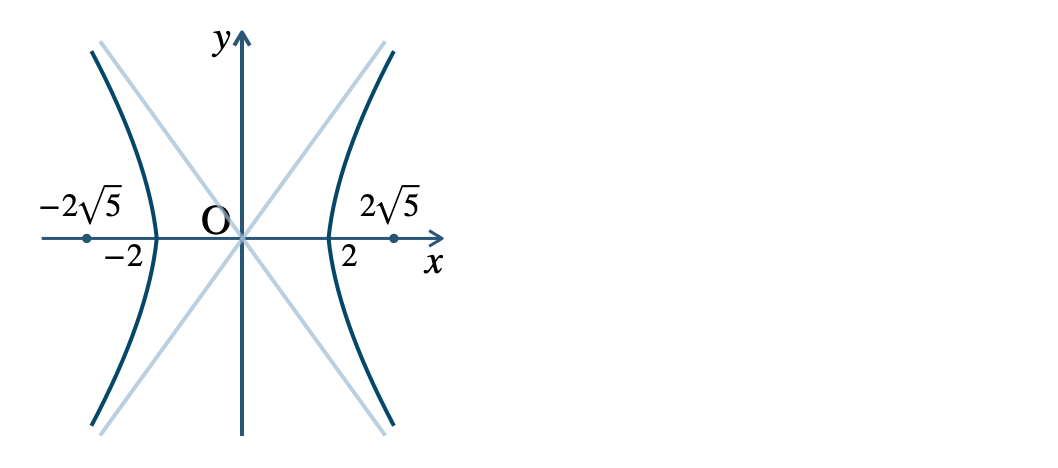
解法のPoint|媒介変数表示の曲線の概形
■ この問題の詳しい解説はこちら!
\({\small (2)}~\)直線 \(x=-p\)
■ この問題の詳しい解説はこちら!
\(2\) 定点 \({\rm A}(-a~,~0)~,~\)\({\rm B}(a~,~0)\) からの距離の積が \(a^2\) に等しいので、
\({\rm AP} \cdot {\rm BP}=a^2\)
ここで、\(2\) 点間の距離より、
\(\begin{eqnarray}~~~{\rm AP}&=&\sqrt{\,\left\{\,x-(-a)\,\right\}^2+(y-0)^2\,}
\\[3pt]~~~&=&\sqrt{\,(x+a)^2+y^2\,}\end{eqnarray}\)
\(\begin{eqnarray}~~~{\rm BP}&=&\sqrt{\,(x-a)^2+(y-0)^2\,}
\\[3pt]~~~&=&\sqrt{\,(x-a)^2+y^2\,}\end{eqnarray}\)
これより、
\(\sqrt{\,(x+a)^2+y^2\,} \cdot \sqrt{\,(x-a)^2+y^2\,}=a^2\)
両辺は \(0\) 以上なので、両辺を \(2\) 乗すると、
\(\left\{\,(x+a)^2+y^2\,\right\}\left\{\,(x-a)^2+y^2\,\right\}=a^4\)
ここで、
\(\begin{eqnarray}~~~(x+a)^2+y^2&=&x^2+2ax+a^2+y^2
\\[3pt]~~~&=&(x^2+y^2+a^2)+2ax\end{eqnarray}\)
\(\begin{eqnarray}~~~(x-a)^2+y^2&=&x^2-2ax+a^2+y^2
\\[3pt]~~~&=&(x^2+y^2+a^2)-2ax\end{eqnarray}\)
これより、
\\[3pt]~~~(x^2+y^2+a^2)^2-(2ax)^2&=&a^4
\\[3pt]~~~(x^2+y^2)^2+2a^2(x^2+y^2)+a^4-4a^2x^2&=&a^4
\\[3pt]~~~(x^2+y^2)^2+2a^2(x^2+y^2)-4a^2x^2&=&0
\\[3pt]~~~(x^2+y^2)^2&=&4a^2x^2-2a^2(x^2+y^2)
\\[3pt]~~~&=&4a^2x^2-2a^2x^2-2a^2y^2
\\[3pt]~~~&=&2a^2x^2-2a^2y^2
\\[3pt]~~~&=&2a^2(x^2-y^2)\end{eqnarray}\)
※ 数式は横にスクロールできます。
逆に、この方程式を満たす点 \({\rm P}\) は条件を満たす
したがって、レムニスケートの方程式は \((x^2+y^2)^2=2a^2(x^2-y^2)\) となる [終]
\({\small (2)}~r^2=2a^2\cos 2\theta\)
■ この問題の詳しい解説はこちら!