このページは、「合成関数の定義域」の練習問題アーカイブページとなります。
この問題の解き方の詳細は↓
合成関数の定義域 で確認できます。
問題アーカイブ01
問題アーカイブ01関数 \(f_1(x)=1-x~,~\)\(f_2(x)=\displaystyle \frac{\,1\,}{\,1-x\,}~,~\)\(f_3(x)=\displaystyle \frac{\,x\,}{\,x-1\,}~,~\)\(f_4(x)=\displaystyle \frac{\,x-1\,}{\,x\,}\) について、次のことを示せ。
\({\small (1)}~(f_1\circ f_3)(x)=f_2(x)\)
\({\small (2)}~(f_4\circ f_2)(x)=(f_3\circ f_3)(x)\)
\({\small (3)}~{f_4}^{-1}(x)=f_2(x)\)
\({\small (1)}~(f_1\circ f_3)(x)=f_2(x)\)
\({\small (2)}~(f_4\circ f_2)(x)=(f_3\circ f_3)(x)\)
\({\small (3)}~{f_4}^{-1}(x)=f_2(x)\)
数研出版|数学Ⅲ[708] p.23 演習問題A 4
▼ クリックして「より詳しい解説」を開く
\(f_1(x)=1-x~,~\)\(f_2(x)=\displaystyle \frac{\,1\,}{\,1-x\,}~,~\)\(f_3(x)=\displaystyle \frac{\,x\,}{\,x-1\,}~,~\)\(f_4(x)=\displaystyle \frac{\,x-1\,}{\,x\,}\) より、
\(f_1(x)\) の定義域は実数全体、値域は実数全体
\(f_2(x)\) の定義域は \(x\neq 1\) 、値域は \(y\neq 0\)
\(f_3(x)\) の定義域は \(x\neq 1\) 、値域は \(y\neq 1\)
\(f_4(x)\) の定義域は \(x\neq 0\) 、値域は \(y\neq 1\)
\({\small (1)}~\)\((f_1\circ f_3)(x)\) は、
\(f_3(x)\) の値域が \(f_1(x)\) の定義域に含まれるので、
\((f_1\circ f_3)(x)=f_1(f_3(x))\) となり、
\(\begin{eqnarray}~~~f_1(f_3(x))&=&1-f_3(x)
\\[5pt]~~~&=&1-\displaystyle \frac{\,x\,}{\,x-1\,}
\\[5pt]~~~&=&\displaystyle \frac{\,x-1\,}{\,x-1\,}-\displaystyle \frac{\,x\,}{\,x-1\,}
\\[5pt]~~~&=&\displaystyle \frac{\,(x-1)-x\,}{\,x-1\,}
\\[5pt]~~~&=&\displaystyle \frac{\,-1\,}{\,x-1\,}
\\[5pt]~~~&=&\displaystyle \frac{\,1\,}{\,1-x\,}
\\[5pt]~~~&=&f_2(x)\end{eqnarray}\)
定義域は \(f_3(x)\) の定義域 \(x\neq 1\) となり、\(f_2(x)\) の定義域と一致する
したがって、
\((f_1\circ f_3)(x)=f_2(x)\) が成り立つ
\({\small (2)}~\)\((f_4\circ f_2)(x)\) は、
\(f_2(x)\) の値域が \(f_4(x)\) の定義域に含まれるので、
\((f_4\circ f_2)(x)=f_4(f_2(x))\) となり、
\(\begin{eqnarray}~~~f_4(f_2(x))&=&\displaystyle \frac{\,f_2(x)-1\,}{\,f_2(x)\,}
\\[5pt]~~~&=&\displaystyle \frac{\,\displaystyle \frac{\,1\,}{\,1-x\,}-1\,}{\,\displaystyle \frac{\,1\,}{\,1-x\,}\,}
\\[5pt]~~~&=&\displaystyle \frac{\,\left(\displaystyle \frac{\,1\,}{\,1-x\,}-1\right){\, \small \times \,}(1-x)\,}{\,\displaystyle \frac{\,1\,}{\,1-x\,}{\, \small \times \,}(1-x)\,}
\\[5pt]~~~&=&\displaystyle \frac{\,1-(1-x)\,}{\,1\,}
\\[5pt]~~~&=&1-1+x
\\[3pt]~~~&=&x\end{eqnarray}\)
定義域は \(f_2(x)\) の定義域 \(x\neq 1\) となる
次に、\((f_3\circ f_3)(x)\) は、
\(f_3(x)\) の値域が \(f_3(x)\) の定義域に含まれるので、
\((f_3\circ f_3)(x)=f_3(f_3(x))\) となり、
\(\begin{eqnarray}~~~f_3(f_3(x))&=&\displaystyle \frac{\,f_3(x)\,}{\,f_3(x)-1\,}
\\[5pt]~~~&=&\displaystyle \frac{\,\displaystyle \frac{\,x\,}{\,x-1\,}\,}{\,\displaystyle \frac{\,x\,}{\,x-1\,}-1\,}
\\[5pt]~~~&=&\displaystyle \frac{\,\displaystyle \frac{\,x\,}{\,x-1\,}{\, \small \times \,}(x-1)\,}{\,\left(\displaystyle \frac{\,x\,}{\,x-1\,}-1\right){\, \small \times \,}(x-1)\,}
\\[5pt]~~~&=&\displaystyle \frac{\,x\,}{\,x-(x-1)\,}
\\[5pt]~~~&=&\displaystyle \frac{\,x\,}{\,1\,}
\\[5pt]~~~&=&x\end{eqnarray}\)
定義域は \(f_3(x)\) の定義域 \(x\neq 1\) となる
したがって、
\((f_4\circ f_2)(x)\) と \((f_3\circ f_3)(x)\) はどちらも \(x\) 、定義域 \(x\neq 1\) となるので、\((f_4\circ f_2)(x)=(f_3\circ f_3)(x)\) が成り立つ
\({\small (3)}~\)\( y=\displaystyle \frac{\,x-1\,}{\,x\,} \) より、
分子を「分母の1次式の倍数+定数」に式変形すると、
\( x-1=1 \cdot x-1 \)
これより、
\(\begin{eqnarray}~~~y&=&\displaystyle \frac{\,x-1\,}{\,x\,}
\\[5pt]~~~&=&\displaystyle \frac{\,1 \cdot x-1\,}{\,x\,}
\\[5pt]~~~&=&\displaystyle \frac{\,1 \cdot x\,}{\,x\,}-\displaystyle \frac{\,1\,}{\,x\,}
\\[5pt]~~~&=&1-\displaystyle \frac{\,1\,}{\,x\,}
\\[5pt]~~~&=&-\displaystyle \frac{\,1\,}{\,x\,}+1
\end{eqnarray}\)
よって、値域は \( y\neq 1 \)
次に、分数関数を \( x \) について解くと、
\(\begin{eqnarray}~~~y&=&\displaystyle \frac{\,x-1\,}{\,x\,}
\\[5pt]~~~xy&=&x-1
\\[3pt]~~~xy-x&=&-1
\\[3pt]~~~(y-1)x&=&-1
\\[3pt]~~~(1-y)x&=&1
\end{eqnarray}\)
\( y\neq 1 \) より、\(1-y\) で割ると、
\(\hspace{38pt} x=\displaystyle \frac{\,1\,}{\,1-y\,} \)
\( x \) と \( y \) を入れ替えて逆関数を求めると、
\( y=\displaystyle \frac{\,1\,}{\,1-x\,} \)
また、もとの関数の値域が逆関数の定義域となるので、
\( x\neq 1 \)
これより、
\( {f_4}^{-1}(x)=\displaystyle \frac{\,1\,}{\,1-x\,}~~(\,x\neq 1\,)\)
したがって、
\({f_4}^{-1}(x)\) は \(f_2(x)\) と式も定義域も一致するので、\({f_4}^{-1}(x)=f_2(x)\) が成り立つ
\(f_1(x)\) の定義域は実数全体、値域は実数全体
\(f_2(x)\) の定義域は \(x\neq 1\) 、値域は \(y\neq 0\)
\(f_3(x)\) の定義域は \(x\neq 1\) 、値域は \(y\neq 1\)
\(f_4(x)\) の定義域は \(x\neq 0\) 、値域は \(y\neq 1\)
\({\small (1)}~\)\((f_1\circ f_3)(x)\) は、
\(f_3(x)\) の値域が \(f_1(x)\) の定義域に含まれるので、
\((f_1\circ f_3)(x)=f_1(f_3(x))\) となり、
\(\begin{eqnarray}~~~f_1(f_3(x))&=&1-f_3(x)
\\[5pt]~~~&=&1-\displaystyle \frac{\,x\,}{\,x-1\,}
\\[5pt]~~~&=&\displaystyle \frac{\,x-1\,}{\,x-1\,}-\displaystyle \frac{\,x\,}{\,x-1\,}
\\[5pt]~~~&=&\displaystyle \frac{\,(x-1)-x\,}{\,x-1\,}
\\[5pt]~~~&=&\displaystyle \frac{\,-1\,}{\,x-1\,}
\\[5pt]~~~&=&\displaystyle \frac{\,1\,}{\,1-x\,}
\\[5pt]~~~&=&f_2(x)\end{eqnarray}\)
定義域は \(f_3(x)\) の定義域 \(x\neq 1\) となり、\(f_2(x)\) の定義域と一致する
したがって、
\((f_1\circ f_3)(x)=f_2(x)\) が成り立つ
\({\small (2)}~\)\((f_4\circ f_2)(x)\) は、
\(f_2(x)\) の値域が \(f_4(x)\) の定義域に含まれるので、
\((f_4\circ f_2)(x)=f_4(f_2(x))\) となり、
\(\begin{eqnarray}~~~f_4(f_2(x))&=&\displaystyle \frac{\,f_2(x)-1\,}{\,f_2(x)\,}
\\[5pt]~~~&=&\displaystyle \frac{\,\displaystyle \frac{\,1\,}{\,1-x\,}-1\,}{\,\displaystyle \frac{\,1\,}{\,1-x\,}\,}
\\[5pt]~~~&=&\displaystyle \frac{\,\left(\displaystyle \frac{\,1\,}{\,1-x\,}-1\right){\, \small \times \,}(1-x)\,}{\,\displaystyle \frac{\,1\,}{\,1-x\,}{\, \small \times \,}(1-x)\,}
\\[5pt]~~~&=&\displaystyle \frac{\,1-(1-x)\,}{\,1\,}
\\[5pt]~~~&=&1-1+x
\\[3pt]~~~&=&x\end{eqnarray}\)
定義域は \(f_2(x)\) の定義域 \(x\neq 1\) となる
次に、\((f_3\circ f_3)(x)\) は、
\(f_3(x)\) の値域が \(f_3(x)\) の定義域に含まれるので、
\((f_3\circ f_3)(x)=f_3(f_3(x))\) となり、
\(\begin{eqnarray}~~~f_3(f_3(x))&=&\displaystyle \frac{\,f_3(x)\,}{\,f_3(x)-1\,}
\\[5pt]~~~&=&\displaystyle \frac{\,\displaystyle \frac{\,x\,}{\,x-1\,}\,}{\,\displaystyle \frac{\,x\,}{\,x-1\,}-1\,}
\\[5pt]~~~&=&\displaystyle \frac{\,\displaystyle \frac{\,x\,}{\,x-1\,}{\, \small \times \,}(x-1)\,}{\,\left(\displaystyle \frac{\,x\,}{\,x-1\,}-1\right){\, \small \times \,}(x-1)\,}
\\[5pt]~~~&=&\displaystyle \frac{\,x\,}{\,x-(x-1)\,}
\\[5pt]~~~&=&\displaystyle \frac{\,x\,}{\,1\,}
\\[5pt]~~~&=&x\end{eqnarray}\)
定義域は \(f_3(x)\) の定義域 \(x\neq 1\) となる
したがって、
\((f_4\circ f_2)(x)\) と \((f_3\circ f_3)(x)\) はどちらも \(x\) 、定義域 \(x\neq 1\) となるので、\((f_4\circ f_2)(x)=(f_3\circ f_3)(x)\) が成り立つ
\({\small (3)}~\)\( y=\displaystyle \frac{\,x-1\,}{\,x\,} \) より、
分子を「分母の1次式の倍数+定数」に式変形すると、
\( x-1=1 \cdot x-1 \)
これより、
\(\begin{eqnarray}~~~y&=&\displaystyle \frac{\,x-1\,}{\,x\,}
\\[5pt]~~~&=&\displaystyle \frac{\,1 \cdot x-1\,}{\,x\,}
\\[5pt]~~~&=&\displaystyle \frac{\,1 \cdot x\,}{\,x\,}-\displaystyle \frac{\,1\,}{\,x\,}
\\[5pt]~~~&=&1-\displaystyle \frac{\,1\,}{\,x\,}
\\[5pt]~~~&=&-\displaystyle \frac{\,1\,}{\,x\,}+1
\end{eqnarray}\)
よって、値域は \( y\neq 1 \)
次に、分数関数を \( x \) について解くと、
\(\begin{eqnarray}~~~y&=&\displaystyle \frac{\,x-1\,}{\,x\,}
\\[5pt]~~~xy&=&x-1
\\[3pt]~~~xy-x&=&-1
\\[3pt]~~~(y-1)x&=&-1
\\[3pt]~~~(1-y)x&=&1
\end{eqnarray}\)
\( y\neq 1 \) より、\(1-y\) で割ると、
\(\hspace{38pt} x=\displaystyle \frac{\,1\,}{\,1-y\,} \)
\( x \) と \( y \) を入れ替えて逆関数を求めると、
\( y=\displaystyle \frac{\,1\,}{\,1-x\,} \)
また、もとの関数の値域が逆関数の定義域となるので、
\( x\neq 1 \)
これより、
\( {f_4}^{-1}(x)=\displaystyle \frac{\,1\,}{\,1-x\,}~~(\,x\neq 1\,)\)
したがって、
\({f_4}^{-1}(x)\) は \(f_2(x)\) と式も定義域も一致するので、\({f_4}^{-1}(x)=f_2(x)\) が成り立つ
問題アーカイブ02
問題アーカイブ02\(2\) つの関数 \(f(x)=\displaystyle \frac{\,1\,}{\,1-x\,}~,~\)\(g(x)=\displaystyle \frac{\,x\,}{\,x-1\,}\) について、次の合成関数を求めよ。
\({\small (1)}~f(g(x))\)
\({\small (2)}~g(g(x))\)
\({\small (1)}~f(g(x))\)
\({\small (2)}~g(g(x))\)
数研出版|高等学校数学Ⅲ[709] p.22 章末問題B 6
▼ クリックして「より詳しい解説」を開く
\(f(x)=\displaystyle \frac{\,1\,}{\,1-x\,}~,~g(x)=\displaystyle \frac{\,x\,}{\,x-1\,}\) より、
\(f(x)\) の定義域は \(x\neq 1\) 、値域は \(y\neq 0\)
\(g(x)\) の定義域は \(x\neq 1\) 、値域は \(y\neq 1\)
\({\small (1)}~\)\(f(g(x))\) は、
\(g(x)\) の値域が \(f(x)\) の定義域に含まれるので、
\((f\circ g)(x)=f(g(x))\) となり、
\(\begin{eqnarray}~~~f(g(x))&=&\displaystyle \frac{\,1\,}{\,1-g(x)\,}
\\[5pt]~~~&=&\displaystyle \frac{\,1\,}{\,1-\displaystyle \frac{\,x\,}{\,x-1\,}\,}
\\[5pt]~~~&=&\displaystyle \frac{\,1{\, \small \times \,}(x-1)\,}{\,\left(1-\displaystyle \frac{\,x\,}{\,x-1\,}\right){\, \small \times \,}(x-1)\,}
\\[5pt]~~~&=&\displaystyle \frac{\,x-1\,}{\,(x-1)-x\,}
\\[5pt]~~~&=&\displaystyle \frac{\,x-1\,}{\,-1\,}
\\[5pt]~~~&=&-(x-1)
\\[3pt]~~~&=&1-x\end{eqnarray}\)
したがって、
\(f(g(x))=1-x\) 、定義域 \(x\neq 1\)
\({\small (2)}~\)\(g(g(x))\) は、
\(g(x)\) の値域が \(g(x)\) の定義域に含まれるので、
\((g\circ g)(x)=g(g(x))\) となり、
\(\begin{eqnarray}~~~g(g(x))&=&\displaystyle \frac{\,g(x)\,}{\,g(x)-1\,}
\\[5pt]~~~&=&\displaystyle \frac{\,\displaystyle \frac{\,x\,}{\,x-1\,}\,}{\,\displaystyle \frac{\,x\,}{\,x-1\,}-1\,}
\\[5pt]~~~&=&\displaystyle \frac{\,\displaystyle \frac{\,x\,}{\,x-1\,}{\, \small \times \,}(x-1)\,}{\,\left(\displaystyle \frac{\,x\,}{\,x-1\,}-1\right){\, \small \times \,}(x-1)\,}
\\[5pt]~~~&=&\displaystyle \frac{\,x\,}{\,x-(x-1)\,}
\\[5pt]~~~&=&\displaystyle \frac{\,x\,}{\,1\,}
\\[5pt]~~~&=&x\end{eqnarray}\)
したがって、
\(g(g(x))=x\) 、定義域 \(x\neq 1\)
\(f(x)\) の定義域は \(x\neq 1\) 、値域は \(y\neq 0\)
\(g(x)\) の定義域は \(x\neq 1\) 、値域は \(y\neq 1\)
\({\small (1)}~\)\(f(g(x))\) は、
\(g(x)\) の値域が \(f(x)\) の定義域に含まれるので、
\((f\circ g)(x)=f(g(x))\) となり、
\(\begin{eqnarray}~~~f(g(x))&=&\displaystyle \frac{\,1\,}{\,1-g(x)\,}
\\[5pt]~~~&=&\displaystyle \frac{\,1\,}{\,1-\displaystyle \frac{\,x\,}{\,x-1\,}\,}
\\[5pt]~~~&=&\displaystyle \frac{\,1{\, \small \times \,}(x-1)\,}{\,\left(1-\displaystyle \frac{\,x\,}{\,x-1\,}\right){\, \small \times \,}(x-1)\,}
\\[5pt]~~~&=&\displaystyle \frac{\,x-1\,}{\,(x-1)-x\,}
\\[5pt]~~~&=&\displaystyle \frac{\,x-1\,}{\,-1\,}
\\[5pt]~~~&=&-(x-1)
\\[3pt]~~~&=&1-x\end{eqnarray}\)
したがって、
\(f(g(x))=1-x\) 、定義域 \(x\neq 1\)
\({\small (2)}~\)\(g(g(x))\) は、
\(g(x)\) の値域が \(g(x)\) の定義域に含まれるので、
\((g\circ g)(x)=g(g(x))\) となり、
\(\begin{eqnarray}~~~g(g(x))&=&\displaystyle \frac{\,g(x)\,}{\,g(x)-1\,}
\\[5pt]~~~&=&\displaystyle \frac{\,\displaystyle \frac{\,x\,}{\,x-1\,}\,}{\,\displaystyle \frac{\,x\,}{\,x-1\,}-1\,}
\\[5pt]~~~&=&\displaystyle \frac{\,\displaystyle \frac{\,x\,}{\,x-1\,}{\, \small \times \,}(x-1)\,}{\,\left(\displaystyle \frac{\,x\,}{\,x-1\,}-1\right){\, \small \times \,}(x-1)\,}
\\[5pt]~~~&=&\displaystyle \frac{\,x\,}{\,x-(x-1)\,}
\\[5pt]~~~&=&\displaystyle \frac{\,x\,}{\,1\,}
\\[5pt]~~~&=&x\end{eqnarray}\)
したがって、
\(g(g(x))=x\) 、定義域 \(x\neq 1\)
問題アーカイブ03
問題アーカイブ03\(2\) つの関数 \(f(x)=\displaystyle \frac{\,1\,}{\,1-x\,}~,~\)\(g(x)=\displaystyle \frac{\,x\,}{\,x-1\,}\) について、次の合成関数を求めよ。
\({\small (1)}~(f\circ g)(x)\)
\({\small (2)}~(g\circ g)(x)\)
\({\small (1)}~(f\circ g)(x)\)
\({\small (2)}~(g\circ g)(x)\)
数研出版|新編数学Ⅲ[710] p.23 章末問題B 7
▼ クリックして「より詳しい解説」を開く
\(f(x)=\displaystyle \frac{\,1\,}{\,1-x\,}~,~g(x)=\displaystyle \frac{\,x\,}{\,x-1\,}\) より、
\(f(x)\) の定義域は \(x\neq 1\) 、値域は \(y\neq 0\)
\(g(x)\) の定義域は \(x\neq 1\) 、値域は \(y\neq 1\)
\({\small (1)}~\)\((f\circ g)(x)\) は、
\(g(x)\) の値域が \(f(x)\) の定義域に含まれるので、
\((f\circ g)(x)=f(g(x))\) となり、
\(\begin{eqnarray}~~~f(g(x))&=&\displaystyle \frac{\,1\,}{\,1-g(x)\,}
\\[5pt]~~~&=&\displaystyle \frac{\,1\,}{\,1-\displaystyle \frac{\,x\,}{\,x-1\,}\,}
\\[5pt]~~~&=&\displaystyle \frac{\,1{\, \small \times \,}(x-1)\,}{\,\left(1-\displaystyle \frac{\,x\,}{\,x-1\,}\right){\, \small \times \,}(x-1)\,}
\\[5pt]~~~&=&\displaystyle \frac{\,x-1\,}{\,(x-1)-x\,}
\\[5pt]~~~&=&\displaystyle \frac{\,x-1\,}{\,-1\,}
\\[5pt]~~~&=&-(x-1)
\\[3pt]~~~&=&1-x\end{eqnarray}\)
したがって、
\((f\circ g)(x)=1-x\) 、定義域 \(x\neq 1\)
\({\small (2)}~\)\((g\circ g)(x)\) は、
\(g(x)\) の値域が \(g(x)\) の定義域に含まれるので、
\((g\circ g)(x)=g(g(x))\) となり、
\(\begin{eqnarray}~~~g(g(x))&=&\displaystyle \frac{\,g(x)\,}{\,g(x)-1\,}
\\[5pt]~~~&=&\displaystyle \frac{\,\displaystyle \frac{\,x\,}{\,x-1\,}\,}{\,\displaystyle \frac{\,x\,}{\,x-1\,}-1\,}
\\[5pt]~~~&=&\displaystyle \frac{\,\displaystyle \frac{\,x\,}{\,x-1\,}{\, \small \times \,}(x-1)\,}{\,\left(\displaystyle \frac{\,x\,}{\,x-1\,}-1\right){\, \small \times \,}(x-1)\,}
\\[5pt]~~~&=&\displaystyle \frac{\,x\,}{\,x-(x-1)\,}
\\[5pt]~~~&=&\displaystyle \frac{\,x\,}{\,1\,}
\\[5pt]~~~&=&x\end{eqnarray}\)
したがって、
\((g\circ g)(x)=x\) 、定義域 \(x\neq 1\)
\(f(x)\) の定義域は \(x\neq 1\) 、値域は \(y\neq 0\)
\(g(x)\) の定義域は \(x\neq 1\) 、値域は \(y\neq 1\)
\({\small (1)}~\)\((f\circ g)(x)\) は、
\(g(x)\) の値域が \(f(x)\) の定義域に含まれるので、
\((f\circ g)(x)=f(g(x))\) となり、
\(\begin{eqnarray}~~~f(g(x))&=&\displaystyle \frac{\,1\,}{\,1-g(x)\,}
\\[5pt]~~~&=&\displaystyle \frac{\,1\,}{\,1-\displaystyle \frac{\,x\,}{\,x-1\,}\,}
\\[5pt]~~~&=&\displaystyle \frac{\,1{\, \small \times \,}(x-1)\,}{\,\left(1-\displaystyle \frac{\,x\,}{\,x-1\,}\right){\, \small \times \,}(x-1)\,}
\\[5pt]~~~&=&\displaystyle \frac{\,x-1\,}{\,(x-1)-x\,}
\\[5pt]~~~&=&\displaystyle \frac{\,x-1\,}{\,-1\,}
\\[5pt]~~~&=&-(x-1)
\\[3pt]~~~&=&1-x\end{eqnarray}\)
したがって、
\((f\circ g)(x)=1-x\) 、定義域 \(x\neq 1\)
\({\small (2)}~\)\((g\circ g)(x)\) は、
\(g(x)\) の値域が \(g(x)\) の定義域に含まれるので、
\((g\circ g)(x)=g(g(x))\) となり、
\(\begin{eqnarray}~~~g(g(x))&=&\displaystyle \frac{\,g(x)\,}{\,g(x)-1\,}
\\[5pt]~~~&=&\displaystyle \frac{\,\displaystyle \frac{\,x\,}{\,x-1\,}\,}{\,\displaystyle \frac{\,x\,}{\,x-1\,}-1\,}
\\[5pt]~~~&=&\displaystyle \frac{\,\displaystyle \frac{\,x\,}{\,x-1\,}{\, \small \times \,}(x-1)\,}{\,\left(\displaystyle \frac{\,x\,}{\,x-1\,}-1\right){\, \small \times \,}(x-1)\,}
\\[5pt]~~~&=&\displaystyle \frac{\,x\,}{\,x-(x-1)\,}
\\[5pt]~~~&=&\displaystyle \frac{\,x\,}{\,1\,}
\\[5pt]~~~&=&x\end{eqnarray}\)
したがって、
\((g\circ g)(x)=x\) 、定義域 \(x\neq 1\)
問題アーカイブ04
問題アーカイブ04\(f(x)=\displaystyle \frac{\,1\,}{\,x-1\,}+2~,~\)\(g(x)=\displaystyle \frac{\,1\,}{\,x-3\,}+1\) であるとき、合成関数 \((f\circ g)(x)\) と \((g\circ f)(x)\) を求め、そのグラフをかけ。また、それぞれの定義域を求めよ。
東京書籍|Advanced数学Ⅲ[701] p.19 問6
▼ クリックして「より詳しい解説」を開く
\(f(x)=\displaystyle \frac{\,1\,}{\,x-1\,}+2~,~g(x)=\displaystyle \frac{\,1\,}{\,x-3\,}+1\) より、
\(f(x)\) の定義域は \(x\neq 1\) 、値域は \(y\neq 2\)
\(g(x)\) の定義域は \(x\neq 3\) 、値域は \(y\neq 1\)
\((f\circ g)(x)\) は、
\(g(x)\) の値域が \(f(x)\) の定義域に含まれるので、
\((f\circ g)(x)=f(g(x))\) となり、
\(\begin{eqnarray}~~~f(g(x))&=&\displaystyle \frac{\,1\,}{\,g(x)-1\,}+2
\\[5pt]~~~&=&\displaystyle \frac{\,1\,}{\,\displaystyle \frac{\,1\,}{\,x-3\,}+1-1\,}+2
\\[5pt]~~~&=&\displaystyle \frac{\,1\,}{\,\displaystyle \frac{\,1\,}{\,x-3\,}\,}+2
\\[5pt]~~~&=&(x-3)+2
\\[3pt]~~~&=&x-1\end{eqnarray}\)
したがって、
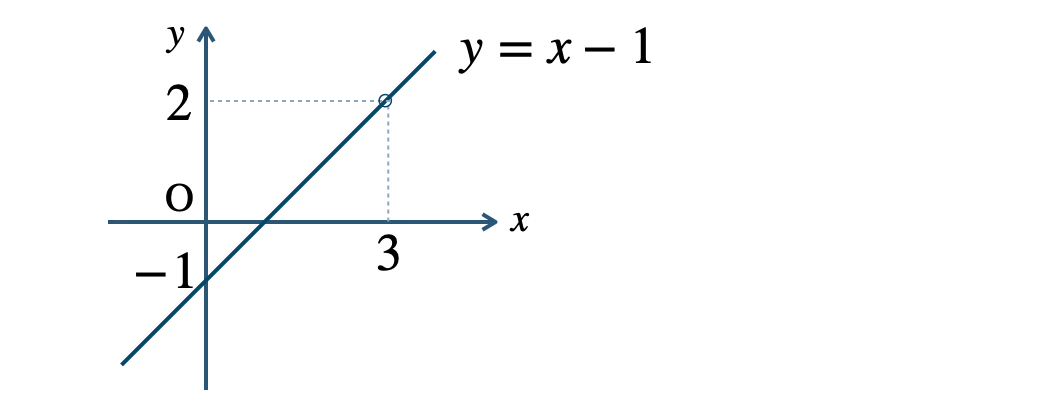
\((f\circ g)(x)=x-1\) 、定義域 \(x\neq 3\)
グラフは、直線 \(y=x-1\) から点 \((3~,~2)\) を除いたものとなる

次に、\((g\circ f)(x)\) は、
\(f(x)\) の値域が \(g(x)\) の定義域に含まれないので、
\(g(x)\) の定義域を \(f(x)\) が満たす条件式を立てると、
\(g(x)\) の定義域 \(x\neq 3\) より、
\(\begin{eqnarray}~~~f(x)=\displaystyle \frac{\,1\,}{\,x-1\,}+2&\neq &3
\\[5pt]~~~\displaystyle \frac{\,1\,}{\,x-1\,}&\neq &1
\\[5pt]~~~x-1&\neq &1
\\[3pt]~~~x&\neq &2\end{eqnarray}\)
このとき、\((g\circ f)(x)=g(f(x))\) より、
\(\begin{eqnarray}~~~g(f(x))&=&\displaystyle \frac{\,1\,}{\,f(x)-3\,}+1
\\[5pt]~~~&=&\displaystyle \frac{\,1\,}{\,\displaystyle \frac{\,1\,}{\,x-1\,}+2-3\,}+1
\\[5pt]~~~&=&\displaystyle \frac{\,1\,}{\,\displaystyle \frac{\,1\,}{\,x-1\,}-1\,}+1
\\[5pt]~~~&=&\displaystyle \frac{\,1{\, \small \times \,}(x-1)\,}{\,\left(\displaystyle \frac{\,1\,}{\,x-1\,}-1\right){\, \small \times \,}(x-1)\,}+1
\\[5pt]~~~&=&\displaystyle \frac{\,x-1\,}{\,1-(x-1)\,}+1
\\[5pt]~~~&=&\displaystyle \frac{\,x-1\,}{\,2-x\,}+1
\\[5pt]~~~&=&\displaystyle \frac{\,(x-1)+(2-x)\,}{\,2-x\,}
\\[5pt]~~~&=&\displaystyle \frac{\,1\,}{\,2-x\,}
\\[5pt]~~~&=&-\displaystyle \frac{\,1\,}{\,x-2\,}\end{eqnarray}\)
定義域は \(f(x)\) の定義域 \(x\neq 1\) かつ \(x\neq 2\) となる
したがって、
\((g\circ f)(x)=-\displaystyle \frac{\,1\,}{\,x-2\,}\) 、定義域 \(x\neq 1~,~x\neq 2\)
グラフは、漸近線が \(2\) 直線 \(x=2~,~y=0\) の双曲線から点 \((1~,~1)\) を除いたものとなる
\(f(x)\) の定義域は \(x\neq 1\) 、値域は \(y\neq 2\)
\(g(x)\) の定義域は \(x\neq 3\) 、値域は \(y\neq 1\)
\((f\circ g)(x)\) は、
\(g(x)\) の値域が \(f(x)\) の定義域に含まれるので、
\((f\circ g)(x)=f(g(x))\) となり、
\(\begin{eqnarray}~~~f(g(x))&=&\displaystyle \frac{\,1\,}{\,g(x)-1\,}+2
\\[5pt]~~~&=&\displaystyle \frac{\,1\,}{\,\displaystyle \frac{\,1\,}{\,x-3\,}+1-1\,}+2
\\[5pt]~~~&=&\displaystyle \frac{\,1\,}{\,\displaystyle \frac{\,1\,}{\,x-3\,}\,}+2
\\[5pt]~~~&=&(x-3)+2
\\[3pt]~~~&=&x-1\end{eqnarray}\)
したがって、
\((f\circ g)(x)=x-1\) 、定義域 \(x\neq 3\)
グラフは、直線 \(y=x-1\) から点 \((3~,~2)\) を除いたものとなる
次に、\((g\circ f)(x)\) は、
\(f(x)\) の値域が \(g(x)\) の定義域に含まれないので、
\(g(x)\) の定義域を \(f(x)\) が満たす条件式を立てると、
\(g(x)\) の定義域 \(x\neq 3\) より、
\(\begin{eqnarray}~~~f(x)=\displaystyle \frac{\,1\,}{\,x-1\,}+2&\neq &3
\\[5pt]~~~\displaystyle \frac{\,1\,}{\,x-1\,}&\neq &1
\\[5pt]~~~x-1&\neq &1
\\[3pt]~~~x&\neq &2\end{eqnarray}\)
このとき、\((g\circ f)(x)=g(f(x))\) より、
\(\begin{eqnarray}~~~g(f(x))&=&\displaystyle \frac{\,1\,}{\,f(x)-3\,}+1
\\[5pt]~~~&=&\displaystyle \frac{\,1\,}{\,\displaystyle \frac{\,1\,}{\,x-1\,}+2-3\,}+1
\\[5pt]~~~&=&\displaystyle \frac{\,1\,}{\,\displaystyle \frac{\,1\,}{\,x-1\,}-1\,}+1
\\[5pt]~~~&=&\displaystyle \frac{\,1{\, \small \times \,}(x-1)\,}{\,\left(\displaystyle \frac{\,1\,}{\,x-1\,}-1\right){\, \small \times \,}(x-1)\,}+1
\\[5pt]~~~&=&\displaystyle \frac{\,x-1\,}{\,1-(x-1)\,}+1
\\[5pt]~~~&=&\displaystyle \frac{\,x-1\,}{\,2-x\,}+1
\\[5pt]~~~&=&\displaystyle \frac{\,(x-1)+(2-x)\,}{\,2-x\,}
\\[5pt]~~~&=&\displaystyle \frac{\,1\,}{\,2-x\,}
\\[5pt]~~~&=&-\displaystyle \frac{\,1\,}{\,x-2\,}\end{eqnarray}\)
定義域は \(f(x)\) の定義域 \(x\neq 1\) かつ \(x\neq 2\) となる
したがって、
\((g\circ f)(x)=-\displaystyle \frac{\,1\,}{\,x-2\,}\) 、定義域 \(x\neq 1~,~x\neq 2\)
グラフは、漸近線が \(2\) 直線 \(x=2~,~y=0\) の双曲線から点 \((1~,~1)\) を除いたものとなる