
第6章 微分法と積分法

文字数が多く、重くなるのでページを分割しています。
各章は下のリンクまたはページ下の「次へ」をクリックしてください。
新編数学Ⅱ 第1章 式と証明
新編数学Ⅱ 第2章 複素数と方程式
新編数学Ⅱ 第3章 図形と方程式
新編数学Ⅱ 第4章 三角関数
新編数学Ⅱ 第5章 指数関数と対数関数
新編数学Ⅱ 第6章 微分法と積分法
第6章 微分法と積分法
第1節 微分係数と導関数
\(\begin{eqnarray}~~~&&f'(x)\\[2pt]~~~&=&\lim_{h\to0}\displaystyle \frac{\,3(x+h)-3x\,}{\,h\,}\\[2pt]~~~&=&\lim_{h\to0}\displaystyle \frac{\,3h\,}{\,h\,}\\[2pt]~~~&=&3\end{eqnarray}\)
\({\small (2)}~\)
\(\begin{eqnarray}~~~&&f'(x)\\[2pt]~~~&=&\lim_{h\to0}\displaystyle \frac{\,-(x+h)^2-(-x^2)\,}{\,h\,}\\[2pt]~~~&=&\lim_{h\to0}\displaystyle \frac{\,-2xh-h^2\,}{\,h\,}\\[2pt]~~~&=&\lim_{h\to0}(-2x-h)\\[2pt]~~~&=&-2x\end{eqnarray}\)
\({\small (3)}~\)
\(\begin{eqnarray}~~~&&f'(x)\\[2pt]~~~&=&\lim_{h\to0}\displaystyle \frac{\,4-4\,}{\,h\,}\\[2pt]~~~&=&\lim_{h\to0}0\\[2pt]~~~&=&0\end{eqnarray}\)
解法のPoint|導関数の定義
\({\small (2)}~y’=4x-5\)
\({\small (3)}~y’=-6x+1\)
\({\small (4)}~y’=-2x-1\)
\({\small (5)}~y’=3x^2+4x-3\)
\({\small (6)}~y’=-6x^2-2x+6\)
\({\small (7)}~y’=4x^2+\displaystyle \frac{\,3\,}{\,2\,}x-\displaystyle \frac{\,1\,}{\,2\,}\)
\({\small (8)}~y’=-x^2-\displaystyle \frac{\,3\,}{\,2\,}\)
解法のPoint|関数xⁿや定数関数の微分
\({\small (2)}~y’=6x-12\)
\({\small (3)}~y’=3x^2-4\)
\({\small (4)}~y’=6x^2-8x-6\)
解法のPoint|関数xⁿや定数関数の微分
解法のPoint|変数がx,y以外の文字の導関数
補充問題
■ この問題の詳しい解説はこちら!
第2節 関数の値の変化
\(x{\small ~≦~}0\) で増加
\(0{\small ~≦~}x{\small ~≦~}4\) で減少
\(4{\small ~≦~}x\) で増加
\({\small (2)}~\)
\(x{\small ~≦~}-2\) で減少
\(-2{\small ~≦~}x{\small ~≦~}1\) で増加
\(1{\small ~≦~}x\) で減少
解法のPoint|導関数と関数の増減
\(\begin{array}{c|ccccc}x & \cdots & 1 & \cdots & 3 & \cdots \\\hline f^{\prime}(x) & + & 0 & – & 0 & + \\\hline f(x) & \nearrow & 4 & \searrow & 0 & \nearrow\end{array}\)
\(x=1\) で極大値 \(4\)
\(x=3\) で極小値 \(0\)

■ この問題の詳しい解説はこちら!
\({\small (2)}~\)
\(\begin{array}{c|ccccc}x & \cdots & 0 & \cdots & 2 & \cdots \\\hline f^{\prime}(x) & – & 0 & + & 0 & – \\\hline f(x) & \searrow & 1 & \nearrow & 5 & \searrow\end{array}\)
\(x=2\) で極大値 \(5\)
\(x=0\) で極小値 \(1\)

■ この問題の詳しい解説はこちら!
\({\small (3)}~\)
\(\begin{array}{c|ccccc}x & \cdots & -2 & \cdots & 0 & \cdots \\\hline f^{\prime}(x) & + & 0 & – & 0 & + \\\hline f(x) & \nearrow & 8 & \searrow & 0 & \nearrow\end{array}\)
\(x=-2\) で極大値 \(8\)
\(x=0\) で極小値 \(0\)

■ この問題の詳しい解説はこちら!
\({\small (4)}~\)
\(\begin{array}{c|ccccc}x & \cdots & 0 & \cdots & \displaystyle \frac{\,2\,}{\,3\,} & \cdots \\\hline f^{\prime}(x) & – & 0 & + & 0 & – \\\hline f(x) & \searrow & 0 & \nearrow & \displaystyle \frac{\,4\,}{\,27\,} & \searrow\end{array}\)
\(x=\displaystyle \frac{\,2\,}{\,3\,}\) で極大値 \(\displaystyle \frac{\,4\,}{\,27\,}\)
\(x=0\) で極小値 \(0\)

■ この問題の詳しい解説はこちら!
\(\begin{eqnarray}~~~f^{\prime}(x)&=&-(x^3)^{\prime}\\[3pt]~~~&=&-3x^2\end{eqnarray}\)
\(f^{\prime}(x)=0\) となる \(x\) の値は、
\(\begin{eqnarray}~~~f^{\prime}(x)&=&-3x^2=0\\[3pt]~~~&&x=0\end{eqnarray}\)
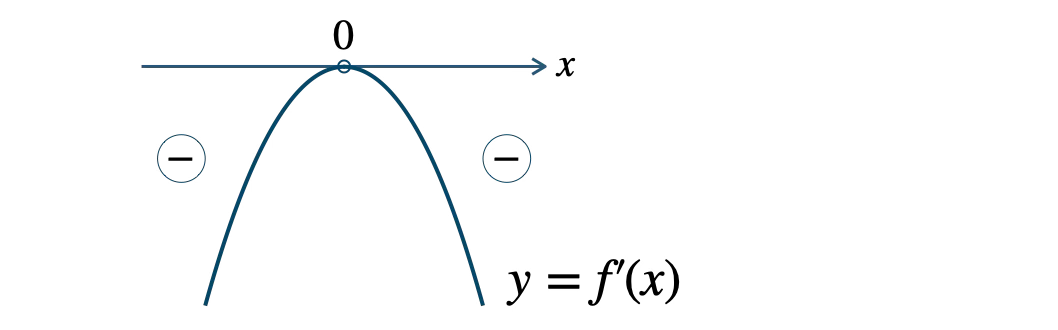
\(x \neq 0\) で \(f^{\prime}(x) \lt 0\)
よって、この \(x\) の前後での\(f^{\prime}(x)\) の符号は、
\(x \neq 0\) で \(f^{\prime}(x) \lt 0\) で、\(f(x)\) は常に単調に減少する
さらに、\(x=0\) のとき、
\(\begin{eqnarray}~~~f(0)&=&-0^3\\[3pt]~~~&=&0\end{eqnarray}\)
よって、\(f^{\prime}(x)\) の符号と \(f(x)\) の増減は、
\(\begin{array}{c|ccc}x & \cdots & 0 & \cdots \\\hline f^{\prime}(x) & – & 0 & – \\\hline f(x) & \searrow & 0 & \searrow\end{array}\)
増減表より、\(x=0\) の前後で \(f^{\prime}(x)\) の符号が変わらないので、\(f(0)=0\) は極値でない
また、\(y=-x^3\) のグラフは、点 \((0~,~0)\) を通り、\(y\) 切片が \(0\) より、

■ この問題の詳しい解説はこちら!
\({\small (2)}~\)\(f(x)=x^3+2x\) を微分すると、
\(\begin{eqnarray}~~~f^{\prime}(x)&=&(x^3)^{\prime}+2 \cdot (x)^{\prime}\\[3pt]~~~&=&3x^2+2\end{eqnarray}\)
ここで、\(3x^2+2 \gt 0\) は常に成り立つので、
\(f^{\prime}(x)=3x^2+2 \gt 0\) が常に成り立つ
よって、\(f^{\prime}(x) \gt 0\) で、\(f(x)\) は常に単調に増加し、極値をもたない
したがって、\(y=x^3+2x\) のグラフは、\(y\) 切片が \(0\) より、

■ この問題の詳しい解説はこちら!
\(\begin{array}{c|ccccccc}x & \cdots & -2 & \cdots & 0 & \cdots & 1 & \cdots \\\hline f^{\prime}(x) & – & 0 & + & 0 & – & 0 & + \\\hline f(x) & \searrow & -27 & \nearrow & 5 & \searrow & 0 & \nearrow\end{array}\)
\(x=-2\) で極小値 \(-27\)
\(x=0\) で極大値 \(5\)
\(x=1\) で極小値 \(0\)

■ この問題の詳しい解説はこちら!
\({\small (2)}~\)
\(\begin{array}{c|ccccccc}x & \cdots & -2 & \cdots & 0 & \cdots & 2 & \cdots \\\hline f^{\prime}(x) & – & 0 & + & 0 & – & 0 & + \\\hline f(x) & \searrow & -14 & \nearrow & 2 & \searrow & -14 & \nearrow\end{array}\)
\(x=0\) で極大値 \(2\)
\(x=\pm2\) で極小値 \(-14\)

■ この問題の詳しい解説はこちら!
\(x=2\) で最大値 \(20\)
\(x=-3~,~0\) で最小値 \(0\)
\({\small (2)}~\)
\(x=-2~,~1\) で最大値 \(3\)
\(x=-1~,~2\) で最小値 \(-1\)
\({\small (3)}~\)
\(x=-1\) で最大値 \(8\)
\(x=2\) で最小値 \(-46\)
解法のPoint|3次関数や4次関数の最大値・最小値
② 微分すると、\(y’=2x-4\)
\(y’=0\) とすると、\(x=2\)
増減表をかくと、
\(\begin{array}{c|cccc}
x & \cdots & 2 & \cdots \\
\hline
f^{\prime}(x) & – & 0 & + \\
\hline
f(x) & \searrow & -2 & \nearrow
\end{array}\)
これより、\(x=2\) のとき最小値 \(-2\)
解法のPoint|3次関数や4次関数の最大値・最小値
\(\begin{eqnarray}~~~&&(x^3+3x^2+5)-9x\\[3pt]~~~&=&x^3+3x^2-9x+5\end{eqnarray}\)
\(f(x)=x^3+3x^2-9x+5\) とおき、\(f(x)\) を微分すると、
\(\begin{eqnarray}~~~f^{\prime}(x)&=&(x^3)^{\prime}+3 \cdot (x^2)^{\prime}-9 \cdot (x)^{\prime}+(5)^{\prime}\\[3pt]~~~&=&3x^2+3 \cdot 2x-9 \cdot 1+0\\[3pt]~~~&=&3x^2+6x-9\\[3pt]~~~&=&3(x^2+2x-3)\\[3pt]~~~&=&3(x+3)(x-1)\end{eqnarray}\)
\(f^{\prime}(x)=0\) となる \(x\) の値は、
\(\begin{eqnarray}~~~f^{\prime}(x)&=&3(x+3)(x-1)=0\\[3pt]~~~&&x=-3~,~1\end{eqnarray}\)
2次関数 \(y=f^{\prime}(x)\) のグラフより、
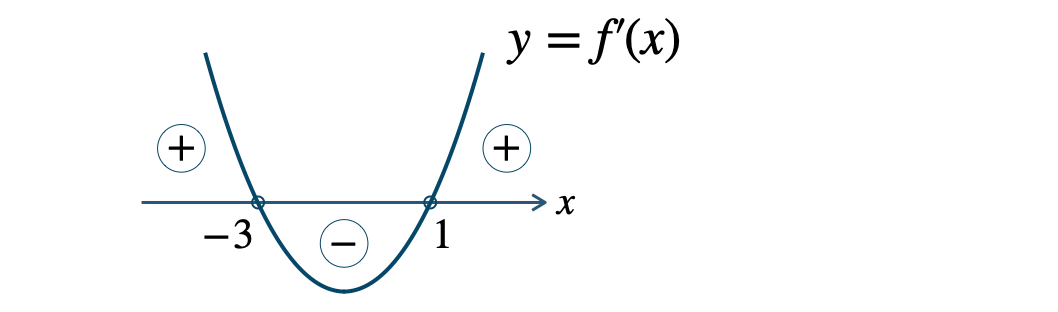
よって、\(x{\small ~≧~}0\) の区間で、
\(0 \lt x \lt 1\) のとき、\(f^{\prime}(x) \lt 0\)
\(1 \lt x\) のとき、\(f^{\prime}(x) \gt 0\)
さらに、
\(x=0\) のとき、
\(\begin{eqnarray}~~~f(0)&=&0^3+3 \cdot 0^2-9 \cdot 0+5\\[3pt]~~~&=&5\end{eqnarray}\)
\(x=1\) のとき、
\(\begin{eqnarray}~~~f(1)&=&1^3+3 \cdot 1^2-9 \cdot 1+5\\[3pt]~~~&=&1+3-9+5\\[3pt]~~~&=&0\end{eqnarray}\)
よって、\(x{\small ~≧~}0\) の区間での増減表は、
\(\begin{array}{c|ccccc}x & 0 & \cdots & 1 & \cdots \\\hline f^{\prime}(x) & & – & 0 & + \\\hline f(x) & 5 & \searrow & 0 & \nearrow\end{array}\)
これより、\(f(x)\) は \(x=1\) のとき最小値 \(0\) をとるので、
\(x{\small ~≧~}0\) で \(f(x){\small ~≧~}0\) となるので、
\(x^3+3x^2-9x+5{\small ~≧~}0\)
したがって、\(x^3+3x^2+5{\small ~≧~}9x\) [終]
■ この問題の詳しい解説はこちら!
補充問題
■ この問題の詳しい解説はこちら!
\({\small (2)}~\)極値なし
■ この問題の詳しい解説はこちら!
\({\small (2)}~6\) cm
■ この問題の詳しい解説はこちら!
第3節 積分法
\(n\) が \(0\) または正の整数のとき、
\(~~~F(x)=\displaystyle \frac{\,1\,}{\,n+1\,}x^{n+1}\)とすると、
\(~~~F'(x)=(n+1)\cdot\displaystyle \frac{\,1\,}{\,n+1\,}x^{n}=x^n\)
よって、\(x^n\) の不定積分の1つは \(F(x)\) である
したがって、
\(~~~\displaystyle\int x^n dx=\displaystyle \frac{\,1\,}{\,n+1\,}x^{n+1}+C\)[終]
また、\(C\) を積分定数として
\(~~~\displaystyle\int x^3 dx=\displaystyle \frac{\,1\,}{\,4\,}x^4+C\)
解法のPoint|関数xⁿの不定積分
\({\small (1)}~2x^3+C\)
\({\small (2)}~\displaystyle \frac{\,1\,}{\,3\,}x^3+\displaystyle \frac{\,1\,}{\,2\,}x^2-x+C\)
\({\small (3)}~x^3-x^2+5x+C\)
\({\small (4)}~-\displaystyle \frac{\,2\,}{\,3\,}x^3-\displaystyle \frac{\,1\,}{\,2\,}x^2+7x+C\)
解法のPoint|関数xⁿの不定積分
\({\small (1)}~\displaystyle \frac{\,2\,}{\,3\,}t^3-\displaystyle \frac{\,3\,}{\,2\,}t^2-4t+C\)
\({\small (2)}~y^3+\displaystyle \frac{\,5\,}{\,2\,}y^2-2y+C\)
解法のPoint|関数xⁿの不定積分
解法のPoint|関数xⁿの定積分の計算
解法のPoint|関数xⁿの定積分の計算
解法のPoint|定積分の性質を用いた計算
解法のPoint|x軸より上側の範囲の囲まれた面積
解法のPoint|x軸より下側の範囲の囲まれた面積
■ この問題の詳しい解説はこちら!
■ 1/6の公式を用いた解説はこちら!
解法のPoint|関数xⁿの不定積分
\({\small (2)}~-\displaystyle \frac{\,3\,}{\,4\,}\)
解法のPoint|関数xⁿの定積分の計算
補充問題
解法のPoint|関数xⁿの定積分の計算
■ この問題の詳しい解説はこちら!
■ 1/6の公式を用いた解説はこちら!
章末問題 微分法と積分法
\({\small (2)}~y^{\prime}=3x^2\)
解法のPoint|関数xⁿや定数関数の微分
解法のPoint|傾きの条件と接線の方程式
\({\small (2)}~\)極大値なし
\({\small (3)}~x=\displaystyle \frac{\,2\,}{\,3\,}a\) で極大値 \(-\displaystyle \frac{\,4\,}{\,27\,}a^3\)
■ この問題の詳しい解説はこちら!
解法のPoint|関数xⁿの定積分の計算
■ この問題の詳しい解説はこちら!
正しい式と答えは、
\(\begin{eqnarray}~~~S&=&\displaystyle\int_{-1}^{0}(x^3-x)dx-\displaystyle\int_{0}^{1}(x^3-x)dx
\\[5pt]~~~&=&\displaystyle \frac{\,1\,}{\,2\,}\end{eqnarray}\)
解法のPoint|2つの部分に分けられた面積