
第4章 式と曲線

文字数が多く、重くなるのでページを分割しています。
各章は下のリンクまたはページ下の「次へ」をクリックしてください。
新編数学C 第1章 平面のベクトル
新編数学C 第2章 空間のベクトル
新編数学C 第3章 複素数平面
新編数学C 第4章 式と曲線
第4章 式と曲線
第1節 2次曲線
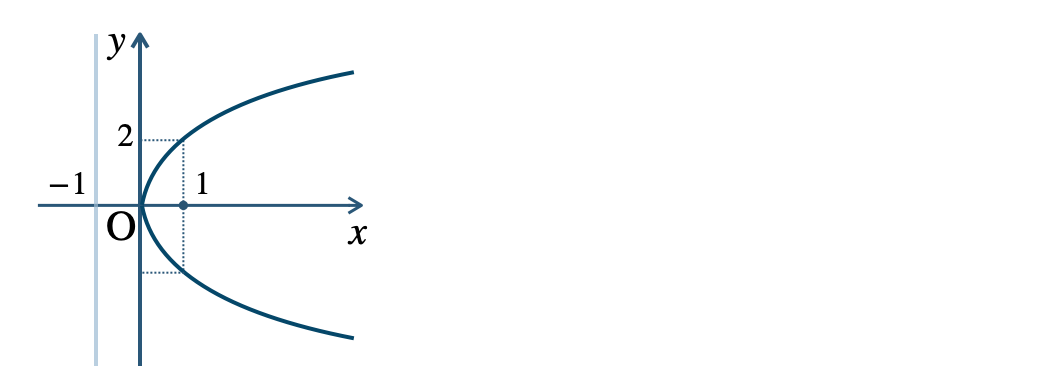
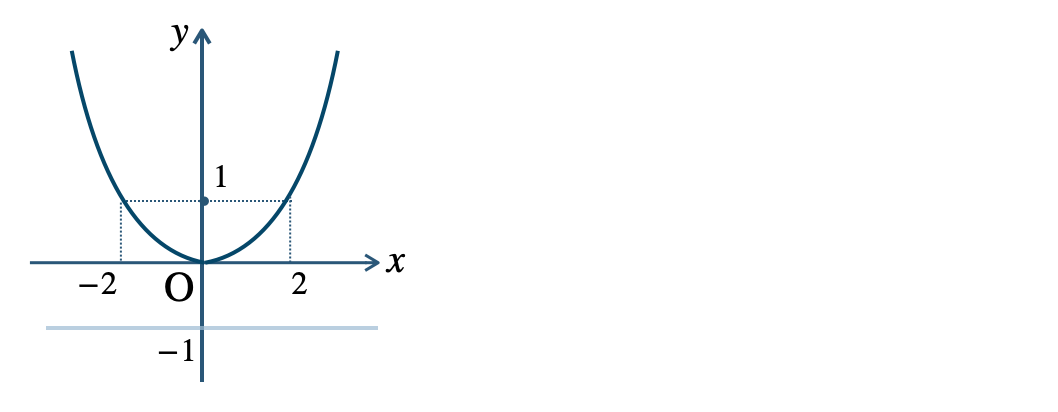
\({\small (2)}~\)焦点 \((-3~,~0)\)、準線 \(x=3\)
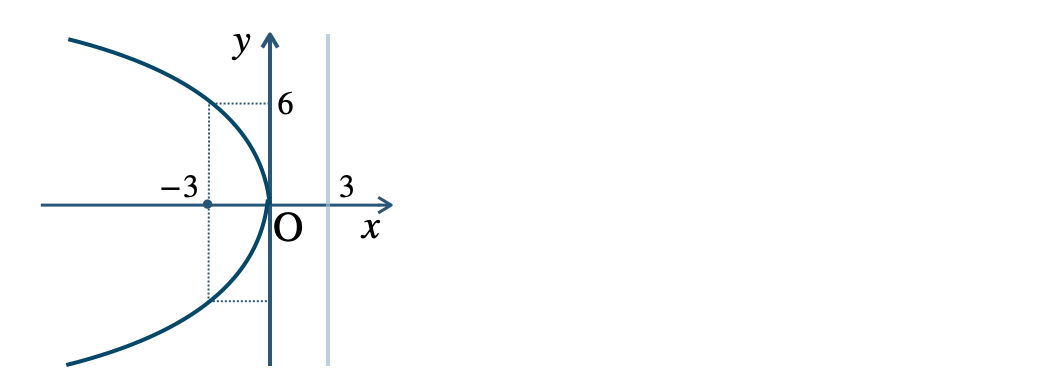
\({\small (3)}~\)焦点 \(\left(-\displaystyle \frac{\,1\,}{\,4\,}~,~0\right)\)、準線 \(x=\displaystyle \frac{\,1\,}{\,4\,}\)
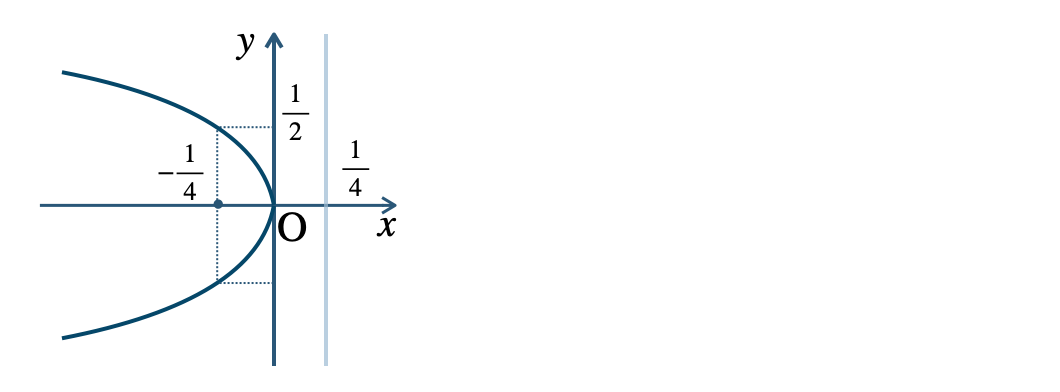
解法のPoint|放物線の方程式と焦点・準線
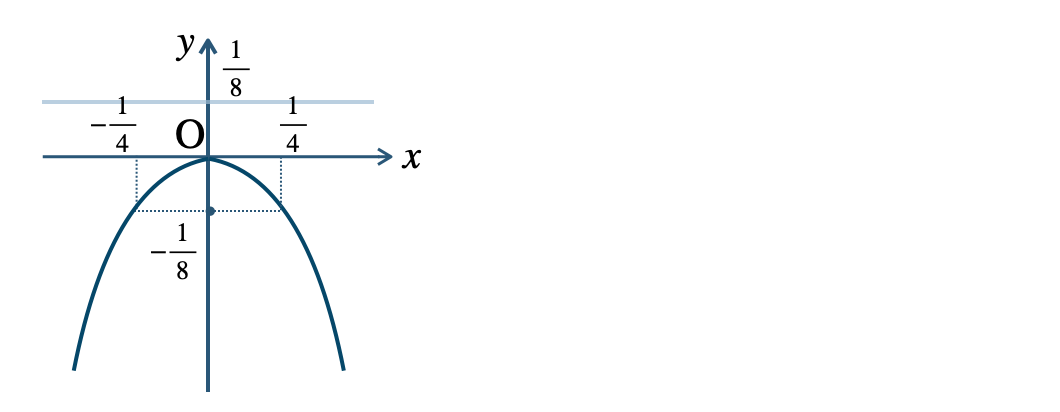
\({\small (2)}~\)焦点 \(\left(0~,~-\displaystyle \frac{\,1\,}{\,8\,}\right)\)、準線 \(y=\displaystyle \frac{\,1\,}{\,8\,}\)
解法のPoint|放物線の方程式と焦点・準線
焦点 \((4~,~0)~,~(-4~,~0)\)
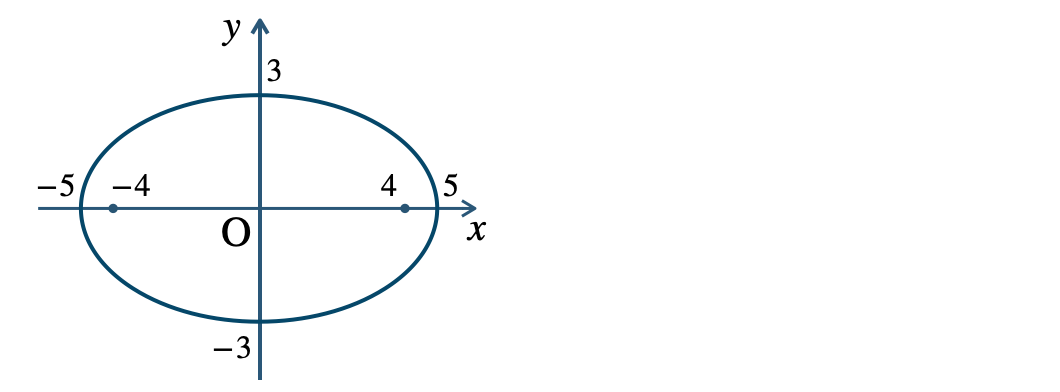
\({\small (2)}~\)長軸 \(6\)、短軸 \(2\)
焦点 \((2\sqrt{2}~,~0)~,~(-2\sqrt{2}~,~0)\)
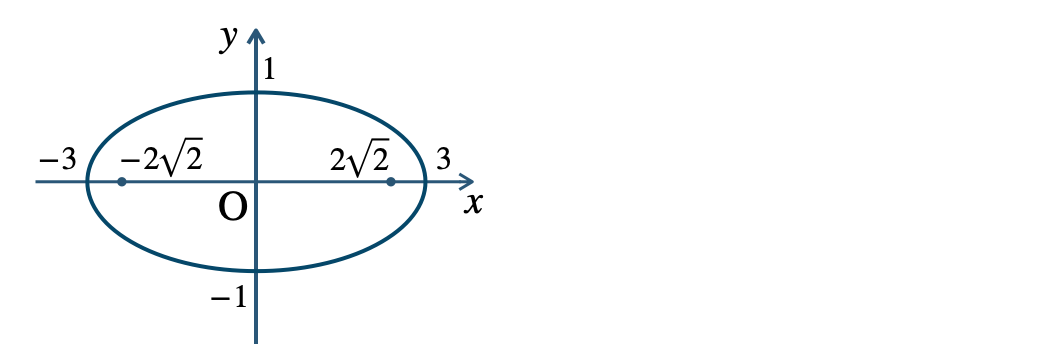
\({\small (3)}~\)長軸 \(4\sqrt{2}\)、短軸 \(2\sqrt{2}\)
焦点 \((\sqrt{6}~,~0)~,~(-\sqrt{6}~,~0)\)
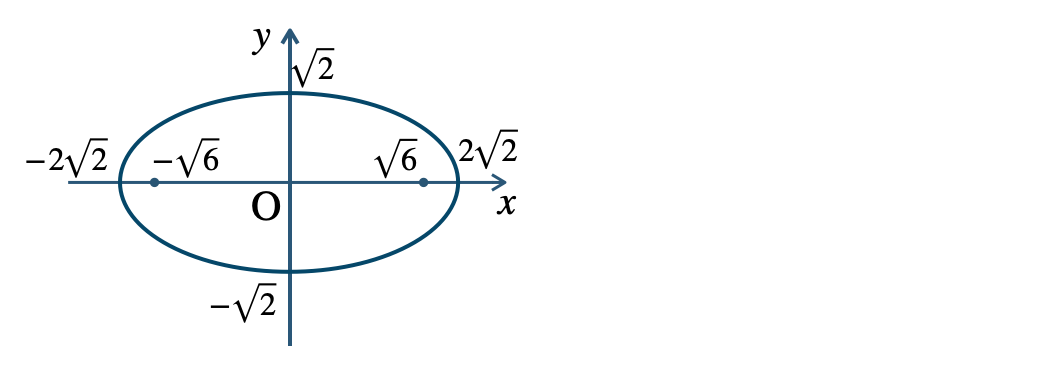
解法のPoint|楕円の方程式と概形
\({\small (2)}~\displaystyle \frac{\,x^2\,}{\,4\,}+y^2=1\)
解法のPoint|楕円の方程式の決定
焦点 \((0~,~\sqrt{5})~,~(0~,~-\sqrt{5})\)
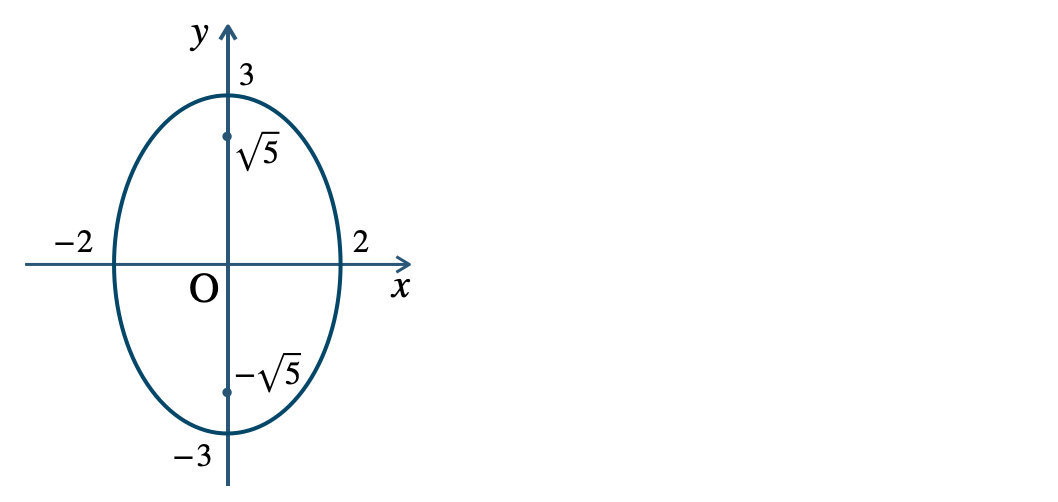
\({\small (2)}~\)長軸 \(6\)、短軸 \(2\)
焦点 \((0~,~2\sqrt{2})~,~(0~,~-2\sqrt{2})\)
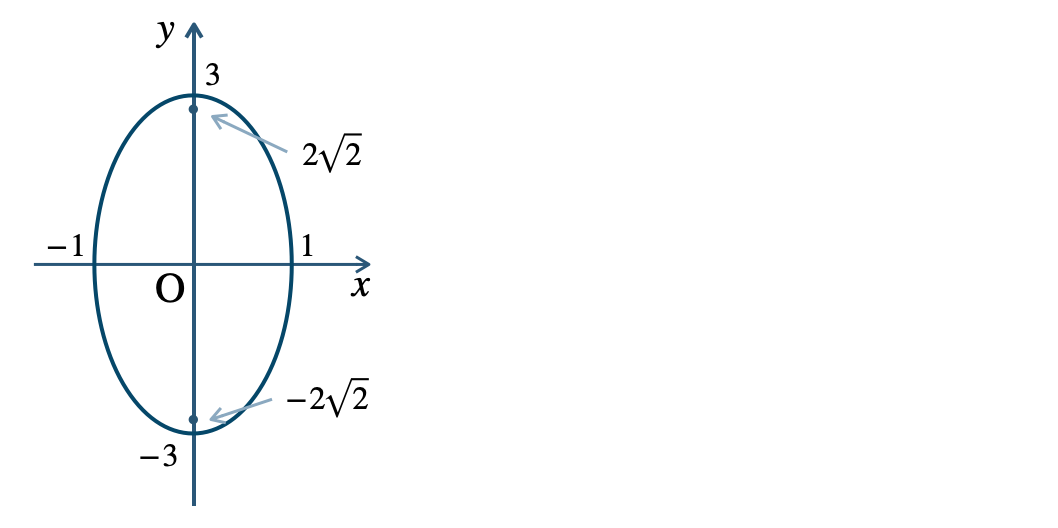
解法のPoint|楕円の方程式と概形
\({\small (2)}~\displaystyle \frac{\,x^2\,}{\,9\,}+\displaystyle \frac{\,x^2\,}{\,16\,}=1\)
解法のPoint|円と楕円の関係
\(~~~\displaystyle \frac{\,x^2\,}{\,16\,}+\displaystyle \frac{\,x^2\,}{\,9\,}=1\)
■ この問題の詳しい解説はこちら!
頂点 \((5~,~0)~,~(-5~,~0)\)
漸近線\(~~~y=\displaystyle \frac{\,4\,}{\,5\,}x~,~y=-\displaystyle \frac{\,4\,}{\,5\,}x\)
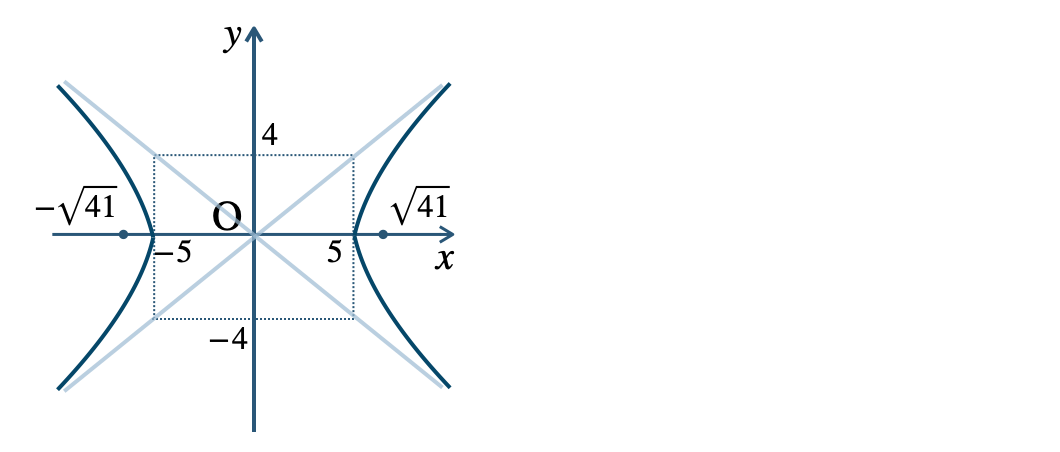
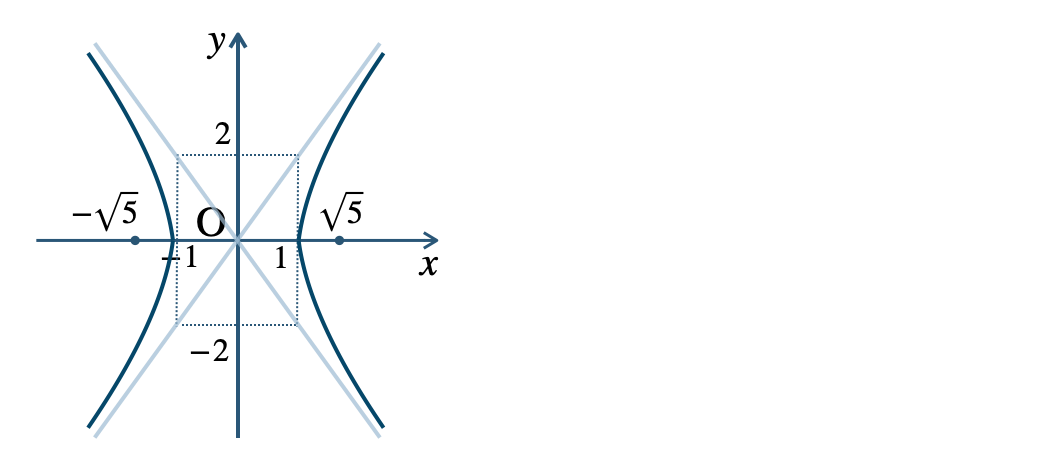
\({\small (2)}~\)焦点 \((\sqrt{5}~,~0)~,~(-\sqrt{5}~,~0)\)
頂点 \((1~,~0)~,~(-1~,~0)\)
漸近線\(~~~y=2x~,~y=-2x\)
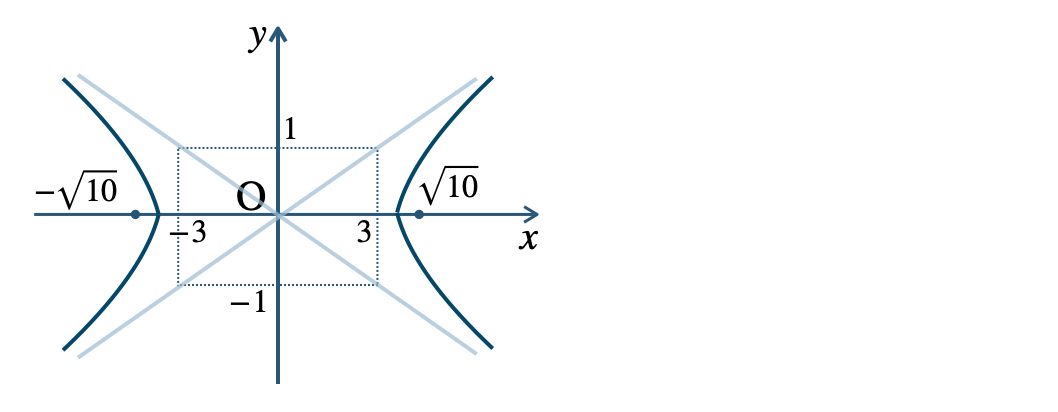
\({\small (3)}~\)焦点 \((\sqrt{10}~,~0)~,~(-\sqrt{10}~,~0)\)
頂点 \((3~,~0)~,~(-3~,~0)\)
漸近線\(~~~y=\displaystyle \frac{\,1\,}{\,3\,}x~,~y=-\displaystyle \frac{\,1\,}{\,3\,}x\)
解法のPoint|双曲線の方程式と概形
解法のPoint|双曲線の方程式の決定
解法のPoint|直角双曲線の方程式
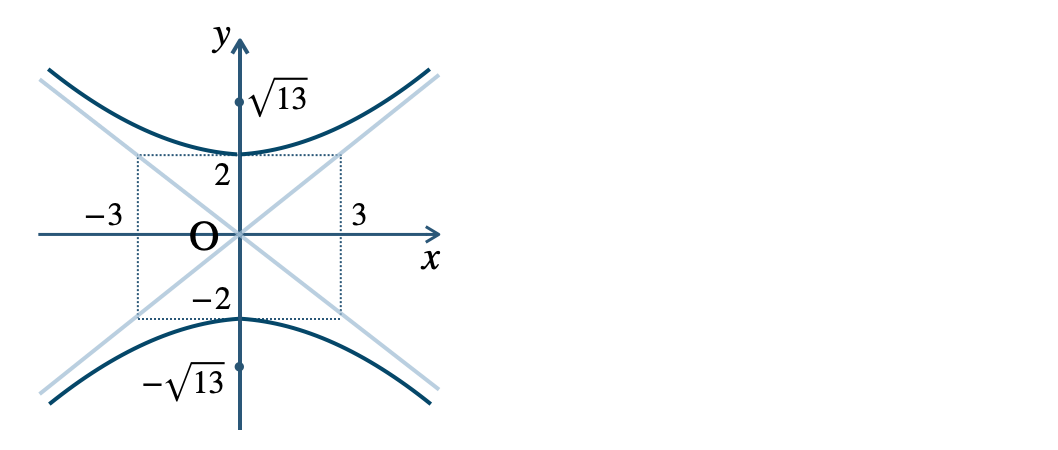
頂点 \((0~,~2)~,~(0~,~-2)\)
漸近線\(~~~y=\displaystyle \frac{\,2\,}{\,3\,}x~,~y=-\displaystyle \frac{\,2\,}{\,3\,}x\)
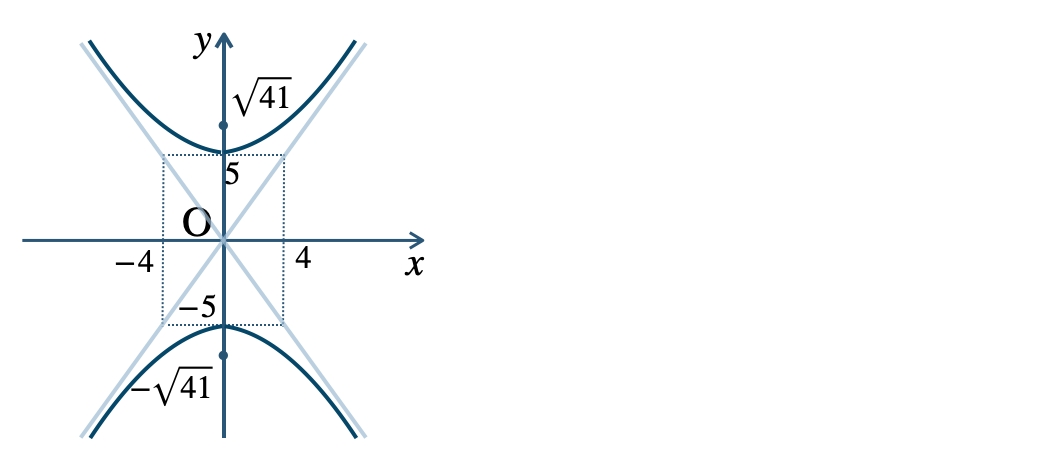
\({\small (2)}~\)焦点 \((0~,~\sqrt{41})~,~(0~,~-\sqrt{41})\)
頂点 \((0~,~5)~,~(0~,~-5)\)
漸近線\(~~~y=\displaystyle \frac{\,5\,}{\,4\,}x~,~y=-\displaystyle \frac{\,5\,}{\,4\,}x\)
解法のPoint|双曲線の方程式と概形
焦点 \((\sqrt{3}+3~,~-2)~,~(-\sqrt{3}+3~,~-2)\)
解法のPoint|平行移動した2次曲線の方程式
\(y\) 軸方向に \(1\) だけ平行移動させた楕円
\({\small (2)}~\)放物線 \(y^2=16x\) を \(x\) 軸方向に \(-1\)、
\(y\) 軸方向に \(-4\) だけ平行移動させた放物線
\({\small (3)}~\)双曲線 \(\displaystyle \frac{\,x^2\,}{\,9\,}-\displaystyle \frac{\,y^2\,}{\,4\,}=1\) を \(x\) 軸方向に \(2\)、
\(y\) 軸方向に \(-2\) だけ平行移動させた双曲線
解法のPoint|x,yの2次方程式と2次曲線
\(k=\pm \sqrt{2}\) のとき、1個
\(-\sqrt{2}\lt k\lt \sqrt{2}\) のとき、0個
解法のPoint|2次曲線と直線の共有点の個数
解法のPoint|放物線y²=4px上の接線の方程式
\({\small (2)}~x+y=4\)
解法のPoint|楕円・双曲線の接線の方程式
補充問題
解法のPoint|放物線の方程式の決定
\({\small (2)}~\displaystyle \frac{\,x^2\,}{\,25\,}+\displaystyle \frac{\,(y-1)^2\,}{\,16\,}=1\)
解法のPoint|楕円の方程式の決定
\({\small (3)}~\displaystyle \frac{\,x^2\,}{\,16\,}-\displaystyle \frac{\,(y+2)^2\,}{\,9\,}=1\)
解法のPoint|双曲線の方程式の決定
第2節 媒介変数表示と極座標
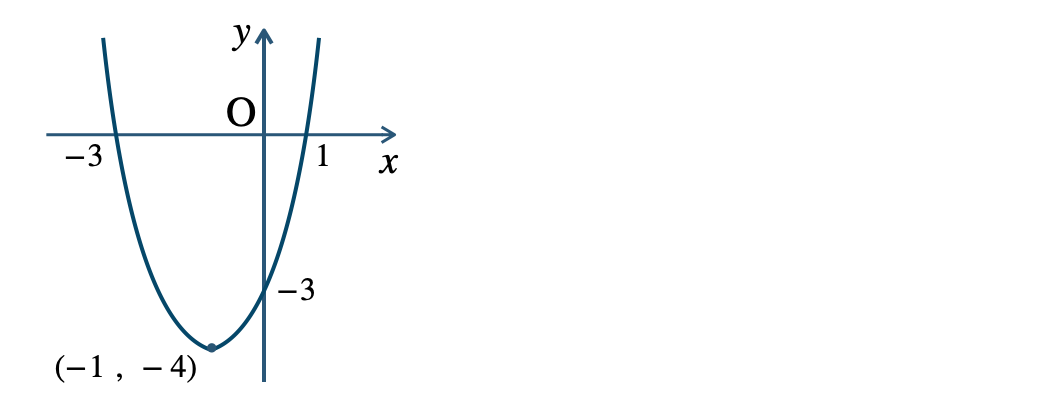
\({\small (2)}~y=-\displaystyle \frac{\,1\,}{\,4\,}x^2+x\)
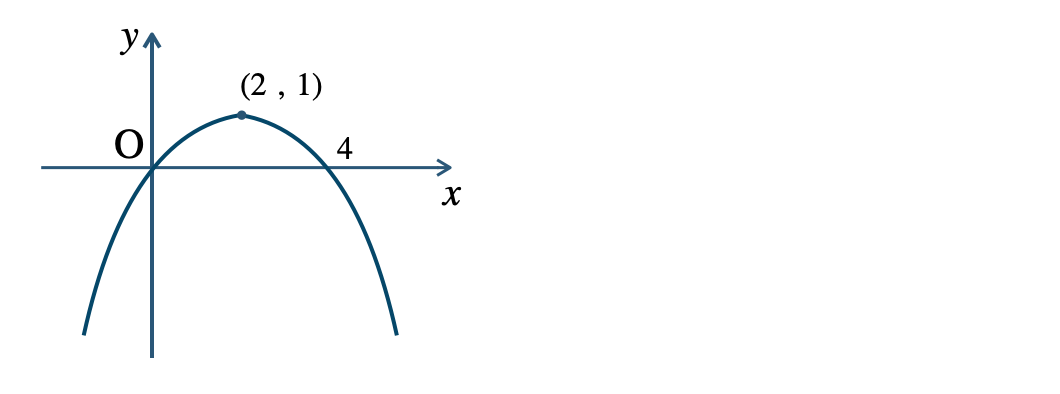
解法のPoint|媒介変数表示の曲線の概形
\({\small (2)}~x=\sqrt{3}\cos{\theta}~,~y=\sqrt{3}\sin{\theta}\)
解法のPoint|円・楕円・双曲線の媒介変数表示
\({\small (2)}~x=4\cos{\theta}~,~y=5\sin{\theta}\)
解法のPoint|円・楕円・双曲線の媒介変数表示
\(\begin{eqnarray}~~~&&\displaystyle \frac{\,x^2\,}{\,3^2\,}-\displaystyle \frac{\,y^2\,}{\,2^2\,}
\\[5pt]~~~&=&\displaystyle \frac{\,3^2\,}{\,3^2\cos^2{\theta}\,}-\displaystyle \frac{\,2^2\tan^2{\theta}\,}{\,2^2\,}
\\[5pt]~~~&=&\displaystyle \frac{\,1\,}{\,\cos^2{\theta}\,}-\tan^2{\theta}
\\[5pt]~~~&=&1+\tan^2{\theta}-\tan^2{\theta}=1\end{eqnarray}\)
したがって、\(\displaystyle \frac{\,x^2\,}{\,3^2\,}-\displaystyle \frac{\,y^2\,}{\,2^2\,}=1\) を満たすので、
点 \({\rm P}\) は双曲線上を動く [終]
解法のPoint|円・楕円・双曲線の媒介変数表示
解法のPoint|円・楕円・双曲線の媒介変数表示
\({\small (2)}~\)楕円\(~~~\displaystyle \frac{\,(x-1)^2\,}{\,9\,}+\displaystyle \frac{\,(y-3)^2\,}{\,4\,}=1\)
解法のPoint|媒介変数表示の曲線の平行移動
\({\small (2)}~(2\pi~,~4)\)
\({\small (3)}~(3\pi+2~,~2)\)
\({\small (4)}~(4\pi~,~0)\)
■ この問題の詳しい解説はこちら!
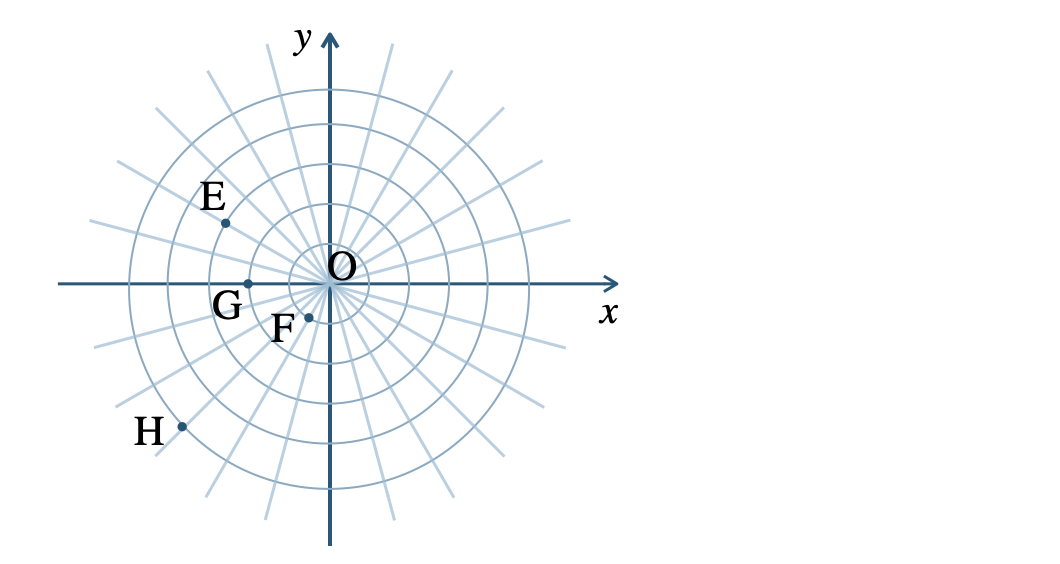
解法のPoint|極座標の表し方と直交座標に変換
\({\small (2)}~\left(2~,~\displaystyle \frac{\,2\,}{\,3\,}\pi \right)\)
\({\small (3)}~\left(2~,~\displaystyle \frac{\,7\,}{\,6\,}\pi \right)\)
解法のPoint|直交座標の点を極座標に変換
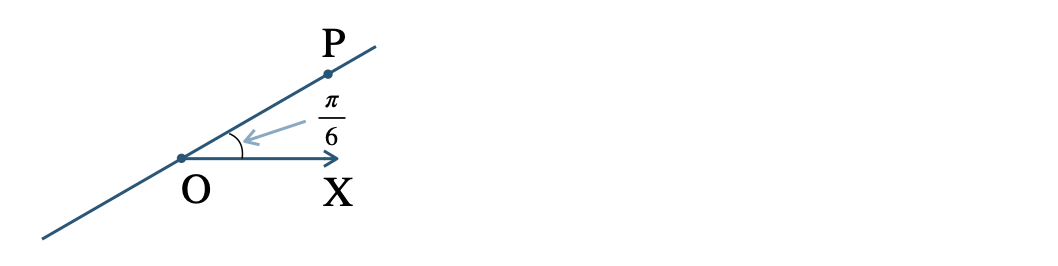
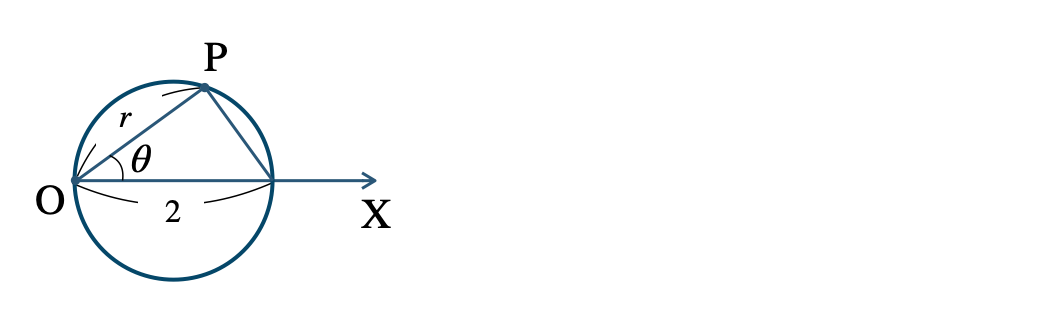
補充問題
\({\small (2)}~(x-2)^2-\displaystyle \frac{\,(y-1)^2\,}{\,4\,}=1\)
解法のPoint|媒介変数表示の曲線の平行移動
\(\triangle {\rm POA}\) は \(\angle {\rm PAO}=90°\) の直角三角形となるので、
\(\angle {\rm POA}=\theta-\displaystyle \frac{\,\pi\,}{\,4\,}\) より、
\(\cos \left(\theta-\displaystyle \frac{\,\pi\,}{\,4\,}\right)=\displaystyle \frac{\,3\,}{\,r\,}\)
\(r\cos \left(\theta-\displaystyle \frac{\,\pi\,}{\,4\,}\right)=3\)
したがって、極方程式は \(r\cos \left(\theta-\displaystyle \frac{\,\pi\,}{\,4\,}\right)=3\) となる [終]
■ この問題の詳しい解説はこちら!
章末問題 式と曲線
解法のPoint|放物線の方程式と焦点・準線
\({\small (2)}~\left(\displaystyle \frac{\,\sqrt{\,3\,}\,}{\,4\,}~,~0\right)~,~\left(-\displaystyle \frac{\,\sqrt{\,3\,}\,}{\,4\,}~,~0\right)\)
解法のPoint|楕円の方程式と概形
\({\small (3)}~(2\sqrt{\,3\,}~,~0)~,~(-2\sqrt{\,3\,}~,~0)\)
解法のPoint|双曲線の方程式と概形
解法のPoint|放物線の方程式の決定
\({\small (2)}~\displaystyle \frac{\,x^2\,}{\,4\,}+\displaystyle \frac{\,y^2\,}{\,2\,}=1\)
解法のPoint|楕円の方程式の決定
\({\small (3)}~x^2-\displaystyle \frac{\,y^2\,}{\,4\,}=1\)
解法のPoint|双曲線の方程式の決定
\({\small (2)}~\)放物線、\((0~,~2)\)
\({\small (3)}~\)双曲線、\((\sqrt{\,13\,}+1~,~-1)~,~(-\sqrt{\,13\,}+1~,~-1)\)
解法のPoint|x,yの2次方程式と2次曲線
\({\small (2)}~\)放物線 \(y=-\displaystyle \frac{\,x^2\,}{\,2\,}+\displaystyle \frac{\,x\,}{\,2\,}\) の \(x{\small ~≧~}0\) の部分
解法のPoint|媒介変数表示の曲線の概形
焦点 \((0~,~2\sqrt{\,3\,}-1)~,~(0~,~-2\sqrt{\,3\,}-1)\)
解法のPoint|平行移動した2次曲線の方程式
■ この問題の詳しい解説はこちら!
\({\small (2)}~\)円 \(x^2+y^2=1\) ただし、点 \((-1~,~0)\) を除く
解法のPoint|媒介変数表示の曲線の概形
\({\small [\,1\,]}~\theta \gt \theta_1\) のとき、
\(\angle {\rm POC}=\theta-\theta_1\) となるので、
\(\triangle {\rm POC}\) の余弦定理より、
\\[3pt]~~~a^2&=&r^2+r_1^2-2rr_1\cos (\theta-\theta_1)
\\[3pt]~~~r^2+r_1^2-2rr_1\cos (\theta-\theta_1)&=&a^2\end{eqnarray}\)
※ 数式は横にスクロールできます。
\({\small [\,2\,]}~\theta \lt \theta_1\) のとき、
\(\angle {\rm COP}=\theta_1-\theta\) となるので、
\(\triangle {\rm COP}\) の余弦定理より、
\\[3pt]~~~a^2&=&r^2+r_1^2-2rr_1\cos (\theta_1-\theta)
\\[3pt]~~~r^2+r_1^2-2rr_1\cos (\theta_1-\theta)&=&a^2\end{eqnarray}\)
※ 数式は横にスクロールできます。
ここで、
\(\begin{eqnarray}~~~\cos (\theta_1-\theta)&=&\cos \left\{\,-(\theta-\theta_1)\,\right\}
\\[3pt]~~~&=&\cos (\theta-\theta_1)\end{eqnarray}\)
これより、
\(r^2+r_1^2-2rr_1\cos (\theta-\theta_1)=a^2\)
\({\small [\,3\,]}~\theta=\theta_1\) のとき、
点 \({\rm P}\) は半直線 \({\rm OC}\) 上にあるので、
\({\rm OP}=r_1-a\) または \({\rm OP}=r_1+a\)
これより、\(r=r_1-a~,~r_1+a\) となる
ここで、\(r^2+r_1^2-2rr_1\cos (\theta-\theta_1)=a^2\) に \(\theta=\theta_1\) を代入すると、
\(\begin{eqnarray}~~~r^2+r_1^2-2rr_1\cos 0&=&a^2
\\[3pt]~~~r^2-2r_1r+r_1^2&=&a^2
\\[3pt]~~~(r-r_1)^2&=&a^2
\\[3pt]~~~r-r_1&=&\pm a
\\[3pt]~~~r&=&r_1-a~,~r_1+a\end{eqnarray}\)
よって、\({\small [\,3\,]}\) のときも極方程式は成り立つ
\({\small [\,1\,]}~,~{\small [\,2\,]}~,~{\small [\,3\,]}\) より、
\(r^2+r_1^2-2rr_1\cos (\theta-\theta_1)=a^2\)
逆に、この極方程式を満たす点は条件を満たす
したがって、極方程式は \(r^2+r_1^2-2rr_1\cos (\theta-\theta_1)=a^2\) となる [終]
■ この問題の詳しい解説はこちら!