
このページは、数研出版:高等学校数学Ⅱ[710]
第6章 微分法と積分法
第6章 微分法と積分法
教科書の復習から入試の入門まで|数学入門問題精講
旺文社の入門問題精講シリーズの紹介高校生の皆さん、数学の勉強に困ったことはありませんか?教科書の内容...

yorikuwa.com
リンク
文字数が多く、重くなるのでページを分割しています。
各章は下のリンクまたはページ下の「次へ」をクリックしてください。
高等学校数学Ⅱ 第1章 式と証明
高等学校数学Ⅱ 第2章 複素数と方程式
高等学校数学Ⅱ 第3章 図形と方程式
高等学校数学Ⅱ 第4章 三角関数
高等学校数学Ⅱ 第5章 指数関数と対数関数
高等学校数学Ⅱ 第6章 微分法と積分法
第6章 微分法と積分法
第1節 微分係数と導関数
p.187 練習5\({\small (1)}~\)
\(\begin{eqnarray}~~~&&f'(x)\\[2pt]~~~&=&\lim_{h\to0}\displaystyle \frac{\,3(x+h)-3x\,}{\,h\,}\\[2pt]~~~&=&\lim_{h\to0}\displaystyle \frac{\,3h\,}{\,h\,}\\[2pt]~~~&=&3\end{eqnarray}\)
\({\small (2)}~\)
\(\begin{eqnarray}~~~&&f'(x)\\[2pt]~~~&=&\lim_{h\to0}\displaystyle \frac{\,-(x+h)^2-(-x^2)\,}{\,h\,}\\[2pt]~~~&=&\lim_{h\to0}\displaystyle \frac{\,-2xh-h^2\,}{\,h\,}\\[2pt]~~~&=&\lim_{h\to0}(-2x-h)\\[2pt]~~~&=&-2x\end{eqnarray}\)
解法のPoint|導関数の定義
\(\begin{eqnarray}~~~&&f'(x)\\[2pt]~~~&=&\lim_{h\to0}\displaystyle \frac{\,3(x+h)-3x\,}{\,h\,}\\[2pt]~~~&=&\lim_{h\to0}\displaystyle \frac{\,3h\,}{\,h\,}\\[2pt]~~~&=&3\end{eqnarray}\)
\({\small (2)}~\)
\(\begin{eqnarray}~~~&&f'(x)\\[2pt]~~~&=&\lim_{h\to0}\displaystyle \frac{\,-(x+h)^2-(-x^2)\,}{\,h\,}\\[2pt]~~~&=&\lim_{h\to0}\displaystyle \frac{\,-2xh-h^2\,}{\,h\,}\\[2pt]~~~&=&\lim_{h\to0}(-2x-h)\\[2pt]~~~&=&-2x\end{eqnarray}\)
解法のPoint|導関数の定義
p.189 練習7\({\small (1)}~y’=8x+3\)
\({\small (2)}~y’=-6x+1\)
\({\small (3)}~y’=12x^2-4x-5\)
\({\small (4)}~y’=-4x^3-1\)
\({\small (5)}~y’=2x^2+\displaystyle \frac{\,3\,}{\,2\,}x-\displaystyle \frac{\,1\,}{\,2\,}\)
\({\small (6)}~y’=-\displaystyle \frac{\,3\,}{\,2\,}x^2+3x\)
解法のPoint|関数xⁿや定数関数の微分
\({\small (2)}~y’=-6x+1\)
\({\small (3)}~y’=12x^2-4x-5\)
\({\small (4)}~y’=-4x^3-1\)
\({\small (5)}~y’=2x^2+\displaystyle \frac{\,3\,}{\,2\,}x-\displaystyle \frac{\,1\,}{\,2\,}\)
\({\small (6)}~y’=-\displaystyle \frac{\,3\,}{\,2\,}x^2+3x\)
解法のPoint|関数xⁿや定数関数の微分
p.189 練習8\({\small (1)}~y’=2x+5\)
\({\small (2)}~y’=3x^2-4\)
\({\small (3)}~y’=-6x^2+8x+6\)
\({\small (4)}~y’=12x^3-24x\)
解法のPoint|関数xⁿや定数関数の微分
\({\small (2)}~y’=3x^2-4\)
\({\small (3)}~y’=-6x^2+8x+6\)
\({\small (4)}~y’=12x^3-24x\)
解法のPoint|関数xⁿや定数関数の微分
p.191 練習12\(~~~\displaystyle \frac{\,dV\,}{\,dr\,}=4\pi r^2~,~\displaystyle \frac{\,dS\,}{\,dr\,}=8\pi r\)
解法のPoint|変数がx,y以外の文字の導関数
解法のPoint|変数がx,y以外の文字の導関数
p.192 深める傾き \(0\)
\(y=-x^2+4x=-(x-2)^2+4\) より、頂点は \((2~,~4)\)
よって、\(x=2\) での接線の傾きは \(y’=-2x+4\) より、\(~~~-2{\, \small \times \,}2+4=0\)
解法のPoint|曲線の接線の方程式
\(y=-x^2+4x=-(x-2)^2+4\) より、頂点は \((2~,~4)\)
よって、\(x=2\) での接線の傾きは \(y’=-2x+4\) より、\(~~~-2{\, \small \times \,}2+4=0\)
解法のPoint|曲線の接線の方程式
p.193 深める\(y=x^2+3~,~y=-2x+2\) より、
\(\begin{eqnarray}~~~x^2+3&=&-2x+2\\[2pt]~~~x^2+2x+1&=&0\\[2pt]~~~(x+1)^2&=&0\\[2pt]~~~x&=&-1\end{eqnarray}\)
これより、重解をもつ
また、\(y=x^2+3~,~y=6x-6\) より、
\(\begin{eqnarray}~~~x^2+3&=&6x-6\\[2pt]~~~x^2-6x+9&=&0\\[2pt]~~~(x-3)^2&=&0\\[2pt]~~~x&=&3\end{eqnarray}\)
これより、重解をもつ
\(\begin{eqnarray}~~~x^2+3&=&-2x+2\\[2pt]~~~x^2+2x+1&=&0\\[2pt]~~~(x+1)^2&=&0\\[2pt]~~~x&=&-1\end{eqnarray}\)
これより、重解をもつ
また、\(y=x^2+3~,~y=6x-6\) より、
\(\begin{eqnarray}~~~x^2+3&=&6x-6\\[2pt]~~~x^2-6x+9&=&0\\[2pt]~~~(x-3)^2&=&0\\[2pt]~~~x&=&3\end{eqnarray}\)
これより、重解をもつ
問題
p.194 問題 2\({\small (1)}~y^{\prime}=1+2x+3x^2+4x^3\)
\({\small (2)}~y^{\prime}=4x+1\)
\({\small (3)}~y^{\prime}=3x^2\)
\({\small (4)}~y^{\prime}=3x^2-4x+1\)
解法のPoint|関数xⁿや定数関数の微分
\({\small (2)}~y^{\prime}=4x+1\)
\({\small (3)}~y^{\prime}=3x^2\)
\({\small (4)}~y^{\prime}=3x^2-4x+1\)
解法のPoint|関数xⁿや定数関数の微分
p.194 問題 3\({\small (1)}~\)[証明] \(y=(ax+b)^2\) を展開すると、
\(y=a^2x^2+2abx+b^2\)
微分すると、
\(\begin{eqnarray}~~~y^{\prime}&=&a^2 \cdot (x^2)^{\prime}+2ab \cdot (x)^{\prime}+(b^2)^{\prime}
\\[3pt]~~~&=&a^2 \cdot 2x+2ab \cdot 1+0
\\[3pt]~~~&=&2a^2x+2ab
\\[3pt]~~~&=&2a(ax+b)\end{eqnarray}\)
したがって、
\(y=(ax+b)^2\) のとき \(y^{\prime}=2a(ax+b)\) が成り立つ [終]
\(\begin{eqnarray}~~~y&=&(ax+b)^3
\\[3pt]~~~&=&(ax)^3+3\cdot(ax)^2\cdot b+3\cdot(ax)\cdot b^2+b^3
\\[3pt]~~~&=&a^3x^3+3a^2bx^2+3ab^2x+b^3
\end{eqnarray}\)
微分すると、
したがって、
\(y=(ax+b)^3\) のとき \(y^{\prime}=3a(ax+b)^2\) が成り立つ [終]
■ この問題の詳しい解説はこちら!
\(y=a^2x^2+2abx+b^2\)
微分すると、
\(\begin{eqnarray}~~~y^{\prime}&=&a^2 \cdot (x^2)^{\prime}+2ab \cdot (x)^{\prime}+(b^2)^{\prime}
\\[3pt]~~~&=&a^2 \cdot 2x+2ab \cdot 1+0
\\[3pt]~~~&=&2a^2x+2ab
\\[3pt]~~~&=&2a(ax+b)\end{eqnarray}\)
したがって、
\(y=(ax+b)^2\) のとき \(y^{\prime}=2a(ax+b)\) が成り立つ [終]
\({\small (2)}~\)[証明] \(y=(ax+b)^3\) を展開すると、
\(\begin{eqnarray}~~~y&=&(ax+b)^3
\\[3pt]~~~&=&(ax)^3+3\cdot(ax)^2\cdot b+3\cdot(ax)\cdot b^2+b^3
\\[3pt]~~~&=&a^3x^3+3a^2bx^2+3ab^2x+b^3
\end{eqnarray}\)
微分すると、
\(\begin{eqnarray}~~~y^{\prime}&=&a^3 \cdot (x^3)^{\prime}+3a^2b \cdot (x^2)^{\prime}+3ab^2 \cdot (x)^{\prime}+(b^3)^{\prime}
\\[3pt]~~~&=&a^3 \cdot 3x^2+3a^2b \cdot 2x+3ab^2 \cdot 1+0
\\[3pt]~~~&=&3a^3x^2+6a^2bx+3ab^2
\\[3pt]~~~&=&3a(a^2x^2+2abx+b^2)
\\[3pt]~~~&=&3a(ax+b)^2\end{eqnarray}\)
\\[3pt]~~~&=&a^3 \cdot 3x^2+3a^2b \cdot 2x+3ab^2 \cdot 1+0
\\[3pt]~~~&=&3a^3x^2+6a^2bx+3ab^2
\\[3pt]~~~&=&3a(a^2x^2+2abx+b^2)
\\[3pt]~~~&=&3a(ax+b)^2\end{eqnarray}\)
したがって、
\(y=(ax+b)^3\) のとき \(y^{\prime}=3a(ax+b)^2\) が成り立つ [終]
■ この問題の詳しい解説はこちら!
p.194 問題 6 \(y=2~,~y=\displaystyle \frac{\,27\,}{\,4\,}x-\displaystyle \frac{\,19\,}{\,4\,}\)
■ この問題の詳しい解説はこちら!
■ この問題の詳しい解説はこちら!
第2節 関数の値の変化
p.196 練習15\({\small (1)}~\)
\(x{\small ~≦~}0\) で増加
\(0{\small ~≦~}x{\small ~≦~}4\) で減少
\(4{\small ~≦~}x\) で増加
\({\small (2)}~\)
\(x{\small ~≦~}-1\) で減少
\(-1{\small ~≦~}x{\small ~≦~}0\) で増加
\(0{\small ~≦~}x\) で減少
解法のPoint|導関数と関数の増減
\(x{\small ~≦~}0\) で増加
\(0{\small ~≦~}x{\small ~≦~}4\) で減少
\(4{\small ~≦~}x\) で増加
\({\small (2)}~\)
\(x{\small ~≦~}-1\) で減少
\(-1{\small ~≦~}x{\small ~≦~}0\) で増加
\(0{\small ~≦~}x\) で減少
解法のPoint|導関数と関数の増減
p.198 練習16\({\small (1)}~\)
\(x=1\) で極大値 \(4\)
\(x=3\) で極小値 \(0\)
■ この問題の詳しい解説はこちら!
\({\small (2)}~\)
\(x=2\) で極大値 \(5\)
\(x=0\) で極小値 \(1\)
■ この問題の詳しい解説はこちら!
\(x=1\) で極大値 \(4\)
\(x=3\) で極小値 \(0\)

■ この問題の詳しい解説はこちら!
\({\small (2)}~\)
\(x=2\) で極大値 \(5\)
\(x=0\) で極小値 \(1\)

■ この問題の詳しい解説はこちら!
p.198 練習17\({\small (1)}~\)\(f(x)=-x^3\) を微分すると、
\(\begin{eqnarray}~~~f^{\prime}(x)&=&-(x^3)^{\prime}\\[3pt]~~~&=&-3x^2\end{eqnarray}\)
\(f^{\prime}(x)=0\) となる \(x\) の値は、
\(\begin{eqnarray}~~~f^{\prime}(x)&=&-3x^2=0\\[3pt]~~~&&x=0\end{eqnarray}\)
\(x \neq 0\) で \(f^{\prime}(x) \lt 0\) で、\(f(x)\) は常に単調に減少する
さらに、\(x=0\) のとき、
\(\begin{eqnarray}~~~f(0)&=&-0^3\\[3pt]~~~&=&0\end{eqnarray}\)
よって、\(f^{\prime}(x)\) の符号と \(f(x)\) の増減は、
\(\begin{array}{c|ccc}x & \cdots & 0 & \cdots \\\hline f^{\prime}(x) & – & 0 & – \\\hline f(x) & \searrow & 0 & \searrow\end{array}\)
増減表より、\(x=0\) の前後で \(f^{\prime}(x)\) の符号が変わらないので、\(f(0)=0\) は極値でない
また、\(y=-x^3\) のグラフは、点 \((0~,~0)\) を通り、\(y\) 切片が \(0\) より、
■ この問題の詳しい解説はこちら!
\(\begin{eqnarray}~~~f^{\prime}(x)&=&(x^3)^{\prime}+2 \cdot (x)^{\prime}\\[3pt]~~~&=&3x^2+2\end{eqnarray}\)
ここで、\(3x^2+2 \gt 0\) は常に成り立つので、
\(f^{\prime}(x)=3x^2+2 \gt 0\) が常に成り立つ
よって、\(f^{\prime}(x) \gt 0\) で、\(f(x)\) は常に単調に増加し、極値をもたない
したがって、\(y=x^3+2x\) のグラフは、\(y\) 切片が \(0\) より、
■ この問題の詳しい解説はこちら!
\(\begin{eqnarray}~~~f^{\prime}(x)&=&-(x^3)^{\prime}\\[3pt]~~~&=&-3x^2\end{eqnarray}\)
\(f^{\prime}(x)=0\) となる \(x\) の値は、
\(\begin{eqnarray}~~~f^{\prime}(x)&=&-3x^2=0\\[3pt]~~~&&x=0\end{eqnarray}\)
2次関数 \(y=f^{\prime}(x)\) のグラフより、
\(x \neq 0\) で \(f^{\prime}(x) \lt 0\)
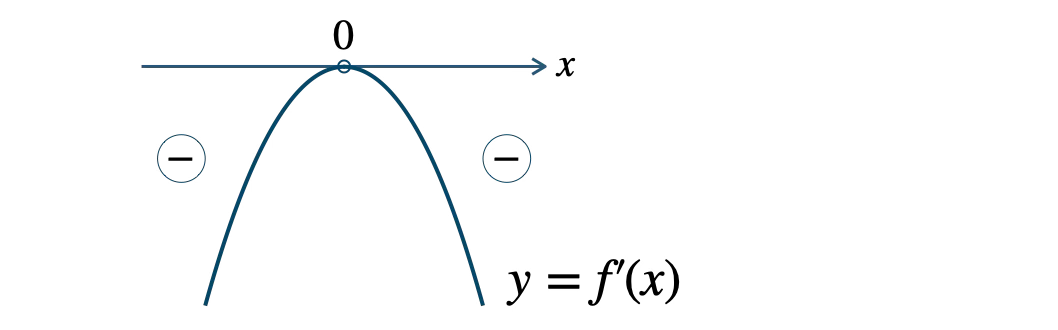
\(x \neq 0\) で \(f^{\prime}(x) \lt 0\)
よって、この \(x\) の前後での\(f^{\prime}(x)\) の符号は、
\(x \neq 0\) で \(f^{\prime}(x) \lt 0\) で、\(f(x)\) は常に単調に減少する
さらに、\(x=0\) のとき、
\(\begin{eqnarray}~~~f(0)&=&-0^3\\[3pt]~~~&=&0\end{eqnarray}\)
よって、\(f^{\prime}(x)\) の符号と \(f(x)\) の増減は、
\(\begin{array}{c|ccc}x & \cdots & 0 & \cdots \\\hline f^{\prime}(x) & – & 0 & – \\\hline f(x) & \searrow & 0 & \searrow\end{array}\)
増減表より、\(x=0\) の前後で \(f^{\prime}(x)\) の符号が変わらないので、\(f(0)=0\) は極値でない
また、\(y=-x^3\) のグラフは、点 \((0~,~0)\) を通り、\(y\) 切片が \(0\) より、

■ この問題の詳しい解説はこちら!
\({\small (2)}~\)\(f(x)=x^3+2x\) を微分すると、
\(\begin{eqnarray}~~~f^{\prime}(x)&=&(x^3)^{\prime}+2 \cdot (x)^{\prime}\\[3pt]~~~&=&3x^2+2\end{eqnarray}\)
ここで、\(3x^2+2 \gt 0\) は常に成り立つので、
\(f^{\prime}(x)=3x^2+2 \gt 0\) が常に成り立つ
よって、\(f^{\prime}(x) \gt 0\) で、\(f(x)\) は常に単調に増加し、極値をもたない
したがって、\(y=x^3+2x\) のグラフは、\(y\) 切片が \(0\) より、

■ この問題の詳しい解説はこちら!
p.199 練習18\({\small (1)}~\)
\(x=-2\) で極小値 \(-27\)
\(x=0\) で極大値 \(5\)
\(x=1\) で極小値 \(0\)
■ この問題の詳しい解説はこちら!
\({\small (2)}~\)
\(x=0\) で極大値 \(2\)
\(x=\pm2\) で極小値 \(-14\)
■ この問題の詳しい解説はこちら!
\({\small (3)}~\)
\(x=0\) で極大値 \(0\)
\(x=1\) で極小値 \(-1\)
\(x=2\) で極大値 \(0\)
■ この問題の詳しい解説はこちら!
\({\small (4)}~\)
\(x=3\) で極小値 \(-15\)
■ この問題の詳しい解説はこちら!
\(x=-2\) で極小値 \(-27\)
\(x=0\) で極大値 \(5\)
\(x=1\) で極小値 \(0\)

■ この問題の詳しい解説はこちら!
\({\small (2)}~\)
\(x=0\) で極大値 \(2\)
\(x=\pm2\) で極小値 \(-14\)

■ この問題の詳しい解説はこちら!
\({\small (3)}~\)
\(x=0\) で極大値 \(0\)
\(x=1\) で極小値 \(-1\)
\(x=2\) で極大値 \(0\)

■ この問題の詳しい解説はこちら!
\({\small (4)}~\)
\(x=3\) で極小値 \(-15\)

■ この問題の詳しい解説はこちら!
p.202 練習20\({\small (1)}~\)
\(x=2\) で最大値 \(20\)
\(x=-3~,~0\) で最小値 \(0\)
\({\small (2)}~\)
\(x=1\) で最大値 \(1\)
\(x=2\) で最小値 \(-2\)
\({\small (3)}~\)
\(x=-1\) で最大値 \(6\)
\(x=\displaystyle \frac{\,3\,}{\,2\,}\) で最小値 \(\displaystyle \frac{\,21\,}{\,16\,}\)
解法のPoint|3次関数や4次関数の最大値・最小値
\(x=2\) で最大値 \(20\)
\(x=-3~,~0\) で最小値 \(0\)
\({\small (2)}~\)
\(x=1\) で最大値 \(1\)
\(x=2\) で最小値 \(-2\)
\({\small (3)}~\)
\(x=-1\) で最大値 \(6\)
\(x=\displaystyle \frac{\,3\,}{\,2\,}\) で最小値 \(\displaystyle \frac{\,21\,}{\,16\,}\)
解法のPoint|3次関数や4次関数の最大値・最小値
p.202 深める① 平方完成すると、\(~~~y=(x-2)^2-1\)よって、\(x=2\) のとき最小値 \(-1\)
② 微分すると、\(y’=2x-4\)
\(y’=0\) とすると、\(x=2\)
増減表をかくと、
\(\begin{array}{c|cccc}
x & \cdots & 2 & \cdots \\
\hline
f^{\prime}(x) & – & 0 & + \\
\hline
f(x) & \searrow & -1 & \nearrow
\end{array}\)
これより、\(x=2\) のとき最小値 \(-1\)
解法のPoint|3次関数や4次関数の最大値・最小値
② 微分すると、\(y’=2x-4\)
\(y’=0\) とすると、\(x=2\)
増減表をかくと、
\(\begin{array}{c|cccc}
x & \cdots & 2 & \cdots \\
\hline
f^{\prime}(x) & – & 0 & + \\
\hline
f(x) & \searrow & -1 & \nearrow
\end{array}\)
これより、\(x=2\) のとき最小値 \(-1\)
解法のPoint|3次関数や4次関数の最大値・最小値
p.204 練習22\({\small (1)}~\)3個 \({\small (2)}~\)1個
\({\small (3)}~\)2個 \({\small (4)}~\)4個
解法のPoint|3次方程式・4次方程式の実数解の個数
\({\small (3)}~\)2個 \({\small (4)}~\)4個
解法のPoint|3次方程式・4次方程式の実数解の個数
p.206 練習24[証明] 左辺−右辺より、
\(\begin{eqnarray}~~~&&(x^3+3x^2+5)-9x\\[3pt]~~~&=&x^3+3x^2-9x+5\end{eqnarray}\)
\(f(x)=x^3+3x^2-9x+5\) とおき、\(f(x)\) を微分すると、
\(\begin{eqnarray}~~~f^{\prime}(x)&=&(x^3)^{\prime}+3 \cdot (x^2)^{\prime}-9 \cdot (x)^{\prime}+(5)^{\prime}\\[3pt]~~~&=&3x^2+3 \cdot 2x-9 \cdot 1+0\\[3pt]~~~&=&3x^2+6x-9\\[3pt]~~~&=&3(x^2+2x-3)\\[3pt]~~~&=&3(x+3)(x-1)\end{eqnarray}\)
\(f^{\prime}(x)=0\) となる \(x\) の値は、
\(\begin{eqnarray}~~~f^{\prime}(x)&=&3(x+3)(x-1)=0\\[3pt]~~~&&x=-3~,~1\end{eqnarray}\)
\(0 \lt x \lt 1\) のとき、\(f^{\prime}(x) \lt 0\)
\(1 \lt x\) のとき、\(f^{\prime}(x) \gt 0\)
さらに、
\(x=0\) のとき、
\(\begin{eqnarray}~~~f(0)&=&0^3+3 \cdot 0^2-9 \cdot 0+5\\[3pt]~~~&=&5\end{eqnarray}\)
\(x=1\) のとき、
\(\begin{eqnarray}~~~f(1)&=&1^3+3 \cdot 1^2-9 \cdot 1+5\\[3pt]~~~&=&1+3-9+5\\[3pt]~~~&=&0\end{eqnarray}\)
よって、\(x{\small ~≧~}0\) の区間での増減表は、
\(\begin{array}{c|ccccc}x & 0 & \cdots & 1 & \cdots \\\hline f^{\prime}(x) & & – & 0 & + \\\hline f(x) & 5 & \searrow & 0 & \nearrow\end{array}\)
これより、\(f(x)\) は \(x=1\) のとき最小値 \(0\) をとるので、
\(x{\small ~≧~}0\) で \(f(x){\small ~≧~}0\) となるので、
\(x^3+3x^2-9x+5{\small ~≧~}0\)
したがって、\(x^3+3x^2+5{\small ~≧~}9x\) [終]
■ この問題の詳しい解説はこちら!
\(\begin{eqnarray}~~~&&(x^3+3x^2+5)-9x\\[3pt]~~~&=&x^3+3x^2-9x+5\end{eqnarray}\)
\(f(x)=x^3+3x^2-9x+5\) とおき、\(f(x)\) を微分すると、
\(\begin{eqnarray}~~~f^{\prime}(x)&=&(x^3)^{\prime}+3 \cdot (x^2)^{\prime}-9 \cdot (x)^{\prime}+(5)^{\prime}\\[3pt]~~~&=&3x^2+3 \cdot 2x-9 \cdot 1+0\\[3pt]~~~&=&3x^2+6x-9\\[3pt]~~~&=&3(x^2+2x-3)\\[3pt]~~~&=&3(x+3)(x-1)\end{eqnarray}\)
\(f^{\prime}(x)=0\) となる \(x\) の値は、
\(\begin{eqnarray}~~~f^{\prime}(x)&=&3(x+3)(x-1)=0\\[3pt]~~~&&x=-3~,~1\end{eqnarray}\)
2次関数 \(y=f^{\prime}(x)\) のグラフより、
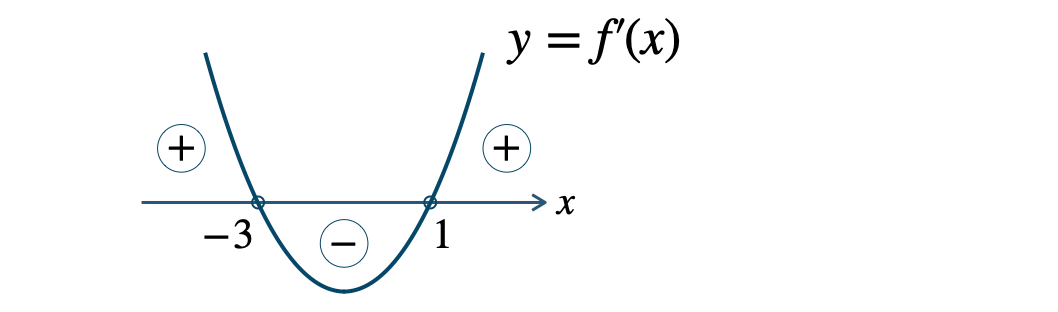
よって、\(x{\small ~≧~}0\) の区間で、
\(0 \lt x \lt 1\) のとき、\(f^{\prime}(x) \lt 0\)
\(1 \lt x\) のとき、\(f^{\prime}(x) \gt 0\)
さらに、
\(x=0\) のとき、
\(\begin{eqnarray}~~~f(0)&=&0^3+3 \cdot 0^2-9 \cdot 0+5\\[3pt]~~~&=&5\end{eqnarray}\)
\(x=1\) のとき、
\(\begin{eqnarray}~~~f(1)&=&1^3+3 \cdot 1^2-9 \cdot 1+5\\[3pt]~~~&=&1+3-9+5\\[3pt]~~~&=&0\end{eqnarray}\)
よって、\(x{\small ~≧~}0\) の区間での増減表は、
\(\begin{array}{c|ccccc}x & 0 & \cdots & 1 & \cdots \\\hline f^{\prime}(x) & & – & 0 & + \\\hline f(x) & 5 & \searrow & 0 & \nearrow\end{array}\)
これより、\(f(x)\) は \(x=1\) のとき最小値 \(0\) をとるので、
\(x{\small ~≧~}0\) で \(f(x){\small ~≧~}0\) となるので、
\(x^3+3x^2-9x+5{\small ~≧~}0\)
したがって、\(x^3+3x^2+5{\small ~≧~}9x\) [終]
■ この問題の詳しい解説はこちら!
問題
p.207 問題 8\({\small (1)}~x=-\sqrt{\,2\,}\) で極大値 \(2+4\sqrt{\,2\,}\) 、\(x=\sqrt{\,2\,}\) で極小値 \(2-4\sqrt{\,2\,}\)
■ この問題の詳しい解説はこちら!
\({\small (2)}~\)極値なし
■ この問題の詳しい解説はこちら!
\({\small (3)}~x=-\displaystyle \frac{\,3\,}{\,2\,}\) で極小値 \(-\displaystyle \frac{\,11\,}{\,16\,}\)
■ この問題の詳しい解説はこちら!
■ この問題の詳しい解説はこちら!
\({\small (2)}~\)極値なし
■ この問題の詳しい解説はこちら!
\({\small (3)}~x=-\displaystyle \frac{\,3\,}{\,2\,}\) で極小値 \(-\displaystyle \frac{\,11\,}{\,16\,}\)
■ この問題の詳しい解説はこちら!
p.207 問題 10\({\small (1)}~V=\pi x^2(18-2x)\) \((0 \lt x \lt 9)\)
\({\small (2)}~6\) cm
■ この問題の詳しい解説はこちら!
\({\small (2)}~6\) cm
■ この問題の詳しい解説はこちら!
第3節 積分法
p.209 練習26[証明]
\(n\) が \(0\) または正の整数のとき、
\(~~~F(x)=\displaystyle \frac{\,1\,}{\,n+1\,}x^{n+1}\) とすると、
\(~~~F'(x)=(n+1)\cdot\displaystyle \frac{\,1\,}{\,n+1\,}x^{n}=x^n\)
よって、\(x^n\) の不定積分の1つは \(F(x)\) である
したがって、
\(~~~\displaystyle\int x^n dx=\displaystyle \frac{\,1\,}{\,n+1\,}x^{n+1}+C\) [終]
また、\(C\) を積分定数として
\(~~~\displaystyle\int x^3 dx=\displaystyle \frac{\,1\,}{\,4\,}x^4+C\)
解法のPoint|関数xⁿの不定積分
\(n\) が \(0\) または正の整数のとき、
\(~~~F(x)=\displaystyle \frac{\,1\,}{\,n+1\,}x^{n+1}\) とすると、
\(~~~F'(x)=(n+1)\cdot\displaystyle \frac{\,1\,}{\,n+1\,}x^{n}=x^n\)
よって、\(x^n\) の不定積分の1つは \(F(x)\) である
したがって、
\(~~~\displaystyle\int x^n dx=\displaystyle \frac{\,1\,}{\,n+1\,}x^{n+1}+C\) [終]
また、\(C\) を積分定数として
\(~~~\displaystyle\int x^3 dx=\displaystyle \frac{\,1\,}{\,4\,}x^4+C\)
解法のPoint|関数xⁿの不定積分
p.210 練習27\(C\) を積分定数として、
\({\small (1)}~\displaystyle \frac{\,5\,}{\,3\,}x^3+C\)
\({\small (2)}~\displaystyle \frac{\,1\,}{\,3\,}x^3+\displaystyle \frac{\,1\,}{\,2\,}x^2-x+C\)
\({\small (3)}~\displaystyle \frac{\,1\,}{\,4\,}x^4-2x^3-x^2+5x+C\)
\({\small (4)}~-\displaystyle \frac{\,2\,}{\,3\,}x^3-\displaystyle \frac{\,1\,}{\,2\,}x^2+7x+C\)
解法のPoint|関数xⁿの不定積分
\({\small (1)}~\displaystyle \frac{\,5\,}{\,3\,}x^3+C\)
\({\small (2)}~\displaystyle \frac{\,1\,}{\,3\,}x^3+\displaystyle \frac{\,1\,}{\,2\,}x^2-x+C\)
\({\small (3)}~\displaystyle \frac{\,1\,}{\,4\,}x^4-2x^3-x^2+5x+C\)
\({\small (4)}~-\displaystyle \frac{\,2\,}{\,3\,}x^3-\displaystyle \frac{\,1\,}{\,2\,}x^2+7x+C\)
解法のPoint|関数xⁿの不定積分
p.211 練習28\(C\) を積分定数として、
\({\small (1)}~t^3+\displaystyle \frac{\,5\,}{\,2\,}t^2-2t+C\)
\({\small (2)}~t^3-3t^2+3t+C\)
解法のPoint|関数xⁿの不定積分
\({\small (1)}~t^3+\displaystyle \frac{\,5\,}{\,2\,}t^2-2t+C\)
\({\small (2)}~t^3-3t^2+3t+C\)
解法のPoint|関数xⁿの不定積分
p.213 練習30\({\small (1)}~4\) \({\small (2)}~3\)
\({\small (3)}~-\displaystyle \frac{\,15\,}{\,4\,}\) \({\small (4)}~-6\)
解法のPoint|関数xⁿの定積分の計算
\({\small (3)}~-\displaystyle \frac{\,15\,}{\,4\,}\) \({\small (4)}~-6\)
解法のPoint|関数xⁿの定積分の計算
p.213 練習31\({\small (1)}~\displaystyle \frac{\,2\,}{\,3\,}\) \({\small (2)}~-\displaystyle \frac{\,1\,}{\,6\,}\)
\({\small (3)}~-\displaystyle \frac{\,3\,}{\,4\,}\) \({\small (4)}~\displaystyle \frac{\,64\,}{\,3\,}\)
解法のPoint|関数xⁿの定積分の計算
\({\small (3)}~-\displaystyle \frac{\,3\,}{\,4\,}\) \({\small (4)}~\displaystyle \frac{\,64\,}{\,3\,}\)
解法のPoint|関数xⁿの定積分の計算
p.215 練習34\({\small [\,1\,]}~\)[証明] \(f(x)\)の原始関数の1つを \(F(x)\) とすると、
\(\begin{eqnarray}~~~&&\displaystyle\int_{a}^{a}f(x)dx\\[2pt]~~~&=&\left[ F(x) \right]_{a}^{a}\\[2pt]~~~&=&F(a)-F(a)=0\end{eqnarray}\)
したがって、\(~~~\displaystyle\int_{a}^{a}f(x)dx=0\)[終]
\({\small [\,2\,]}~\)[証明] \(f(x)\)の原始関数の1つを \(F(x)\) とすると、
\(\begin{eqnarray}~~~&&\displaystyle\int_{b}^{a}f(x)dx\\[2pt]~~~&=&\left[ F(x) \right]_{b}^{a}\\[2pt]~~~&=&F(a)-F(b)\\[2pt]~~~&=&-\left(F(b)-F(a)\right)\\[2pt]~~~&=&-\left[ F(x) \right]_{a}^{b}\\[2pt]~~~&=&-\displaystyle\int_{a}^{b}f(x)dx\end{eqnarray}\)
したがって、\(~~~\displaystyle\int_{b}^{a}f(x)dx=-\displaystyle\int_{a}^{b}f(x)dx\)[終]
解法のPoint|定積分の性質を用いた計算
\(\begin{eqnarray}~~~&&\displaystyle\int_{a}^{a}f(x)dx\\[2pt]~~~&=&\left[ F(x) \right]_{a}^{a}\\[2pt]~~~&=&F(a)-F(a)=0\end{eqnarray}\)
したがって、\(~~~\displaystyle\int_{a}^{a}f(x)dx=0\)[終]
\({\small [\,2\,]}~\)[証明] \(f(x)\)の原始関数の1つを \(F(x)\) とすると、
\(\begin{eqnarray}~~~&&\displaystyle\int_{b}^{a}f(x)dx\\[2pt]~~~&=&\left[ F(x) \right]_{b}^{a}\\[2pt]~~~&=&F(a)-F(b)\\[2pt]~~~&=&-\left(F(b)-F(a)\right)\\[2pt]~~~&=&-\left[ F(x) \right]_{a}^{b}\\[2pt]~~~&=&-\displaystyle\int_{a}^{b}f(x)dx\end{eqnarray}\)
したがって、\(~~~\displaystyle\int_{b}^{a}f(x)dx=-\displaystyle\int_{a}^{b}f(x)dx\)[終]
解法のPoint|定積分の性質を用いた計算
p.216 練習35\({\small (1)}~10\) \({\small (2)}~\displaystyle \frac{\,4\,}{\,3\,}\)
解法のPoint|定積分の性質を用いた計算
解法のPoint|定積分の性質を用いた計算
p.216 練習36\({\small (1)}~f(x)=4x-\displaystyle \frac{\,16\,}{\,3\,}\) \({\small (2)}~f(x)=3x^2-2\)
■ この問題の詳しい解説はこちら!
■ この問題の詳しい解説はこちら!
p.220 練習39\({\small (1)}~\displaystyle \frac{\,26\,}{\,3\,}\) \({\small (2)}~9\)
解法のPoint|x軸より上側の範囲の囲まれた面積
解法のPoint|x軸より上側の範囲の囲まれた面積
p.221 練習40\({\small (1)}~\displaystyle \frac{\,8\,}{\,3\,}\) \({\small (2)}~\displaystyle \frac{\,4\,}{\,3\,}\)
解法のPoint|x軸より下側の範囲の囲まれた面積
解法のPoint|x軸より下側の範囲の囲まれた面積
p.223 練習41\({\small (1)}~\displaystyle \frac{\,9\,}{\,2\,}\) \({\small (2)}~\displaystyle \frac{\,32\,}{\,3\,}\) \({\small (3)}~\displaystyle \frac{\,64\,}{\,3\,}\)
■ この問題の詳しい解説はこちら!
■ 1/6の公式を用いた解説はこちら!
■ この問題の詳しい解説はこちら!
■ 1/6の公式を用いた解説はこちら!
問題
p.228 問題 15\({\small (1)}~8\) \({\small (2)}~-\displaystyle \frac{\,9\,}{\,2\,}\)
解法のPoint|関数xⁿの定積分の計算
\({\small (3)}~3\)
■ この問題の詳しい解説はこちら!
解法のPoint|関数xⁿの定積分の計算
\({\small (3)}~3\)
■ この問題の詳しい解説はこちら!
p.228 問題 16\({\small (1)}~\displaystyle \frac{\,16\,}{\,3\,}\)
■ この問題の詳しい解説はこちら!
■ 1/6の公式を用いた解説はこちら!
\({\small (2)}~\displaystyle \frac{\,4\,}{\,3\,}\)
解法のPoint|x軸より下側の範囲の囲まれた面積
■ この問題の詳しい解説はこちら!
■ 1/6の公式を用いた解説はこちら!
\({\small (2)}~\displaystyle \frac{\,4\,}{\,3\,}\)
解法のPoint|x軸より下側の範囲の囲まれた面積
章末問題 微分法と積分法
p.229 章末問題A 1\({\small (1)}~y^{\prime}=-6x^2-2x+2\)
\({\small (2)}~y^{\prime}=3x^2\)
解法のPoint|関数xⁿや定数関数の微分
\({\small (2)}~y^{\prime}=3x^2\)
解法のPoint|関数xⁿや定数関数の微分
p.229 章末問題A 2\({\small (1)}~y=3x-18\) \({\small (2)}~-\displaystyle \frac{\,1\,}{\,3\,}\)
解法のPoint|傾きの条件と接線の方程式
解法のPoint|傾きの条件と接線の方程式
p.229 章末問題A 3\({\small (1)}~x=0\) で極大値 \(0\)
\({\small (2)}~\)極大値なし
\({\small (3)}~x=\displaystyle \frac{\,2\,}{\,3\,}a\) で極大値 \(-\displaystyle \frac{\,4\,}{\,27\,}a^3\)
■ この問題の詳しい解説はこちら!
\({\small (2)}~\)極大値なし
\({\small (3)}~x=\displaystyle \frac{\,2\,}{\,3\,}a\) で極大値 \(-\displaystyle \frac{\,4\,}{\,27\,}a^3\)
■ この問題の詳しい解説はこちら!
p.229 章末問題A 6\({\small (1)}~\displaystyle \frac{\,172\,}{\,3\,}\) \({\small (2)}~-\displaystyle \frac{\,8\sqrt{\,2\,}\,}{\,3\,}\)
解法のPoint|関数xⁿの定積分の計算
解法のPoint|関数xⁿの定積分の計算
p.229 章末問題A 9\({\small (1)}~\displaystyle \frac{\,49\,}{\,3\,}\) \({\small (2)}~\displaystyle \frac{\,39\,}{\,2\,}\)
■ この問題の詳しい解説はこちら!
■ この問題の詳しい解説はこちら!
p.230 章末問題B 13[証明] 1次関数を \(f(x)=ax+b~~(a \neq 0)\) とおくと、
\(\begin{eqnarray}~~~&&\displaystyle\int_0^1\{f(x)\}^2\,dx
\\[5pt]~~~&=&\displaystyle\int_0^1(ax+b)^2\,dx
\\[5pt]~~~&=&\displaystyle\int_0^1(a^2x^2+2abx+b^2)\,dx
\\[5pt]~~~&=&\left[\,\displaystyle \frac{\,a^2\,}{\,3\,}x^3+abx^2+b^2x\,\right]_0^1
\\[5pt]~~~&=&\displaystyle \frac{\,a^2\,}{\,3\,}+ab+b^2\end{eqnarray}\)
また、
\(\begin{eqnarray}~~~&&\displaystyle\int_0^1f(x)\,dx
\\[5pt]~~~&=&\displaystyle\int_0^1(ax+b)\,dx
\\[5pt]~~~&=&\left[\,\displaystyle \frac{\,a\,}{\,2\,}x^2+bx\,\right]_0^1
\\[5pt]~~~&=&\displaystyle \frac{\,a\,}{\,2\,}+b\end{eqnarray}\)
よって、
\(\begin{eqnarray}~~~&&\left\{\displaystyle\int_0^1f(x)\,dx\right\}^2
\\[5pt]~~~&=&\left(\displaystyle \frac{\,a\,}{\,2\,}+b\right)^2
\\[5pt]~~~&=&\displaystyle \frac{\,a^2\,}{\,4\,}+ab+b^2\end{eqnarray}\)
以上より、
\(\begin{eqnarray}~~~&&\displaystyle\int_0^1\{f(x)\}^2\,dx-\left\{\displaystyle\int_0^1f(x)\,dx\right\}^2
\\[5pt]~~~&=&\left(\displaystyle \frac{\,a^2\,}{\,3\,}+ab+b^2\right)-\left(\displaystyle \frac{\,a^2\,}{\,4\,}+ab+b^2\right)
\\[5pt]~~~&=&\displaystyle \frac{\,a^2\,}{\,3\,}+ab+b^2-\displaystyle \frac{\,a^2\,}{\,4\,}-ab-b^2
\\[5pt]~~~&=&\displaystyle \frac{\,4a^2-3a^2\,}{\,12\,}
\\[5pt]~~~&=&\displaystyle \frac{\,a^2\,}{\,12\,} \gt 0\end{eqnarray}\)
したがって、
\(\left\{\displaystyle\int_0^1f(x)\,dx\right\}^2 \lt \displaystyle\int_0^1\{f(x)\}^2\,dx\) [終]
■ この問題の詳しい解説はこちら!
\(\begin{eqnarray}~~~&&\displaystyle\int_0^1\{f(x)\}^2\,dx
\\[5pt]~~~&=&\displaystyle\int_0^1(ax+b)^2\,dx
\\[5pt]~~~&=&\displaystyle\int_0^1(a^2x^2+2abx+b^2)\,dx
\\[5pt]~~~&=&\left[\,\displaystyle \frac{\,a^2\,}{\,3\,}x^3+abx^2+b^2x\,\right]_0^1
\\[5pt]~~~&=&\displaystyle \frac{\,a^2\,}{\,3\,}+ab+b^2\end{eqnarray}\)
また、
\(\begin{eqnarray}~~~&&\displaystyle\int_0^1f(x)\,dx
\\[5pt]~~~&=&\displaystyle\int_0^1(ax+b)\,dx
\\[5pt]~~~&=&\left[\,\displaystyle \frac{\,a\,}{\,2\,}x^2+bx\,\right]_0^1
\\[5pt]~~~&=&\displaystyle \frac{\,a\,}{\,2\,}+b\end{eqnarray}\)
よって、
\(\begin{eqnarray}~~~&&\left\{\displaystyle\int_0^1f(x)\,dx\right\}^2
\\[5pt]~~~&=&\left(\displaystyle \frac{\,a\,}{\,2\,}+b\right)^2
\\[5pt]~~~&=&\displaystyle \frac{\,a^2\,}{\,4\,}+ab+b^2\end{eqnarray}\)
以上より、
\(\begin{eqnarray}~~~&&\displaystyle\int_0^1\{f(x)\}^2\,dx-\left\{\displaystyle\int_0^1f(x)\,dx\right\}^2
\\[5pt]~~~&=&\left(\displaystyle \frac{\,a^2\,}{\,3\,}+ab+b^2\right)-\left(\displaystyle \frac{\,a^2\,}{\,4\,}+ab+b^2\right)
\\[5pt]~~~&=&\displaystyle \frac{\,a^2\,}{\,3\,}+ab+b^2-\displaystyle \frac{\,a^2\,}{\,4\,}-ab-b^2
\\[5pt]~~~&=&\displaystyle \frac{\,4a^2-3a^2\,}{\,12\,}
\\[5pt]~~~&=&\displaystyle \frac{\,a^2\,}{\,12\,} \gt 0\end{eqnarray}\)
したがって、
\(\left\{\displaystyle\int_0^1f(x)\,dx\right\}^2 \lt \displaystyle\int_0^1\{f(x)\}^2\,dx\) [終]
■ この問題の詳しい解説はこちら!